

Most teams adopted AI. Few changed how they work. Here’s the difference.
Key Insights
- Adoption without maturity: 87% of marketers now use AI in at least one workflow, up from 51% in 2024, but only 1% of organisations describe themselves as mature in AI deployment (Shno/HubSpot 2026)
- Speed gains, execution gaps: Teams using AI report 44% higher productivity and recover 6-11 hours per week, yet 85% of marketing teams still missed a campaign launch date last year (MarTech/HubSpot 2026)
- Process before tools: Tool sprawl is the number one killer of AI ROI; most teams are adding tools to broken processes rather than fixing workflows first (Margaret Lee, CMO of Devart)
- New team structure: The shift is from channel specialists to strategic orchestrators who direct AI systems across search, social, email, and content simultaneously (Customer.io/DOJO AI 2026)
- Do more with less: Marketing output grew 24% between 2024 and 2026 while job postings grew only 6%, meaning existing teams are producing far more with fewer people (KissMySkills 2026)
- Training that sticks: Knowledge without same-week application disappears within 7 days; every AI training session must be paired with a real project (MarTech 2026)
Why Are Most Marketing Teams Still Struggling With AI?
Because they added AI tools without changing how they work. The adoption numbers look impressive on paper: 87% of marketers use generative AI in at least one workflow in 2026, up from 51% just two years ago. But dig deeper and the picture changes. Only 1% of organisations say AI is fully embedded and producing major business outcomes.
The problem isn’t the technology. It’s the approach. Most teams bolted AI onto existing processes, hoping for a productivity boost. What they got instead was tool sprawl, inconsistent output quality, and team members using AI for isolated tasks without any shared system or standards.
As Margaret Lee, CMO of Devart and TMetric, puts it: “If a process isn’t clear, AI won’t fix it. It’ll only amplify existing issues.” That single sentence explains why 85% of marketing teams adopted AI to move faster but still missed a campaign launch date last year.

What Does an AI-First Marketing Team Actually Look Like?
An AI-first team isn’t one where everyone uses ChatGPT. It’s one where AI is built into the operating system of how work gets done. The structure is fundamentally different from a traditional marketing team.
The biggest shift is from channel specialists to strategic orchestrators. Instead of having a separate person managing search ads, another managing social, and another handling email, you have campaign orchestrators who direct AI systems across multiple channels simultaneously. The human brings the strategy, judgment, and creativity. The AI handles execution, optimisation, and analysis at scale.
Three principles define the AI-first structure:
- Intelligence-centred design: Every role connects to a central intelligence system, not isolated tools. Information flows between campaigns, channels, and team members through shared AI workflows.
- Baseline AI fluency for all: Every team member can produce first-draft content using AI, structure prompts for any marketing task, recognise and correct common AI output quality issues, and use shared prompt libraries.
- Clear human-AI task boundaries: AI handles the high-volume, low-complexity tasks (lead routing, CRM enrichment, campaign tagging, report aggregation, meeting notes) while humans focus on strategy, client relationships, and creative direction.
How Do You Get Your Team to Actually Adopt AI?
Mandates don’t work. Adoption comes from two directions simultaneously, and you need both.
Top-down: Leaders must be visible practitioners.
If the CMO or marketing director isn’t using AI themselves and sharing their prompts publicly, the team reads that as permission to ignore it. Share your wins in team syncs. Show what you built. Make it normal, not special.
Bottom-up: Find your internal champions.
Every team has people who experiment with AI on their own. Find them. Give them airtime in meetings. Convert their examples into company playbooks. These champions create peer pressure that no mandate can match.
The critical mistake most companies make is treating AI adoption as a training problem. It’s not. Margaret Lee’s research shows that knowledge without same-week application disappears within 7 days. The fix: pair every training session with a real project starting that same week. Not a hypothetical exercise. A real deliverable with a real deadline.
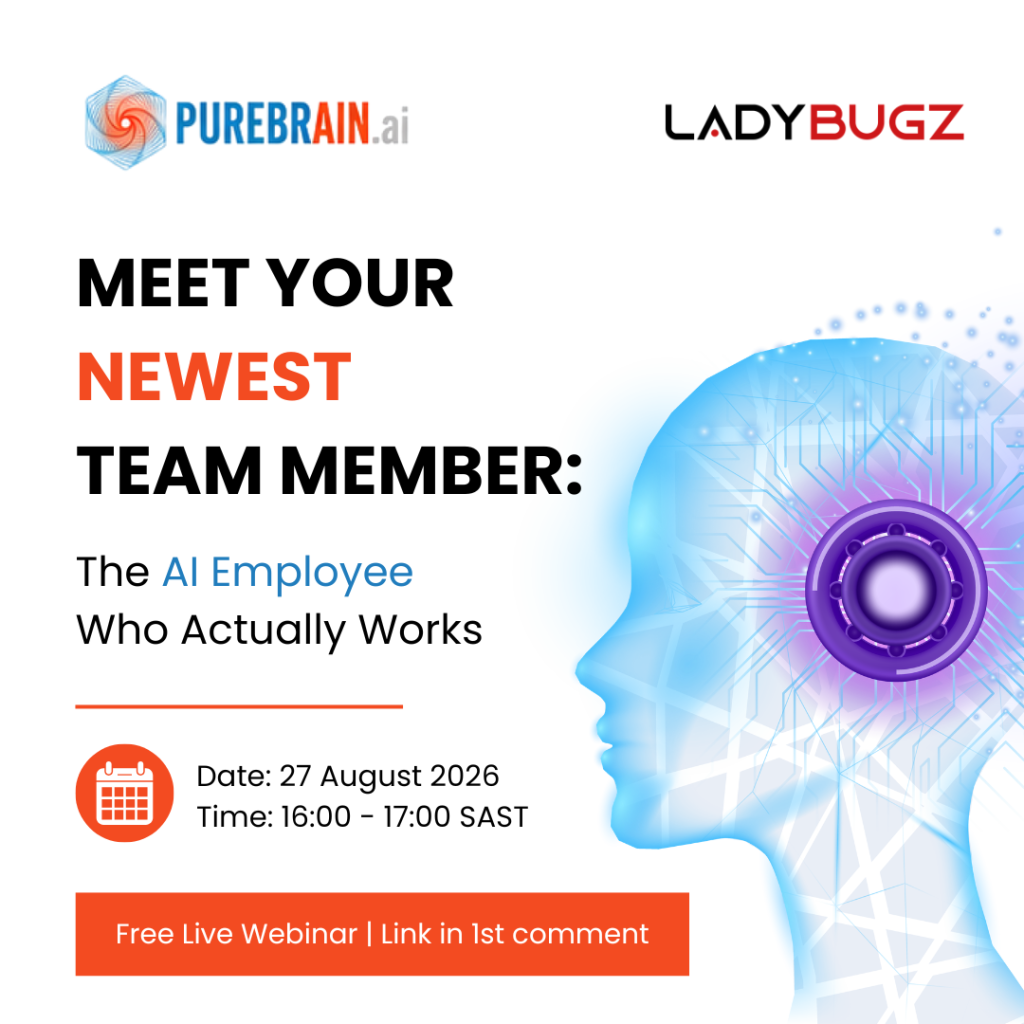
See how LadyBugz built an AI-first marketing team with a live demo:
REGISTER FREE: Meet Your Newest Team Member: The AI Employee Who Actually Works
27 August 2026 | 4:00 PM SAST | Free
What Should You Automate First?
Start with high-time, low-strategy tasks. Look at where your team spends the most hours on work that doesn’t require deep thinking or creative judgment.
The first wins for most marketing teams:
- Lead routing and CRM enrichment
- Campaign tagging and UTM management
- Report aggregation and dashboard updates
- Meeting note summaries and action item extraction
- First-draft content creation (blog outlines, social captions, email sequences)
- Competitor monitoring and alert digestion
Before automating anything, audit your processes. Use time-tracking data to identify where hours actually go. Most marketing leaders are surprised by how much time their team spends on tasks that could be eliminated entirely, not just automated.
A useful benchmark from the MarTech research: aim for a 60% reduction in time on your top three routine tasks within the first six months. If you’re not hitting that, you’re likely automating the wrong things or automating broken processes.

How Do You Measure Whether It’s Working?
Vanity metrics like ‘hours of training completed’ or ‘number of prompts run’ tell you nothing about business impact. Here’s what actually matters:
- Output growth: Are you producing more with the same team? The benchmark is 5x content volume without headcount increases.
- Time recovered: Is your team recovering 6-11 hours per week? Senior practitioners should save 8-10 hours; junior staff 3-4 hours (HubSpot 2026).
- Quality acceptance rate: Are 80% of AI-assisted outputs accepted with minor edits only? If your team is rewriting everything AI produces, the prompts, processes, or both need fixing.
- Campaign performance: AI-driven campaigns should deliver 22% better ROI and 32% more conversions through better audience segmentation (BizIQ 2026).
- Shipping rate: Are you hitting deadlines more consistently? Speed without execution is just faster chaos.
- Playbook created: By year-end, you should have a documented playbook covering prompts, workflows, QA rules, agent logic, data rules, and mistakes to avoid. This is how institutional knowledge compounds.
What Does This Mean for South African Marketing Teams?
South Africa is in an interesting position. According to DataReportal’s Digital 2026 report, 41.2% of SA internet users have adopted ChatGPT, and 56.6% express excitement about AI’s potential. That’s high adoption energy. But most SA marketing teams, like their global counterparts, are using AI for isolated tasks rather than building it into their workflows.
The opportunity is significant for agencies and in-house teams willing to make the structural shift. Marketing output grew 24% globally between 2024 and 2026 while job postings grew only 6%. The teams that figure out AI-first operations won’t just be more productive. They’ll be able to serve more clients, produce higher-quality work, and compete with agencies twice their size.
The gap between ‘using AI’ and ‘being AI-first’ is where the competitive advantage sits right now. Most of your competitors are in the 87% who adopted AI. Almost none are in the 1% who are mature. That’s the gap to close.
The shift from ‘using AI tools’ to ‘being an AI-first team’ isn’t a technology upgrade. It’s an operating system change. Clean your processes before you automate them. Train your people with real projects, not workshops. Measure what matters, not what’s easy to count. And build the playbook as you go, because the teams that document their AI workflows today will compound that advantage every month.
See how LadyBugz built an AI-first marketing team with a live demo:
REGISTER FREE: Meet Your Newest Team Member: The AI Employee Who Actually Works
27 August 2026 | 4:00 PM SAST | Free
Noleen Thompson, LadyBugz Marketing