Published Wednesday, 21 October 2026 | By Noleen Thompson, LadyBugz Marketing
A new global report puts South Africa first in the world for LinkedIn use. Here’s what that means for South African companies that sell to other businesses.
Key Insights
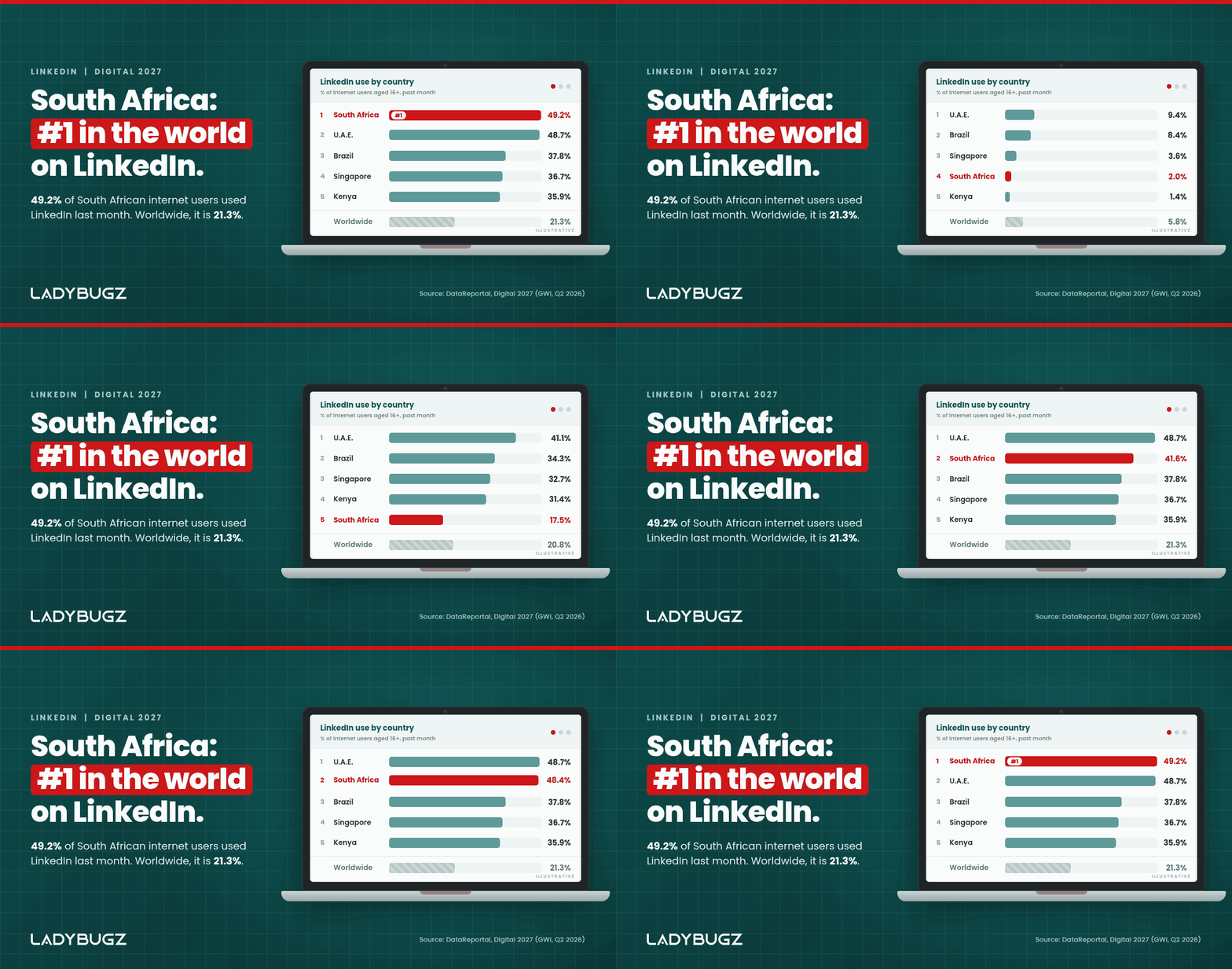
- South Africa is number one for LinkedIn: 49.2% of South African internet users aged 16+ used LinkedIn in the past month, the highest of every country surveyed, against 21.3% worldwide (DataReportal, Digital 2027, survey data from GWI, a global audience research company, for April to June 2026).
- 19 million reachable South Africans: LinkedIn says its adverts can reach 19 million people in South Africa (based on registered members), equal to 41.7% of adults, against 26.2% of adults worldwide (DataReportal, Digital 2027).
- South Africans do more homework: 56.1% research brands online before buying, against 48.0% worldwide, and 93.3% use AI tools every month (DataReportal, Digital 2027, GWI).
- Brand pages are not the main draw: only 23.5% of LinkedIn users use it to follow or research brands, the lowest of the eight platforms measured (DataReportal, Digital 2027, GWI).
- Your website and inbox still count: 53.1% of South African internet users visited a brand website in the past month, and 96.4% use email every month (DataReportal, Digital 2027, GWI).
South Africa has the highest rate of LinkedIn use of any country in DataReportal’s Digital 2027 Global Overview Report, published with We Are Social and Meltwater: 49.2% of South African internet users aged 16 and over used LinkedIn in the past month, against 21.3% worldwide. For a business-to-business (B2B) company, meaning one that sells to other companies, that makes LinkedIn the busiest professional room in the country. The same report shows South Africans research more before they buy, use AI tools more, and visit brand websites and use email more than the global average. I’ve been on LinkedIn since 2009, and I still sat up when I saw this ranking. In my experience, LinkedIn works hardest when it leads people somewhere you own.
How many South Africans use LinkedIn, according to Digital 2027?
South Africa has the highest LinkedIn use of any country in Digital 2027. GWI’s survey shows 49.2% of South African internet users aged 16+ used LinkedIn in the past month (April to June 2026), against 21.3% worldwide. The United Arab Emirates is second at 48.7%, and third-placed Brazil is a long way back at 37.8%.
The report is written by Simon Kemp of DataReportal and was published in October 2026 with We Are Social, a social media agency, and Meltwater, a company that tracks media coverage. Its LinkedIn advertising figures point the same way. LinkedIn says its adverts can reach 19 million people in South Africa, a number based on registered members rather than people who log in. That equals 41.7% of South African adults, against 26.2% of adults worldwide.
South Africans have always taken LinkedIn more seriously than most, but first in the world is still striking. Your buyers are on it. So are their bosses, and usually whoever advises them. Turning up is no longer the hard part. The useful question now is what people find when they look you up.
Do South African buyers research suppliers before they talk to anyone?
South African buyers research more than most before they buy. Digital 2027 shows 56.1% of South African internet users research brands, products and services online before making a purchase, against 48.0% worldwide (GWI). That covers all purchases, not only business ones, but research on B2B buyers points the same way:
- Gartner’s sales survey of 632 B2B buyers (June 2025) found 61% prefer a buying experience with no sales rep involved.
- 6sense’s 2025 Buyer Experience Report (November 2025) found 94% of buying groups (the colleagues who decide on a purchase together) had already ranked a preferred supplier before first contact, and they bought from that early favourite 77% of the time.
- Forrester’s State of Business Buying 2026 (January 2026) says a typical buying decision now involves 13 people inside the buying company and nine outside advisers, such as consultants.
So by the time someone fills in your contact form, most of the choosing is done. A group of people did it, and you will never meet most of them. They will look you up, though, and in this country LinkedIn is where many of them will find your people.
Do LinkedIn users research brands there?
LinkedIn users research brands on LinkedIn less often than users of any other major platform do on theirs. Digital 2027 shows 23.5% of active LinkedIn users say they use it to follow or research brands and products, the lowest of the eight social platforms in the table (GWI). Keeping up with news and current events comes out slightly higher, at 27.0%.
On paper that looks bad for LinkedIn marketing. Look at who actually gets noticed there, though, and it’s mostly people. Buyers follow the managing director who explains what is moving in the market. They follow the engineer who admits a project went sideways and shows how the team fixed it. Finance heads who write plainly about risk get read too.
AI tools lean the same way. A Semrush study of 325,000 questions typed into AI tools (March 2026) found LinkedIn was the second most-cited website in AI search answers, showing up in about 11% of them. In ChatGPT Search and Google AI Mode, 59% of the LinkedIn content cited came from individual people rather than company pages (a business’s own LinkedIn page, separate from its people’s profiles). Perplexity was the exception and leaned towards company pages.
In my experience the company page is your shop front, and it should be well kept. The reach sits with your leaders and your experts. That’s why so much of our work goes into LinkedIn profile management for executives and into employee ambassador programmes, where staff share expertise on their own profiles so a whole team shows up, not only the logo.
How is AI changing the way buyers find suppliers?
AI tool use in South Africa is close to universal among people who are online. Digital 2027 shows 93.3% of South African internet users aged 16+ use AI tools each month, against 85.2% worldwide (GWI). And 27.8% use tools like ChatGPT to research potential purchases, against 26.0% worldwide.
Search hasn’t gone anywhere, though. Worldwide, search engines are still the top way people discover new brands, at 32.0%, while AI tools sit at 17.0% (GWI). Plan for search and AI together.
Where AI gets its answers matters more than how often you post. Meltwater, the report’s co-presenter, analysed 7 million brand citations across eight AI platforms in August 2026:
- 29.4% came from earned media and news, meaning coverage you don’t pay for, such as news stories and interviews
- 7.2% came from social media
- 0.2% came from press releases
- 61.3% was “other”, which includes brand and corporate websites, research databases and reference sites
That study covered consumer categories such as retail banking, cars, fast food and fashion, so read them as a direction rather than a B2B rule. The direction is plain enough. Coverage you earn and a website that answers real questions get quoted. A press release on its own barely registers. That thinking sits behind our answer engine optimisation (AEO) work, which shapes your content so AI tools can find it, trust it and quote it.
Your website and your email list still carry weight
Brand websites are still the most common way people interact with a brand online. Digital 2027 shows 42.7% of internet users worldwide visited a brand website in the past month, and in South Africa the figure is 53.1% (GWI).
Email is the other old favourite making a comeback. In his introduction to the report, Simon Kemp points to “the resurgence of email, one of digital’s original stalwarts”. In South Africa, 96.4% of internet users use email every month, second only to Nigeria in the survey and well above the 76.4% worldwide figure (GWI).
LinkedIn lends you attention. Your website and your mailing list are the parts you own. The setups that work best for our clients send people from a LinkedIn post or profile to a useful page on the website, then keep in touch by email. If your website still reads like a brochure from 2019, the visitor LinkedIn sends you will leave. And if your profiles and articles aren’t set up to be found at all, start with our guide to LinkedIn SEO (search engine optimisation, or getting found in search).
What should a South African B2B company do about it?
A medium or large South African B2B company should treat LinkedIn as its main professional channel and connect it to a website and an email list it owns. Start with your people, then your page, then the channels nobody can take away from you. This is where we would begin.
Step 1: Fix your leaders’ profiles first. Headline, About section and Featured section, written in the words your buyers use. With 13 people inside a buying company and nine outside advisers involved in a typical decision (Forrester), your people get looked up, not only your page.
Step 2: Give your experts a voice. Two or three people sharing what they know, regularly, will reach further than a company page on its own.
Step 3: Keep the company page as the hub. It still matters for credibility. One telecoms client grew its company page following by 45.5% in 12 months without spending on ads.
Step 4: Earn coverage and answer questions on your website. Guest articles, interviews and clear answer pages are what AI tools quote.
Step 5: Build an email list and use it. A useful newsletter keeps you in front of the buyers who aren’t ready yet.
Editorial note: The Digital 2027 figures are DataReportal’s, compiled from partners including GWI, Meltwater and LinkedIn’s own advertising tools. GWI surveys internet users aged 16+, not B2B buyers specifically, so we use it as context for B2B rather than as buyer data, and the South African figures describe people who are online, not the whole population. Meltwater and We Are Social co-present the report. We checked every chart value against the report before quoting it.
Frequently asked questions
Is South Africa really number one in the world for LinkedIn use?
Yes, among the countries GWI surveys. Digital 2027 shows 49.2% of South African internet users aged 16+ used LinkedIn in the past month (April to June 2026), ahead of the United Arab Emirates at 48.7% and well above the worldwide figure of 21.3%.
Do people use LinkedIn to research companies?
Less than on other platforms. Only 23.5% of LinkedIn users say they use it to follow or research brands, the lowest of eight platforms in Digital 2027. AI tools also cite people’s LinkedIn content more than company pages (Semrush, March 2026), so the profiles of your leaders and experts tend to carry more weight than a company page.
Is search still important now that people use AI?
Yes. Search engines are still the top channel for discovering new brands worldwide, at 32.0%, against 17.0% for AI tools, according to GWI data in Digital 2027. Plan for both.
Does email marketing still work for B2B in South Africa?
Email reaches almost everyone who is online here: 96.4% of South African internet users use email every month, according to Digital 2027, and Simon Kemp points to a resurgence of email in the report. A useful, regular newsletter is one of the few channels you fully own.
The lunch-table version
If we were having lunch, this is what I’d tell you. South Africa didn’t need a global report to prove LinkedIn works here, but now there is one, and it has plenty to say about how buyers research too. Your buyers are online and they check you out before they call. They also trust people more than logos. Start with the profiles of the people who lead your business. Connect them to a website that answers real questions, and keep in touch by email. That’s the kind of presence that puts you on the shortlist before anyone picks up the phone.
Want to know how your LinkedIn presence looks to a buyer?
Or email us at noleen@ladybugz.co.za
Noleen Thompson, LadyBugz Marketing
Keep reading