Published Monday, 9 November 2026 | By Noleen Thompson, LadyBugz Marketing
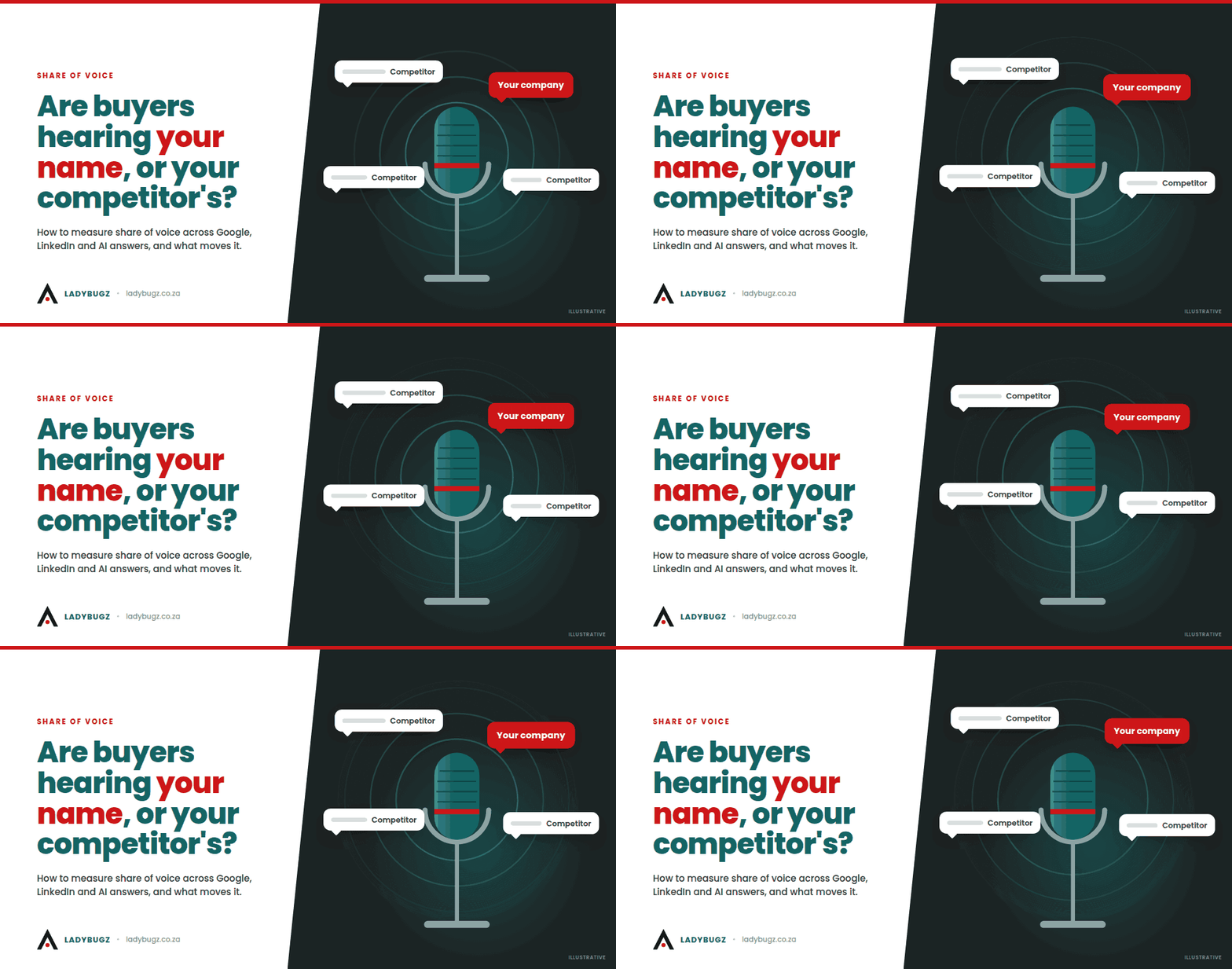
Share of voice is the marketing number most boards understand straight away: how often buyers hear your name instead of a competitor’s. Here’s what it means now that so much buyer research happens in AI chats as well as on Google and LinkedIn, how to measure it without fooling yourself, and what moves it.
Key Insights
- Share of voice, defined: your slice of the conversation in your category. Your mentions, divided by all the mentions in your category, multiplied by 100.
- Boards read it easily because it’s relative: few boards can judge 40,000 impressions, but every board can judge “we’re named as often as our biggest rival”.
- Google rank and AI mentions are different races: on average, only about 12% of the links ChatGPT, Gemini and Copilot cited also ranked in Google’s top ten for the same prompt (Ahrefs, August 2025).
- Fewer clicks make being named matter more: with an AI summary on the page, Google users clicked a regular result on 8% of visits, against 15% without one (Pew Research Center, July 2025).
- One check proves very little: AI answers change from one session to the next. Track the same buyer questions against the same named competitors every month and watch the trend.
- People move the number: an organic LinkedIn presence, employees acting as brand ambassadors, content that answers real buyer questions and mentions on trusted sites all lift share of voice over time.
The short answer
Share of voice measures how often your company is the one named in your category, compared with your competitors, across Google, LinkedIn and AI answers. Track the same questions and competitors every month. The trend tells a board whether you’re gaining ground.
Every month we ask AI tools the questions our own buyers ask, and we write down who gets named. We’re never in every answer. Some answers name a firm we’ve never once competed against. That habit is why I believe share of voice deserves a line in your board pack.
Most marketing reports are full of numbers that mean a lot to marketers and very little to a managing director (MD). Share of voice answers the question every MD asks sooner or later. Are we being seen more, or less, than the competition?
If AI search is new ground for you, our piece on why so few marketers talk about AI visibility is a good primer. This article zooms out to the whole picture.
What is share of voice, in plain language?
Share of voice is the percentage of the conversation in your category that belongs to you. If buyers came across 100 mentions of companies like yours this month and 18 of them were you, your share of voice is 18%.
The term comes from advertising, where brands compared their ad spend with everyone else’s. Les Binet and Peter Field, in their effectiveness research for the IPA (the UK’s Institute of Practitioners in Advertising), found that brands whose share of voice runs ahead of their share of the market tend to grow. Their work was built on paid advertising, but the logic carries over: the company buyers keep hearing about is the one they think of first.
Few B2B (business to business) companies win share of voice through ad spend alone. They win it by being named, in search results, LinkedIn feeds, industry publications and AI answers. The formula fits on a napkin. The hard part is deciding what counts as a mention, where you count, and whose mentions belong in the total.
Why should a board care about share of voice?
A board should care about share of voice because it’s a competitive number. It shows whether the market sees more or less of you than of the firms you lose deals to, which is the question behind most “is marketing working?” conversations.
Our article on the CEO blind spot in B2B marketing looked at research showing how many chief executive officers (CEOs) and senior leaders see marketing as a support function. Part of the reason, in my experience, is that marketers report activity while boards want position. “We posted 22 times this month” is activity. “We were named in more buyer searches than our two biggest competitors this quarter” is position.
Share of voice also works as an early warning. Pipeline, the deals in progress that could turn into revenue, shows up months after buyers first notice you. Share of voice moves sooner, so a competitor creeping into your space shows up before it hits the sales figures.
A client or two have mentioned to me that they are the best kept secret. This means they are not consistent across all channels, which is needed now. Being the best kept secret is just that, zero share of voice. Your directors, sales, marketing and other staff all need to be on the same page and learn how to share your brand so that it’s no longer a secret.
Noleen Thompson, Managing Director and Founder, LadyBugz
One caution. A high share of voice in a shrinking category can make a weak year look good. Read it next to pipeline and revenue, never instead of them.
Where do B2B buyers come across your company now?
B2B buyers now come across companies in three main places: Google search results, LinkedIn, and the answers AI tools give. Each one has its own share of voice, and a company can lead in one while barely showing up in another.
Google search: how much of the traffic for your category’s search terms lands on your pages rather than your competitors’. This is the home ground of SEO (search engine optimisation).
LinkedIn: close to what marketers call LinkedIn brand awareness, meaning how often your company and your people appear in your buyers’ feeds, and whether those buyers engage. For most B2B firms we work with, the people matter more than the company page.
AI answers: AI share of voice is how often tools such as ChatGPT, Gemini, Perplexity and Google’s AI Overviews name your company when a buyer asks a question in your category, and whether they describe you correctly.
The three don’t move together. Ahrefs analysed 15,000 prompts in August 2025 and found that, on average, only about 12% of the links cited by ChatGPT, Gemini and Copilot also ranked in Google’s top ten for the same prompt. Google’s own AI Overviews were the exception and drew most of their citations from top-ten pages. So a strong Google ranking helps with Google’s AI, but it doesn’t guarantee a place in the other tools’ answers.
Being named also matters more as clicks fall. Pew Research Center studied the browsing data of 900 American adults and reported in July 2025 that Google users who saw an AI summary clicked a regular result on 8% of visits, against 15% without one, and clicked a link inside the summary on only 1%. When fewer people click through, the name inside the answer does more of the selling.
For a closer look at how buyers build shortlists inside AI chats, read our article on how buyers ask AI who to hire.
How do you measure share of voice?
To measure share of voice, settle three things first: the questions or search terms your buyers use, the competitors you compare against, and the places you check. Then count who gets named and work out your percentage. Repeat it in exactly the same way every month.
Start with buyer questions: use the words your buyers use, not your internal product names. Your sales team, the first questions clients ask in a meeting and Google Search Console (Google’s free tool that shows which searches bring people to your website) are the best sources.
Name real competitors: the competitors your board worries about aren’t always the ones buyers see. When we tested our own name, AI tools put firms next to us that we’d never had on our list. Check each one is a real, active business before you count it.
Count in more than one place: look at Google, LinkedIn and more than one AI tool. Each gives a different picture, and any single source can flatter you.
Read what’s said: a mention that gets your services wrong, or describes an offer you stopped years ago, works against you.
Compare against the total: work out your mentions as a share of all the mentions in your category. Being named in half the answers sounds good until you see a competitor named in all of them.
That’s how to measure share of voice in principle. The detail (how many questions, which tools, how to score each answer) is where most of the effort goes, and it decides whether the number can be trusted. Search Engine Land’s share of voice guide, updated in November 2026, adds that there’s no standardised way to measure AI share of voice by hand yet, so treat the result as a directional read.
Why does a one-off share of voice check mislead?
A one-off check misleads because AI answers change. Ask the same question twice, on a different day or in a different tool, and the list of names can shift. One screenshot tells you about one moment, not about your position.
We see it in our own monthly tracking. A firm appears in one tool and not in another. The firm AI named most often in our first check, back in August, had dropped to a couple of mentions by November. Had we reacted to that first check alone, we’d have spent months worrying about the wrong competitor.
Consistency fixes most of this. Use the same buyer questions, competitors and tools every month, and look at the trend over a quarter. A line that rises for three or four months means something. A jump in one week usually doesn’t.
What actually moves share of voice
Share of voice moves when more credible people and places say your name in front of your buyers. In B2B, four things do most of the work.
An organic LinkedIn presence: regular, useful posts from your company page and, even more, from your leaders build LinkedIn brand awareness without buying it. For one of our clients, LinkedIn connections went from 1,850 to 2,077 in 48 days, with 15,854 impressions. If you’re not sure where your own profile stands, our LinkedIn assessment is a quick way to find out.
People as brand ambassadors: your employees reach networks your company page never will. Employee brand advocacy, where staff share the company’s work in their own words, turns one voice into dozens, and in our experience a person draws far more conversation than a logo. Our B2B Ambassador Programme is built around this.
Content that answers real buyer questions: articles and guides built around what buyers actually ask are what search engines rank and AI tools quote. It’s the day job of a good B2B content marketing agency, and the biggest gap we see. Most companies write about themselves instead of answering the buyer.
Mentions on trusted sites: being named in industry publications, association sites, directories and other people’s articles tells both Google and AI tools that you’re credible. You can’t write those mentions yourself, which is exactly why they count.
None of these is a quick fix. They compound. When companies ask us how to win more B2B leads in South Africa without paid ads, the conversation nearly always ends up here: be named more often, by people your buyers already trust.
Most clients think that when we come in with our B2B marketing strategy, that it’s a “quick fix”. There is no “magic wand” that will turn your strategy into a lead generation strategy overnight. We all know that you need to be consistent to be trusted. This means that you have a clear direction and train and trust your team to share consistently. Authentic voices are trusted more than a brand’s, so teach your teams!
Noleen Thompson, Managing Director and Founder, LadyBugz
How LadyBugz tracks share of voice
We track our own share of voice every month, using several AI tools, real buyer questions and verified competitors, and we read what each answer actually says, not only whether we’re named. Our marketing audit brings the AI part of that check to clients.
We started with ourselves, tracking how often LadyBugz was named when buyers asked the questions we want to be found for. It has changed what we write and where we show up. The most useful thing it gave us was a list of competitors. The firms AI tools name next to us aren’t always the ones we’d have guessed. Most leadership teams know their competitors from sales meetings. Very few know who the AI tools put next to them.
In our B2B marketing audit, AI visibility is one of six areas we score, alongside strategy and positioning, channels and social, brand and content, SEO foundations, and website and technical health. A strategist reviews every report before it goes out, because a number without a read on what it means doesn’t help anyone.
Frequently asked questions
What is a good share of voice?
There’s no universal benchmark, because it depends on how crowded your category is. With three main players, an even split is about a third each. With dozens of firms, a much smaller share can still put you near the top. What matters most is whether your share is rising against the competitors you’ve named.
What is AI share of voice?
AI share of voice is how often AI tools such as ChatGPT, Gemini, Perplexity and Google’s AI Overviews name your company when buyers ask questions in your category, compared with how often they name your competitors.
How is share of voice in AI search different from SEO?
SEO measures how well your pages rank and how much search traffic you earn. Share of voice in AI search measures whether your name appears inside the answer an AI tool gives. Ahrefs (August 2025) found that, on average, only about 12% of the links cited by ChatGPT, Gemini and Copilot ranked in Google’s top ten for the same prompt.
How often should you measure share of voice?
Measure share of voice every month, using the same buyer questions, competitors and tools each time, and review the trend every quarter.
Can you build LinkedIn brand awareness without paid ads?
Yes. Regular, useful posts from your company page and your leaders, plus employees who act as brand ambassadors, build LinkedIn brand awareness organically. In one LadyBugz client project, LinkedIn connections went from 1,850 to 2,077 in 48 days, with 15,854 impressions.
Does the LadyBugz B2B marketing audit include share of voice?
It covers the AI part. Our B2B marketing audit includes an AI search visibility check: whether ChatGPT, Perplexity and Google’s AI answers mention and cite you, scored as one of six areas of your marketing.
Where to start, over lunch
If we were having lunch and you asked me where to start, I’d say this. Write down a handful of the questions your best buyers really ask before hiring a company like yours. Ask them in the AI tools your buyers use, and on Google and LinkedIn, and note every company that gets named. Do it over a few weeks, not once. Within a quarter you’ll know more about your real competition than most board packs show, and you’ll have a number your MD will actually read. Whether you work with a B2B digital marketing agency or run marketing in house, ask for that number every month.
Our audit reviews your whole B2B marketing strategy across six areas, including whether AI search can find you. A LadyBugz strategist reads every report before it reaches you.
Questions? Contact me at noleen@ladybugz.co.za
Noleen Thompson, Managing Director and Founder, LadyBugz Marketing
Keep reading