Published Friday, 09 October 2026 | By Noleen Thompson, LadyBugz Marketing
New research found four AI assistants disagree on which brands to name more than a quarter of the time, so visibility in one doesn't mean visibility in the others.
Key Insights
- Four assistants, nine months of data: LLM Scout founder Frank Vitetta analysed 26,996 AI responses across 1,552 unique prompts from ChatGPT, Claude, Gemini and Perplexity (study dated 5 October 2026).
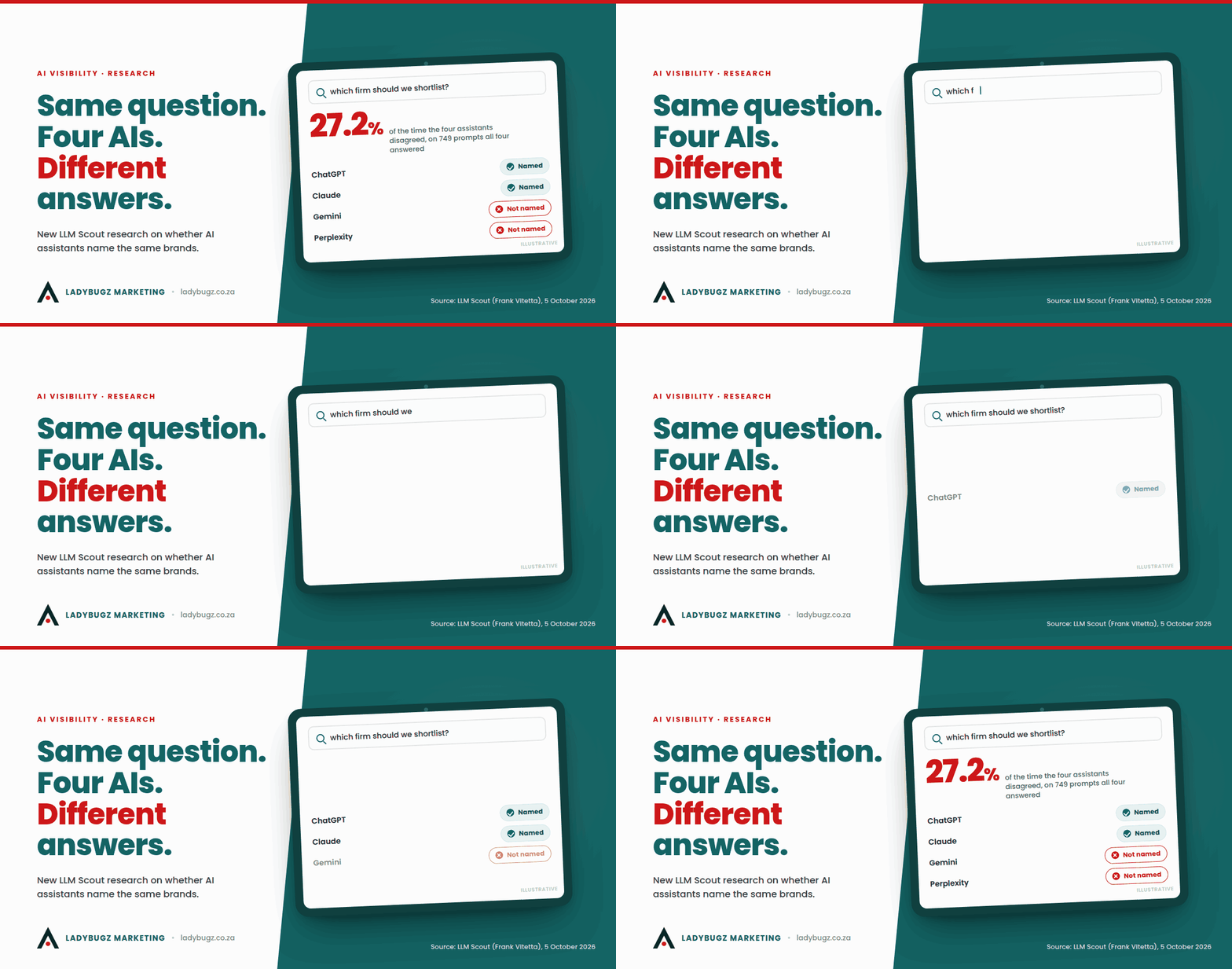
- They split on 27.2% of prompts: On 749 prompts that all four answered, they made the same call 72.8% of the time (545 prompts), so they differed on 204, according to LLM Scout's study.
- Full agreement is rare: When a brand appeared in at least one answer, all four named it only 41.2% of the time, according to Frank Vitetta's study.
- Mention rates differ by assistant: ChatGPT named the tracked brand in 36.0% of responses, Claude 27.6%, Gemini 24.6% and Perplexity 24.1%, per LLM Scout.
- The author calls 27.2% a floor: Vitetta says it is a minimum for how often the full lists differed, and the research is self-published, so read it as a signal, not a verdict.
What did the research actually find?
Four of the best-known AI assistants often gave different answers to the same buyer question about which brand to name. Frank Vitetta, a London-based AI consultant and the founder of LLM Scout, published the study on 5 October 2026. Yahoo Finance carried the coverage on 7 October.
Before we go further, two terms. An LLM (Large Language Model) is the AI engine behind tools like ChatGPT. It reads huge amounts of text and writes answers in plain language. AEO (Answer Engine Optimisation) is the work of making your business the answer those tools give when someone asks a question.
Vitetta logged 26,996 responses to 1,552 unique prompts over nine months. Yahoo Finance rounds that to about 27,000. The prompts were buyer-intent questions, the kind someone types when shopping. He tracked whether each assistant named a brand from a limited set he was monitoring, though the study doesn't disclose how many brands.
On 749 prompts, all four assistants responded. Of those, they made the same call (name the brand or leave it out) on 545, which is 72.8%. On the other 204, they split.
Why does it matter that they disagree?
It means your brand can be named in one assistant and missing from another, and you'd never know unless you looked at each. Most of us check one tool, see a result and assume the rest follow. This study suggests they don't.
Look at the mention rates Vitetta reported:
- ChatGPT named the tracked brand in 36.0% of its responses.
- Claude named it in 27.6%.
- Gemini named it in 24.6%.
- Perplexity named it in 24.1%.
Vitetta notes that ChatGPT named the brand about one and a half times as often as Gemini. That's a gap of about eleven percentage points between two tools that a buyer might pick up on the same afternoon.
We're not reporting this to say one assistant is better than another. The study doesn't say that, and neither do we. Different tools mention brands at different rates, and that's the point. A buyer's answer depends partly on which assistant they happen to open.
You can see a version of this yourself. Ask one assistant to describe your firm, then ask another the same question. The two answers can differ more than you'd expect, in what they say and in whether they name you at all.
How often did all four name the same brand?
Not often. When a brand appeared in at least one response, all four assistants named it only 41.2% of the time, according to the study.
The number is easy to misread. It doesn't say brands are rarely mentioned. It says that once any assistant mentions a brand, the odds that all four do are lower than half. More often than not, at least one left it out.
For a business, that's a useful way to think about it. Being "in" AI answers isn't a single yes or no. It's four separate results, and each one can change.
Why would four AI assistants give different answers?
One likely reason, drawn from the Yahoo Finance coverage, is that each one finds, filters and ranks information in its own way. The study doesn't test the cause, but the coverage draws the practical implication: optimising for a single platform isn't enough, since the models retrieve, filter and rank independently.
In plain terms, each assistant decides for itself which sources to look at, which ones to trust and which brands to put first. Two tools can read the same internet and still come away with different shortlists.
This is worth saying plainly to South African decision-makers. Many local B2B firms may be small next to the global names that dominate English-language sources. If an assistant leans on a handful of sources and your business isn't well described in them, you may simply not come up. And a different assistant, leaning on different sources, may name you without any effort on your side. You can't tell which way it falls without checking.
How much should you trust this study?
Treat it as a useful signal from a single source, not as settled fact. We'd rather you hear the limits from us than discover them later.
Here's what to keep in mind:
- It's self-published. The study sits on Frank Vitetta's own site.
- It's vendor-run. LLM Scout sells brand monitoring, so the author has a commercial interest in people caring about this problem.
- The data isn't public. Nobody outside the study can check the numbers independently.
- The brands and prompts are unnamed. We don't know which brands were tracked, or how many, because that isn't disclosed.
- Prompt mixes differ per assistant. The four tools weren't necessarily asked identical sets of questions.
- The assistants changed. They were updated during the nine months, so some of the difference may come from the tools evolving.
Vitetta himself describes 27.2% as a floor for how often the full lists differed. So the real figure may be higher, though we can't say by how much from what's published.
Why report it, then? Because the question it raises is cheap to test for your own business. You don't need to take anyone's percentage on trust. You can look.
Checking beats assuming
Here's our point of view. Nobody can promise you a place in an AI answer. What you can do is stop assuming.
If a prospect in Johannesburg, Cape Town or Durban asks an assistant who they should talk to about your service, the answer they get is now part of your first impression. It can happen before your website loads and before anyone sends an email. We've written before about how buyers ask AI who to hire. This research adds a layer: the answer isn't the same everywhere.
So what does a sensible, human-sized response look like?
- Check each assistant separately. Ask the questions your buyers ask, in each tool, and note what comes back. Don't stop at the first one.
- Check how you're described, not only whether you appear. Being named with the wrong detail can cost you as much as being missed.
- Repeat it. Because the tools change, a single check is a snapshot. Run it again after a few months.
- Fix the source material. Clear, consistent, accurate information about your business, on your own site and your professional profiles, gives every assistant better material to work from. Our recipe for doing that stays with our clients, but the principle is simple: be easy to describe correctly.
None of this replaces the human work of being good at what you do. AI assistants are describing businesses, and people still choose them. The firms that earn real trust, with real case studies and real people behind them, have the strongest raw material to begin with.
One last thing before you close the tab
If you take only one thing from the research, let it be this: don't assume. Open a few of these assistants this week, ask the questions your buyers would ask and write down what you see. It takes twenty minutes and it tells you more than any report can.
And if you'd rather have a second pair of eyes, that's what we're here for. We'll look at how the main assistants describe your business, tell you what we find in plain language and talk through what's worth doing about it. No jargon and no pressure.
Prefer a structured review of your professional presence first? Our paid LinkedIn Assessment is here: https://www.ladybugz.co.za/linkedin-assessment/
Noleen Thompson, LadyBugz Marketing
Keep reading