
Published Monday, 14 September 2026 | By Noleen Thompson, LadyBugz Marketing
Most B2B deals are now half-decided before a salesperson ever gets a look in. Here is how go-to-market strategy actually works in the AI era, and what established B2B teams should change now.
Key Insights
- The buyer is mostly gone before you meet them: only 17% of a B2B buyer’s total purchase time is spent with any supplier, and that sliver is split across every vendor they consider (Gartner, The B2B Buying Journey).
- AI is now the default research tool: 94% of B2B buyers use generative AI in their buying process, up from 89% the year before (Forrester, Buyers’ Journey Survey 2025).
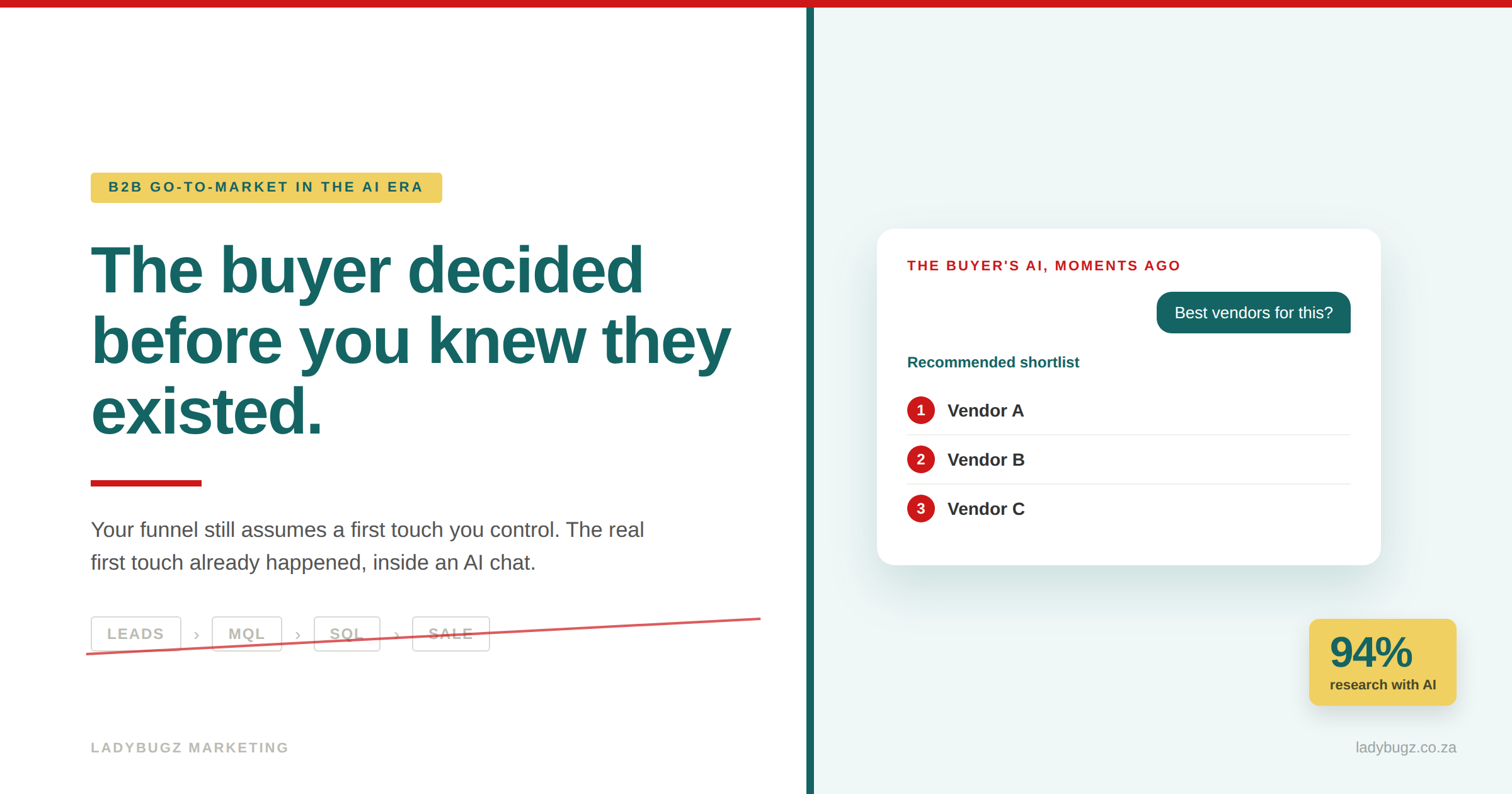
- Shortlists form before contact: 94% of buying groups had ranked their shortlisted vendors before speaking to any of them, and bought from that pre-contact favourite 77% of the time (6sense, 2025 B2B Buyer Experience Report).
- Buyers want to buy on their own terms: the share preferring a rep-free buying experience rose from 61% to 67% in a year (Gartner Sales Survey, 2025 and 2026).
- Humans still matter at the end: 69% of B2B buyers turn to a sales rep to validate the insights AI gives them (Gartner, 2026), and the same share notice when a vendor’s website and its sellers say different things (Gartner Sales Survey, 2025).
How Did B2B Go-To-Market Work in the Past, and Why Did It Work?
Go-to-market, or GTM, simply means the whole plan for how a company takes a product or service to buyers and turns interest into revenue. For roughly two decades, most B2B firms ran the same version of it.
The model was a funnel. You bought attention at the top with adverts, events and gated content, meaning material like a whitepaper or webinar you could only get by handing over your email. Marketing then scored those contacts and passed the promising ones to sales. The industry gave this a name: the Demand Waterfall, published by the analyst firm SiriusDecisions (later acquired by Forrester). A contact who looked interested became an MQL, a Marketing Qualified Lead, meaning marketing thought they were worth a call. Sales agreed or disagreed, and the good ones became an SQL, a Sales Qualified Lead, meaning a rep had confirmed real intent. Volume in, deals out.
Here is the part people forget. That model worked because of information asymmetry, a plain way of saying the seller knew far more than the buyer. If you wanted to understand a product, compare options or see a price band, you often had to talk to the vendor. Gating a guide behind a form was a fair trade. You gave up your email, and in return you got information you genuinely could not find anywhere else.
That trade is what broke.
What Changed in How B2B Buyers Buy?
The buyer stopped needing you to learn. Independent reviews, community forums, pricing pages, comparison sites and peer conversations moved almost all of that product knowledge out into the open. So buyers started educating themselves, quietly, long before raising a hand.
The numbers are stark. Only 17% of a B2B buyer’s total purchase time is now spent with any potential supplier, and because that time is divided across every vendor on the list, a single company might get around 5% of the buyer’s attention (Gartner, The B2B Buying Journey). The rest happens without you.
Three shifts sit underneath that.
Buyers self-educate first. By the time a vendor is contacted, the homework is mostly done. Research from 6sense found the split between independent research and seller-led conversation moved from roughly 70/30 to about 60/40, and the average buying cycle shortened from 11.3 months to 10.1 months (6sense, 2025 B2B Buyer Experience Report). Less of the journey is yours to influence, and it is moving faster.
Buying is a committee sport. A typical B2B purchase now involves a buying group of 6 to 10 decision-makers, each arriving with four or five pieces of information they gathered on their own (Gartner, The B2B Buying Journey). No wonder 77% of buyers describe their most recent purchase as very complex or difficult (Gartner, same source). You are not persuading one person. You are trying to help a room full of people agree.
Trust in gated, seller-led content has thinned. Buyers have learned that the brochure oversells. The proof is in the friction it causes later: 69% of B2B buyers report inconsistencies between what a vendor’s website says and what its sellers tell them (Gartner Sales Survey, 2025). Every one of those gaps is a reason to doubt you.
One more piece of context that reframes the whole thing. At any given moment, only about 5% of your potential buyers are actually in the market to buy. The other 95% are not, a pattern the Ehrenberg-Bass Institute set out for the LinkedIn B2B Institute as the 95:5 rule (Prof. John Dawes, Ehrenberg-Bass Institute, 2021). GTM built purely to capture the ready 5% ignores the far larger group who are quietly forming opinions for next year.
How Is AI Changing the Way Buyers Research and Buy?
AI has become the buyer’s first stop, and it is reshaping research before it touches the sale.
Generative AI, meaning tools like ChatGPT, Gemini and Copilot that produce written answers rather than a list of links, is now mainstream in B2B buying. An LLM, or Large Language Model, is the technology underneath them, trained to answer questions in plain language. 94% of B2B buyers now use generative AI in their buying process, up from 89% (Forrester, Buyers’ Journey Survey 2025). More telling, twice as many buyers name generative AI as a more meaningful source than any other channel, and 61% use private or company-supplied AI tools, with B2B buyers roughly twice as likely to use ChatGPT and four times as likely to use Copilot as ordinary consumers (Forrester, same source).
This changes where you get found. For years the game was SEO, Search Engine Optimisation, meaning shaping your site so it ranks well and earns the click on Google. That click is now optional. 58.5% of US Google searches ended without a click in 2025 as AI-generated answers satisfied the query on the page (Similarweb, Zero-Click Study 2025). The buyer got their answer and never visited a website.
So a new discipline sits next to SEO. AEO, Answer Engine Optimisation, means structuring your content so AI answer engines quote you directly in their replies. GEO, Generative Engine Optimisation, is the same idea by a different name. If SEO was about ranking for the click, AEO and GEO are about being the answer the AI gives, and the source it names. Get this wrong and you are invisible at the exact moment a shortlist is being written.
Then there is the next wave: agentic AI, meaning AI that does not just answer but takes action on the buyer’s behalf, such as researching options and drafting a purchase. Already 38% of surveyed B2B buyers use agentic AI in purchasing, while only 24% of suppliers do and just 13% have fully integrated systems (Deloitte Digital, 2026). Gartner projects that AI agents will intermediate more than $15 trillion in B2B spending by 2028 (Daryl Plummer, Gartner, 2025). Notice the gap between those numbers. Buyers are adopting this faster than the companies trying to sell to them.
None of this removes the human. 69% of B2B buyers still turn to a sales rep to validate the insights AI hands them (Gartner, 2026), and 45% said they had used AI during a recent purchase rather than for it entirely (Gartner Sales Survey, 2026). AI narrows the field. A person still closes the trust gap.
How Should You Do Go-To-Market in the AI Era?
The whole shift comes down to one line: the click matters less than the citation and the shortlist. GTM in the AI era rewards the vendor the AI trusts enough to name, and the buying group already prefers before a call.
At LadyBugz we anchor client GTM on a few principles rather than a rigid funnel. Here is the thinking, and the reasoning behind it.
Be the answer, not just the ad. If buyers form shortlists inside AI tools, your job is to be the source those tools quote. That means clear, well-structured, genuinely useful content that an answer engine can read and cite, published where it can be found. This is why AEO now sits alongside SEO in every plan we build. We ran our own B2B marketing this way and pulled 23,397 organic search visitors and 102,187 organic LinkedIn impressions with R0 in ad spend, which is the same muscle we are describing here.
Feed the 95, not only the 5. Since most of your future buyers are not ready today, GTM has to keep building recognition and trust with people who will not convert for months. Content that teaches, a visible point of view, and a brand people already respect all do quiet work long before a form is filled in.
Design for the committee. With 6 to 10 people in the room, one persuasive champion is not enough. Different members need different proof, so the account, not the individual lead, becomes the unit you plan around. This is the logic behind account-based marketing, where you target a defined set of high-value accounts rather than chasing lead volume.
Keep a human in the loop by design. Buyers use AI to shortlist and a human to confirm. Your GTM should make it easy to self-serve the research and easy to reach a real expert at the point of doubt, because that is exactly where deals are won or lost.
I will be honest about what I am not going to spell out here. The exact channel mix, the cadence, the way we structure an account plan and what we look at inside an audit is the part clients pay us to run. The principles above are the map. The execution is the craft.
Why Must Sales and Marketing Work Closer Together Now?
Because the buyer now experiences your marketing and your sales as one thing, and they notice the seams.
Think about the sequence. A buying group researches you through AI and your content, ranks you, and only then talks to a rep, often just to check that what they found holds up. If the website promised one thing and the salesperson says another, trust cracks. That is not hypothetical. 69% of B2B buyers already report inconsistencies between a vendor’s website and its sellers (Gartner Sales Survey, 2025). Every gap between the marketing story and the sales conversation is a reason for a 6-to-10-person committee to pick someone else.
The old model let the two teams live apart. Marketing counted leads. Sales counted deals. The handover was a throw over the wall. In the AI era that wall costs you, because the buyer moves fluidly between self-serve research and human conversation, and expects a single, consistent story throughout.
This is pushing many firms toward RevOps, or Revenue Operations, meaning a shared way of working where marketing and sales sit under one set of goals, one view of the account and one definition of what a good opportunity looks like, rather than two teams optimising their own scoreboards. Two useful terms here. Your ICP, or Ideal Customer Profile, is the type of company you are best placed to help. Alignment starts with sales and marketing agreeing on that ICP and on which accounts matter, then telling those accounts one coherent story across every touch.
Get this right and the payoff is not soft. It is fewer lost deals from mixed messages, and a buying group that hears the same trustworthy voice whether it is reading your article at 11pm or sitting across from your salesperson the next week.
What Does the Future of Go-To-Market Look Like, and How Do You Stay Ahead?
The direction is clear even if the details keep shifting: GTM is moving from volume to signal, and from human-only research to AI-mediated and increasingly agentic buying.
Volume-based GTM asked “how many leads did we capture?” Signal-based GTM asks “which accounts are showing they are in-market right now, and are we ready when they are?” The rep-free preference is a durable upward trend, from 61% to 67% in a year (Gartner Sales Survey, 2025 and 2026), so the self-serve, high-trust digital path is not a phase to wait out. Meanwhile agentic buying is real and growing, with $15 trillion in B2B spend projected to flow through AI agents by 2028 (Daryl Plummer, Gartner, 2025), which means your product, pricing and proof need to be accurate and machine-readable, because increasingly a machine will read them first.
So how do you stay ahead without chasing every new tool?
Get cited by the AI engines. Invest in being the answer AI tools quote, not only the page Google ranks. If you are absent from the AI reply, you are absent from the shortlist.
Organise around accounts and signals, not lead counts. Align sales and marketing on the ICP, watch for real buying signals, and act as one team when an account heats up. Our organic B2B marketing strategy work is built on exactly this account-and-signal footing.
Keep the human where it counts. Automate the research path, but make it effortless to reach a real expert at the moment of doubt, because buyers still validate AI findings with people.
Check your own foundations honestly. Most teams do not have a visibility problem they can see. They have gaps in how AI, search and their content work together that only show up when someone looks properly.
That last point is where I would start. You cannot fix what you have not measured, and in the AI era the thing most B2B teams have never measured is whether AI even mentions them.
Frequently Asked Questions
What does go-to-market (GTM) mean in B2B?
GTM, or go-to-market, is the complete plan for how a business takes its product or service to buyers and turns interest into revenue. It covers positioning, the channels you use to reach buyers, how marketing and sales work together, and how you convert and retain customers. In the AI era it increasingly includes how visible you are inside AI answer tools.
How has AI changed B2B buying?
Buyers now research with AI before they contact a vendor. 94% of B2B buyers use generative AI in their buying process (Forrester, Buyers’ Journey Survey 2025), and many form and rank a shortlist inside AI tools before a seller is aware of them. AI narrows the field, but 69% of buyers still turn to a human rep to validate what AI tells them (Gartner, 2026).
What is the difference between SEO and AEO?
SEO, Search Engine Optimisation, shapes your website so it ranks well and earns clicks on search engines like Google. AEO, Answer Engine Optimisation (sometimes called GEO, Generative Engine Optimisation), structures your content so AI answer engines quote you directly in their replies and name you as a source. As more searches end without a click, AEO is becoming as important as SEO.
Why do sales and marketing need to be aligned in the AI era?
Because buyers experience your marketing and sales as one story and notice when they disagree. 69% of B2B buyers report inconsistencies between a vendor’s website and its sellers (Gartner Sales Survey, 2025), and with 6 to 10 people in a buying group, any mismatch gives the committee a reason to choose a competitor.
Is the traditional lead funnel dead?
Not dead, but no longer sufficient on its own. The MQL-to-SQL funnel was built for a time when vendors controlled product information. Today only 17% of buying time is spent with suppliers (Gartner, The B2B Buying Journey), so GTM is shifting from chasing lead volume to detecting in-market accounts, being cited by AI, and aligning teams around the account.
How do I know if my B2B marketing is ready for the AI era?
Start with an honest audit of how your positioning, content, website, search and AI-search visibility actually work together, ideally reviewed by a human strategist rather than a scorecard. That is precisely what the LadyBugz Marketing Audit is designed to surface.
Editorial note: figures in this article are drawn from named third-party research (Gartner, Forrester, 6sense, Deloitte Digital, Similarweb and the Ehrenberg-Bass Institute) and are credited inline at each point of use. They reflect the sources available at the time of writing and are shared for general guidance, not as a guarantee of results.
Want to know whether AI search even mentions your business, and where your GTM is leaking deals? The LadyBugz Marketing Audit is a real, human-reviewed read of your whole B2B marketing strategy, including the AI-search visibility most audits still miss.
Noleen Thompson, LadyBugz Marketing