
By Noleen Thompson, LadyBugz
I have been doing this long enough to remember when a new website meant a long, quiet wait. You would launch, hold your breath, and hope that somewhere around the six-month mark Google would start taking you seriously. That wait was just accepted. It was the tax you paid for being new.
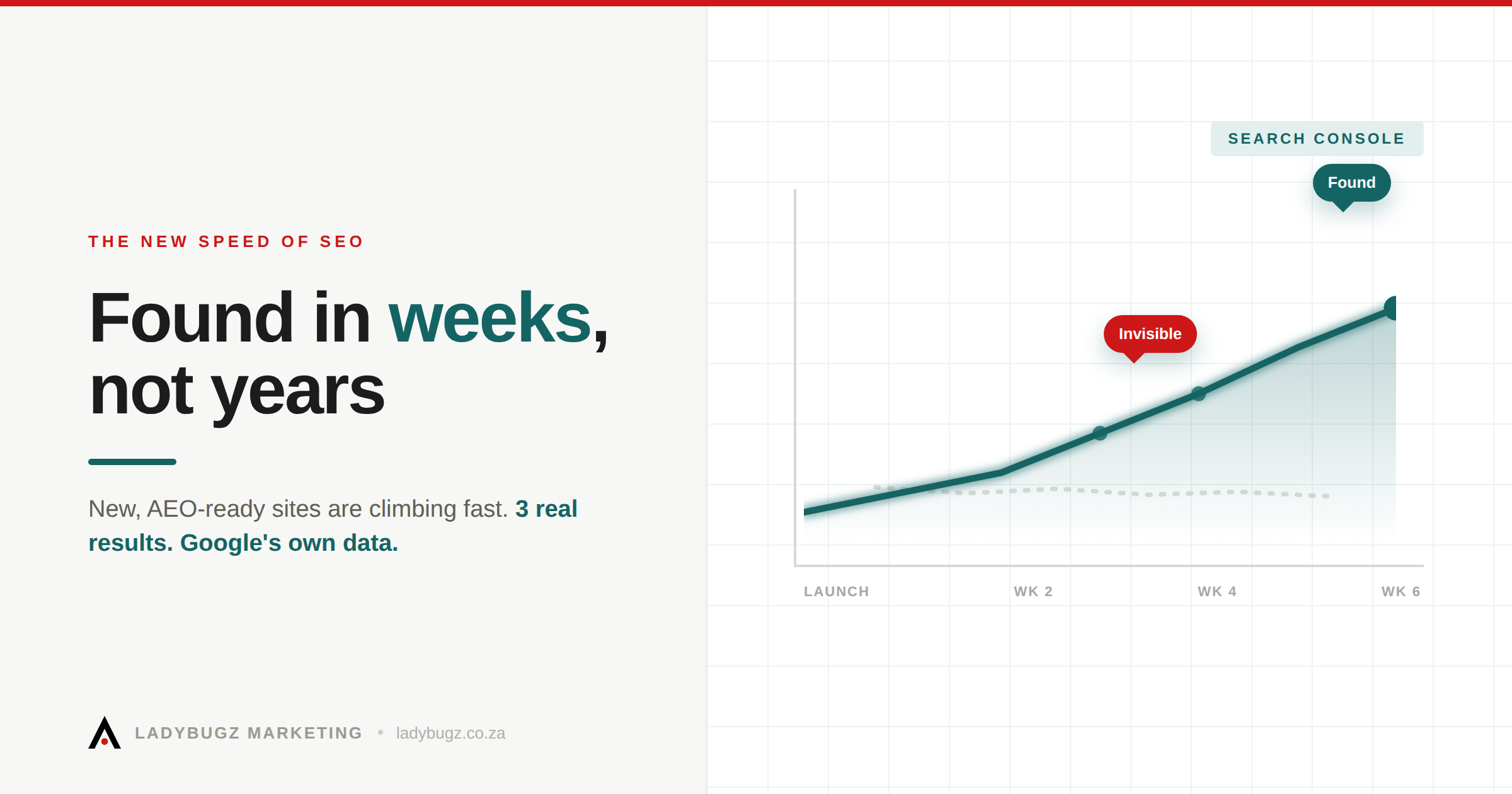
That tax is being refunded. Across the sites we have built and rebuilt this year, something has changed in how quickly they get found, and it is showing up in the data, not in my imagination. New sites are surfacing in Google, and being pulled into AI answers, within weeks of going live. Not for the impressive-looking phrases that never actually bring buyers, either. For the actual questions buyers type when they are close to choosing someone.
I want to make that case honestly, and I want to back it with three real results from our own portfolio. Two of them are client sites, so I will describe the businesses without naming them. One of them is ours, and I will happily put our name on it.
First, two quick definitions, because the acronyms matter
SEO is Search Engine Optimisation. It is the older, familiar game: getting your web page to rank high enough on Google that a person clicks through to it.
AEO is Answer Engine Optimisation, and it is the newer one. An answer engine is a tool that gives people a direct answer instead of a list of links. ChatGPT, Perplexity, Microsoft Copilot and Google’s own AI Overviews are all answer engines. AEO is the work of making sure your business is one of the names those tools mention when someone asks. SEO earns you a click. AEO earns you a citation inside the answer, where there may be no click at all.
One more, because I will keep pointing at it: GSC is Google Search Console, the free tool Google gives every site owner to see exactly what it is showing them for, how often, and where they rank. Everything I am about to quote comes straight from GSC. These are measured numbers, not estimates.
If you want the bigger picture of how buyers now build their shortlist inside an AI chat you will never see, I made that case separately in your buyers are asking AI who to hire. Think of this piece as the proof that sits underneath it.
What is actually going on with fresh sites
Here is the honest mechanics of it, without giving away how we do the work itself.
Answer engines and Google both reward one thing above almost all others: being easy to understand. A site that spells out, in plain readable text, what it does, who it serves and where, gives these systems something solid to repeat. A well-structured new site can offer that clarity from day one, with no years of messy history to wade through. That is the quiet advantage of a fresh site that has been built for how answer engines actually read. It is legible from day one. If you want to see where your own marketing stands, our free AI marketing readiness scorecard shows you in a few minutes.
The second thing is the shape of the questions. People no longer type “b2b agency.” They type “what is the best tool for organic marketing” or “best mobile dog groomers near me” or “how does VR firefighter training compare to traditional methods.” These are full sentences, and two features make them gold. They tell you exactly what the person wants, so the intent is unmistakable. And the word “best,” or “near me,” almost always means someone is close to choosing. Nobody asks who the best supplier is at the start of idle curiosity. They ask it when they are about to hire.
So when a new site is built to answer those exact questions clearly, it can start showing up for them fast, and the traffic it earns is the kind that converts. That is the whole thesis. Now the proof.
Proof one: our own site, over about three months
I will start with ours because I can name it. Since LadyBugz built its current AEO foundation, here is what GSC records over roughly three months, comparing our first 30 days of data against our most recent 30:
- Impressions (how often we appear in results) up 25 percent.
- Clicks doubled, a clean 100 percent increase.
- Average ranking position improved by about four places.
- Click-through rate (CTR), the share of people who actually click when we appear, up 60 percent.
That last pairing is the one I care about most. We are not just appearing more often. We are appearing higher, and more of the people who see us are clicking. And the queries pulling us in are the conversational, buying-intent kind: ranking #1 for “what is the best tool for organic marketing”, and on page one for the comparison questions buyers actually ask about B2B agencies. Those are answer-engine-shaped questions, and we are in the answer.
Fair caveat, because I will not dress this up. Our site is young, so this is genuine growth over three months, not a year-on-year story. I would rather tell you the true version than a fatter one.
Proof two: a local service business, about six weeks
The second proof is a small local service brand we manage, a mobile pet-grooming business. I am keeping it anonymous out of respect for the client, but the results are the business’s own.
Before we relaunched it, the site was effectively invisible in search. Within its first six weeks or so of being properly built and indexed, GSC shows it climbing from near zero to roughly 900 impressions a month, earning its first page-one rankings, and sitting at position one for “best mobile dog groomers near me.”
Think about who is typing that. Someone with a dog that needs grooming, right now, looking for the best option close to them. That is not traffic for a report. That is a customer at the point of choosing. A small local business went from unseen to the top answer for its most valuable question, in about a month and a half.
Proof three: a training provider, its first weeks live
The third is a training and immersive-simulation provider, again anonymised. This one had a rebuilt site with AEO-shaped content go live, and in its first weeks GSC shows clicks up 118 percent and impressions up 106 percent over the previous 28-day period.
More telling than the percentages is what it ranks for. The question-format articles are already landing on page one: “how does VR firefighter training compare to traditional methods” and “does VR firefighter training work,” alongside course-intent terms people search when they are ready to enrol. Someone comparing training methods has already decided to buy. They are just choosing who from. Asking whether a method works is the last check before they commit. This site is meeting them inside those questions, weeks after launch.
Why the spread is the real point
Look at the three together. A global-facing B2B marketing firm. A local mobile pet-grooming service. A specialist training provider. Three businesses that could not be more different in size, market or budget. The same pattern held for all of them: build the site properly for AEO, and it gets found fast, for the questions that actually convert.
That is what I want you to take from this. This is not a trick that only works for big brands with big spend, and it is not a slow grind that only pays off next year. It is a repeatable outcome we are now seeing across very different businesses, and it is the same principle behind the organic B2B marketing we run for every client. We can measure it in Google’s own data. The old six-month wait was never a law of nature. It was just what happened when nobody built for how machines actually read a site.
If your website is more than a couple of years old, or if it has never been structured for how AI and search read it now, you are almost certainly missing from answers your buyers are already asking. The gap is quiet, which is exactly what makes it dangerous. You do not see the conversations you are absent from.
Want to know whether your site shows up when your buyers ask? Start with a real, human read of your whole B2B marketing setup, including the AI visibility most audits still miss.
Take the LinkedIn Assessment Email us
The LinkedIn Assessment is a paid service, live now.
Editorial note: the growth figures above are drawn from Google Search Console for sites in the LadyBugz portfolio. They reflect early-stage growth on newly built and rebuilt sites, not year-on-year comparisons. We would rather show you the honest version.