
By Noleen Thompson, LadyBugz
The calendar is not on your side. Strong LinkedIn results in 2027 are not booked in 2027. They are booked now, in the content you publish this quarter and the trust you start banking this month. B2B buying, which means selling to other companies rather than to consumers, moves slowly. The brands that win next year tend to be the ones already showing up with something worth believing.
So we went through the numbers that actually change a marketer’s decisions, and we put our own read next to each one. Not vanity reach. The stats that tell you where your attention is worth spending between today and next year.
TL;DR: LinkedIn is bigger than ever, with 1.3 billion members (LinkedIn, 2026), but scale is no longer the edge. In 2026 heading into 2027, the marketer’s real game is quality and credibility, not reach and volume. Deals stall on trust, not awareness, so the work that produces 2027 results is the work you start now. This article walks through eleven questions every marketer should be able to answer, with the verified stat behind each.
The stats at a glance
- 1.3 billion members worldwide (LinkedIn, 2026)
- 63 million decision-makers on the platform (LinkedIn, 2026)
- 76% of B2B marketers call it the best channel for thought leadership (Content Marketing Institute, 2026)
- 40% of B2B deals are lost to indecision, not to a competitor (The Jolt Effect, Dixon and McKenna)
- Video watch time up about 36% year over year (LinkedIn, 2025)
How big is LinkedIn in 2026, really?
Big enough that “should we be on it” is the wrong question. LinkedIn now reports 1.3 billion members across 200 countries and regions (LinkedIn, 2026), with close to 100% of the Fortune 500 present on the platform (LinkedIn, 2026). It has posted five straight years of double-digit member growth (LinkedIn, 2026) and around $19.8 billion in annual revenue (LinkedIn and Microsoft, FY26).
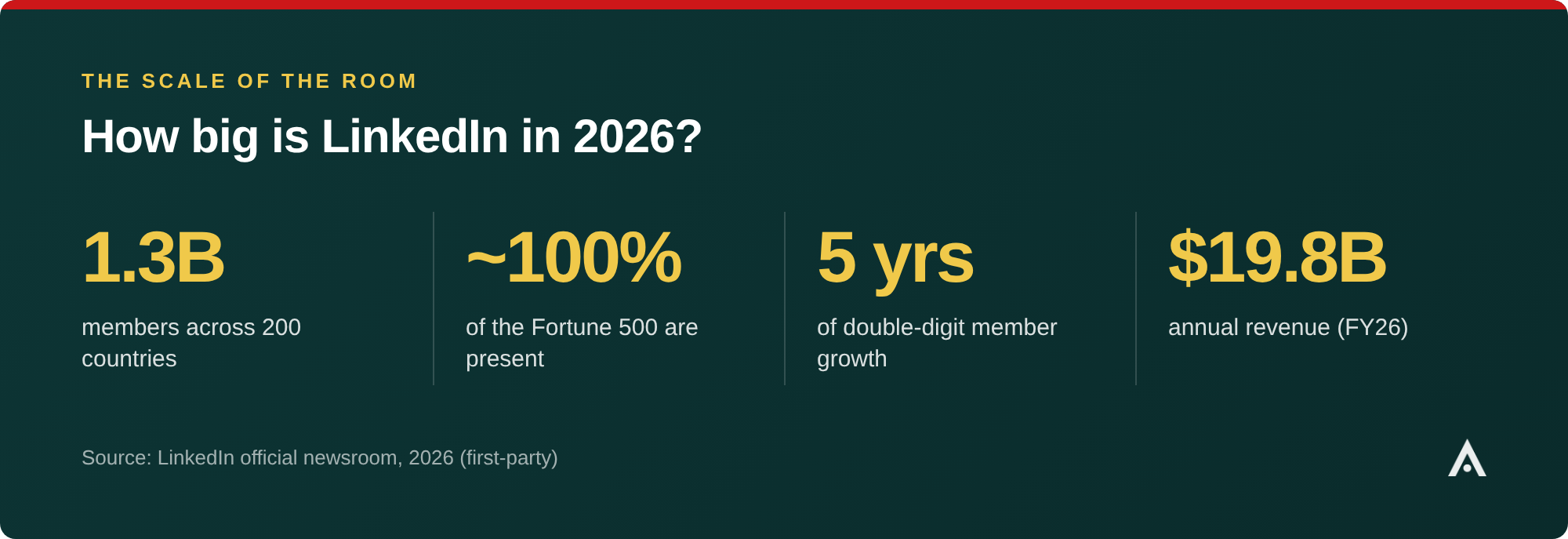
1.3 billion members, and close to 100% of the Fortune 500.
A quick honesty note, because it matters for how you plan. LinkedIn does not publish a monthly active user figure, and third-party traffic estimates vary a lot. We stick to the membership number LinkedIn states about itself. Our take: the platform is not a bet anymore, it is the baseline everyone is already on. When everyone is present, presence stops being an advantage. Credibility becomes the only one left. Hold that thought, because it runs through everything below.
Who is on LinkedIn, and are my buyers there?
Almost certainly, yes. LinkedIn counts 63 million decision-makers, meaning people with the authority to approve a purchase, plus 10 million C-level executives (the CEO, CFO and other chief officers) and 180 million senior people who influence buying decisions (LinkedIn, 2026). The gender split sits at roughly 57% male to 43% female (Kepios and Statista, 2025), and the largest age band is 25 to 34 (Statista, 2025). Just over three quarters of members, 77%, are based outside the United States (DataReportal, 2025), so this is a genuinely global room.
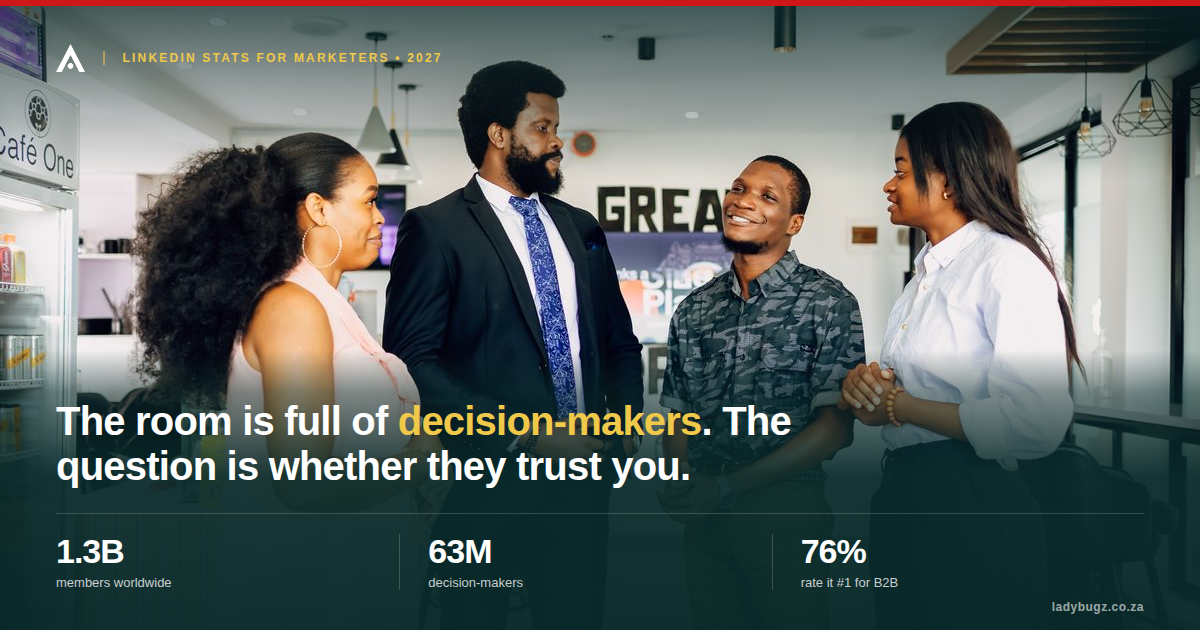
63 million decision-makers are already here. The question is whether they believe you.
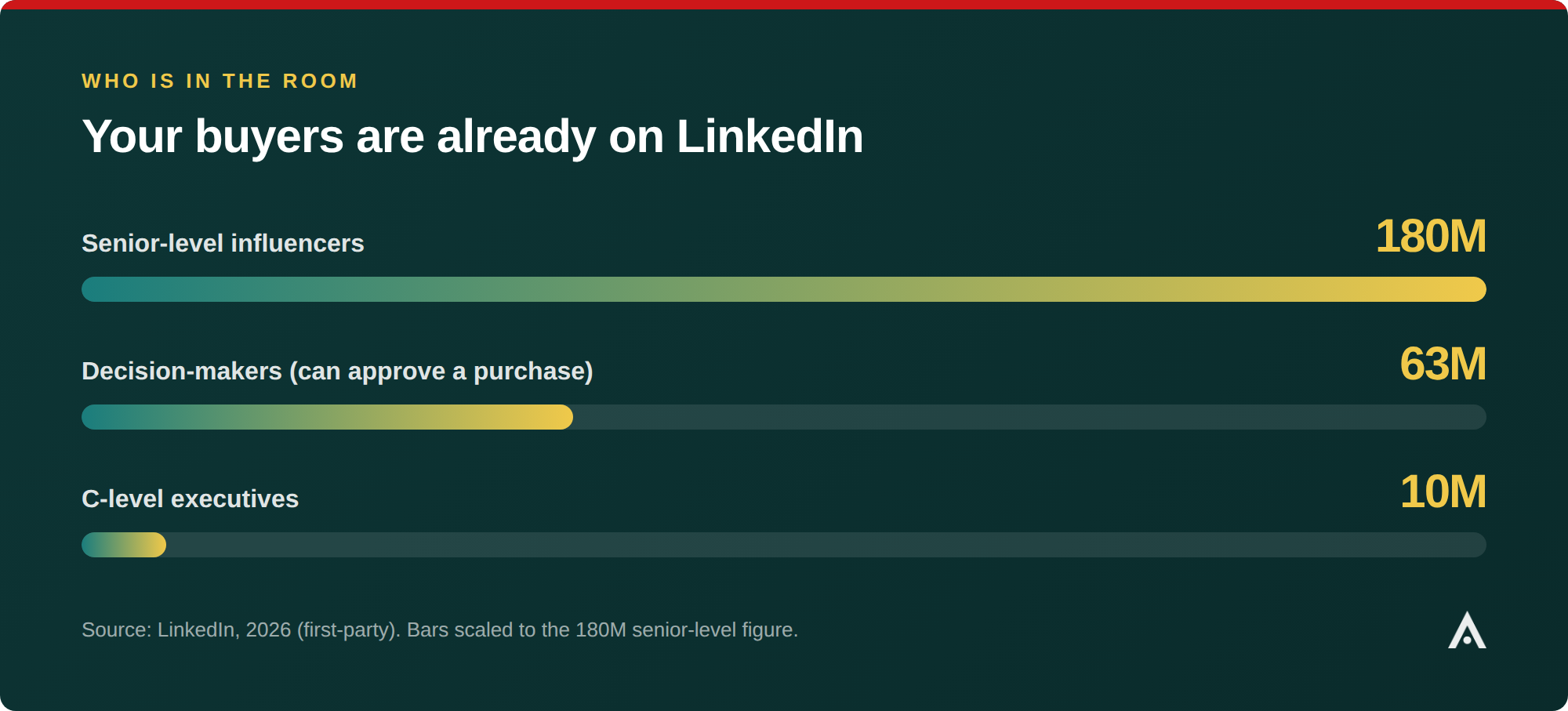
Our take: the people who sign off your deals are already here. The question is not reach, it is whether they believe you when they arrive.
Is LinkedIn really the best channel for B2B marketing?
By the people doing the work, it is rated that way. 76% of B2B marketers say LinkedIn is the most effective channel for thought leadership and organic content (Content Marketing Institute, 2026). Thought leadership means publishing genuine expertise and opinion to earn trust rather than to sell directly, and organic content means posts you earn attention for rather than pay to promote. Roughly nine in ten B2B marketers use the platform (Statista, 2026), and 40% say it delivers their highest-quality leads (LinkedIn, 2026).
Notice the word in that last stat. Quality. Not most leads, best leads. That distinction is the whole story of the next few years.
More leads, or better leads?
This is where a lot of marketing budgets quietly leak. The pressure is real. 78% of B2B chief marketing officers say proving return on investment has become more important over the last two years (LinkedIn). About half justify their spend to the C-suite every single month (LinkedIn). And 87% admit they struggle to measure long-term impact (LinkedIn).
Chasing raw volume looks productive and often is not. LinkedIn’s own framing puts it well: aim for two times the leads at half the cost, not half the leads at double the cost. Predictive audiences, which use data to target the people most likely to buy, cut cost per lead by up to 21% (LinkedIn). Cost per lead, or CPL, is simply what you pay to earn one qualified prospect. LinkedIn also reports a 113% return on ad spend (LinkedIn), where return on ad spend, or ROAS, is the revenue you earn for every rand or dollar you put into ads.
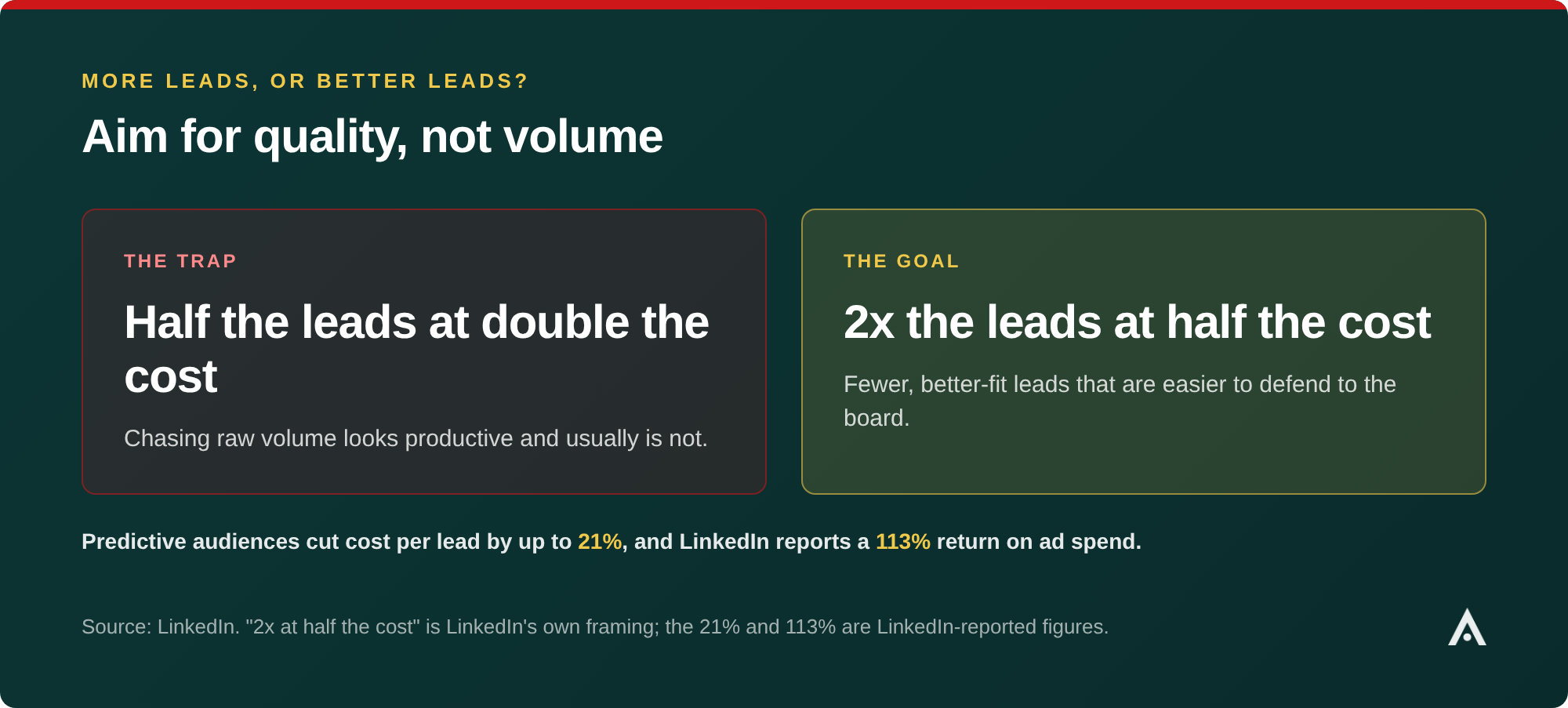
Our take: this is a shift from demand capture to demand generation. Demand capture is chasing people who are already searching for what you sell. Demand generation is the patient work of building awareness and trust over time, so that when someone is ready to buy, you are already the name they reach for. Fewer, better-fit leads are also far easier to defend in a board meeting than a flood of the wrong ones. It is the same thinking behind the organic B2B marketing we run for clients.
Why do B2B deals actually stall?
Not for the reason most marketers assume. The biggest killer of B2B deals is no decision at all. 40% of deals are lost to indecision rather than to a competitor (The Jolt Effect, Matthew Dixon and Ted McKenna). The buying group simply cannot get comfortable enough to move.
40% of B2B deals are lost to indecision, not to a competitor.
And these groups are getting harder to satisfy. The average B2B purchase now involves roughly 10 stakeholders and spans 272 days (Dreamdata, LinkedIn Ads Benchmarks Report, 2026). Meanwhile 94% of marketers say trust is critical to success, yet only 45% of buyers actually trust the vendors they engage (LinkedIn and Ipsos). As one financial-services buyer put it in Bain and LinkedIn’s research, it is a lot harder to get into trouble making the decision everyone else would have made.
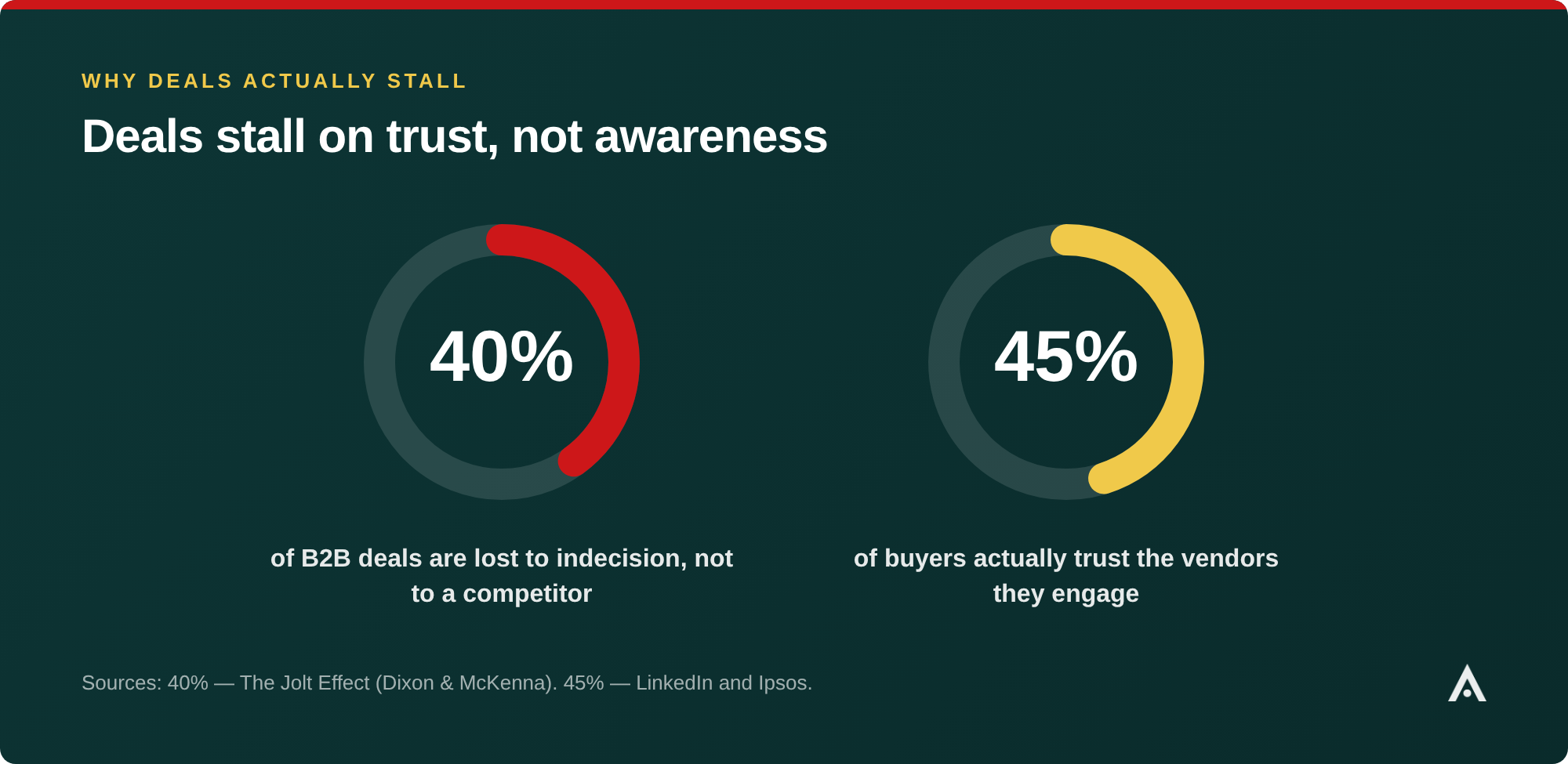
Our take: your prospect’s real fear is not picking the wrong vendor, it is being blamed for it. Marketing that reduces that fear closes deals. Marketing that only raises awareness does not.
What builds trust that converts on LinkedIn?
LinkedIn and Ipsos describe a useful model for this in their Credibility Code research: trust is built by reinforcement, not repetition. Four voices carry the same message and strengthen one another, brand, employees, customers and peers, and creators. No single voice does it alone.
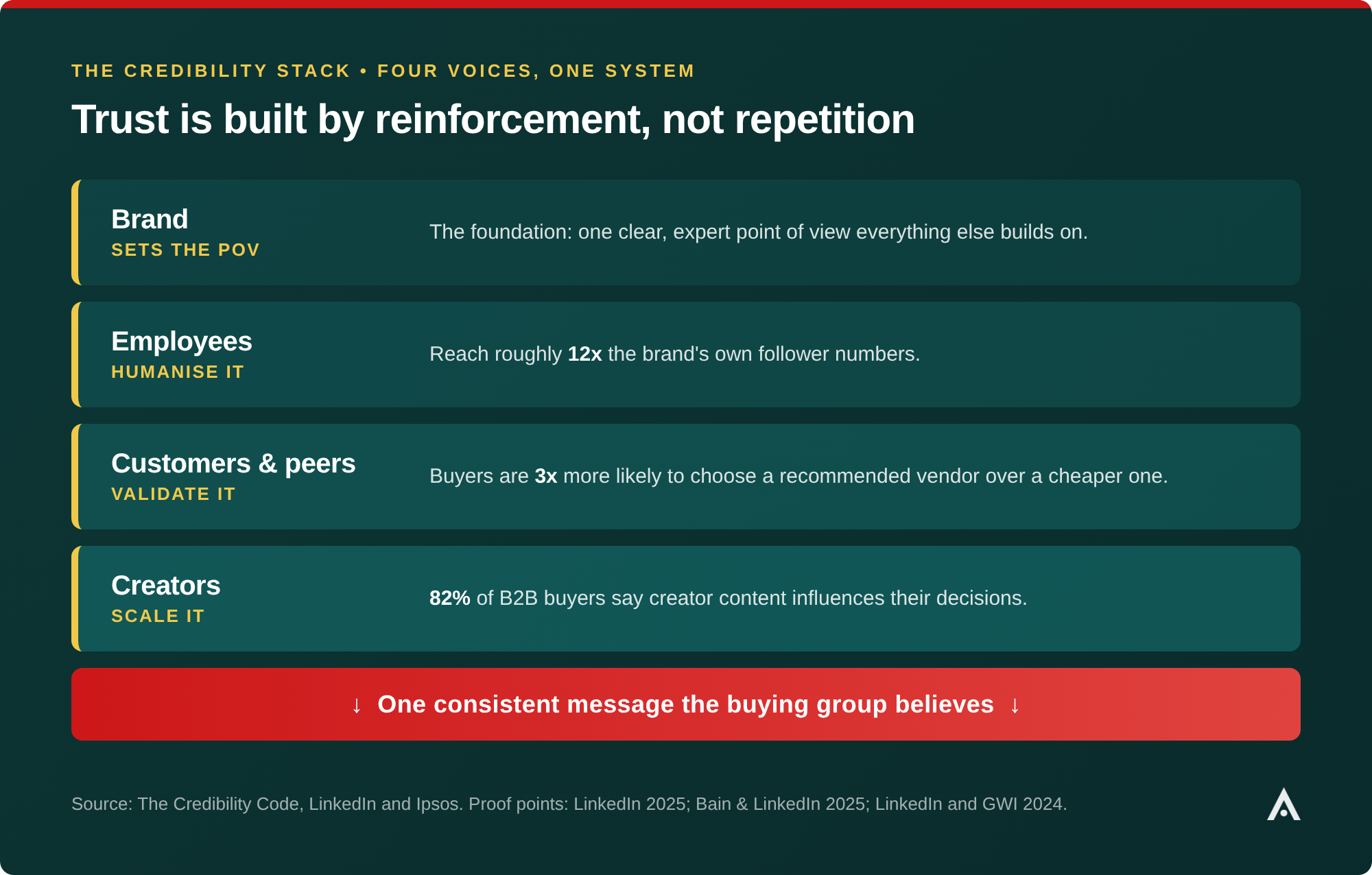
The proof sits underneath each layer. Nine in ten decision-makers say strong thought leadership makes them more receptive to a company’s outreach (Edelman and LinkedIn, 2024). A company’s employees typically reach about 12 times the follower numbers of the brand itself (LinkedIn, 2025). Buyers are three times more likely to choose a recommended vendor over a cheaper one (Bain and LinkedIn, 2025). And 82% of B2B buyers say creator content influences their purchasing decisions (LinkedIn and GWI, 2024). LinkedIn and Ipsos also tested creator-led ads. They found them likely to deliver 1.5 times stronger predicted brand impact, and 1.2 times more likely to be considered as an option (predicted), versus a short-form video benchmark (Ipsos Creative SparkAI). Those numbers come from testing the ads in a lab, not from real campaigns, so treat them as a direction of travel rather than a promise.
Our take: one polished company account cannot carry your credibility on its own. The brands that convert have several believable humans saying a consistent thing. That is a system to build, and it takes time, which is exactly why 2027 starts now.
What content is working on LinkedIn now?
Two things stand out. Thought leadership with a real point of view, and video. Nine in ten decision-makers are more receptive after strong thought leadership (Edelman and LinkedIn, 2024). On the video side, watch time grew about 36% year over year (LinkedIn, 2025), and video ads are 20 times more likely to be shared than other LinkedIn posts (LinkedIn). Content from executives pulls its weight too: C-suite posts drive around four times more engagement than posts from other members (LinkedIn internal data), and thought-leader posts with a clear opinion earn a median 43% engagement uplift over safe announcements (LinkedIn internal data).
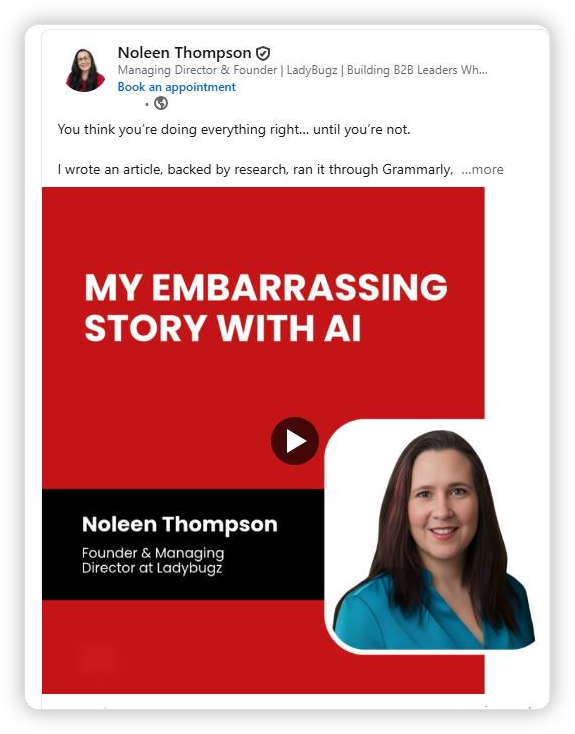
Our take: bland, opinion-free content is the quiet budget-waster of the year. A clear stance from a real person, ideally on camera, is what earns attention now.
Do LinkedIn ads earn their spend?
They can, when the targeting is disciplined. LinkedIn’s advertising reach passed 1.20 billion members, growing more than 17% year over year (Kepios and DataReportal, Jan 2025). LinkedIn reports cost per lead around 28% lower than Google Search on its own comparison (LinkedIn, 2026), a 113% return on ad spend (LinkedIn), and a roughly 33% lift in purchase intent, meaning how likely people are to buy, among those who saw the brand’s messages (LinkedIn). Treat the benchmark figures as illustrative, since real results move with your industry, offer and creative.
Our take: ads amplify credibility, they do not manufacture it. Put spend behind content people already find believable and the numbers work. Put spend behind a weak message and you simply buy indifference faster.
Will AI search change how buyers find you on LinkedIn?
Here is what we think this means for AI (artificial intelligence) search, and we want to be clear that this next part is our point of view, an extrapolation, not a finding from LinkedIn or the Credibility Code research. Neither says anything about answer engines. We are connecting their logic to where buyer behaviour is heading, something we explore in more depth in how B2B marketers get cited in AI search.
AEO stands for Answer Engine Optimisation. It is the practice of making your content easy for AI answer tools to find, trust and cite you. Those are the tools that write you a summary instead of showing ten blue links. The research is blunt that AI-generated content is flooding the market and that credibility, not volume, is now the differentiator. We think the same mechanic applies inside AI search. When an answer engine decides who to cite, corroboration is the filter. A brand whose employees, customers and creators all echo a consistent, expert point of view gives an AI many reinforcing signals to trust. A brand with one thin company page gives it almost nothing.
Our take: the credibility stack you build for human buyers is very likely the same asset that gets you surfaced by AI. Building it is slow, which is the whole point of starting now rather than next year.
What does all this mean for South African marketers?
The room is bigger than many local marketers assume. South Africa has around 17 million LinkedIn members (DataReportal, 2026), which is 37.8% of the adult population (DataReportal, 2026). More than a third of South African adults are reachable here.
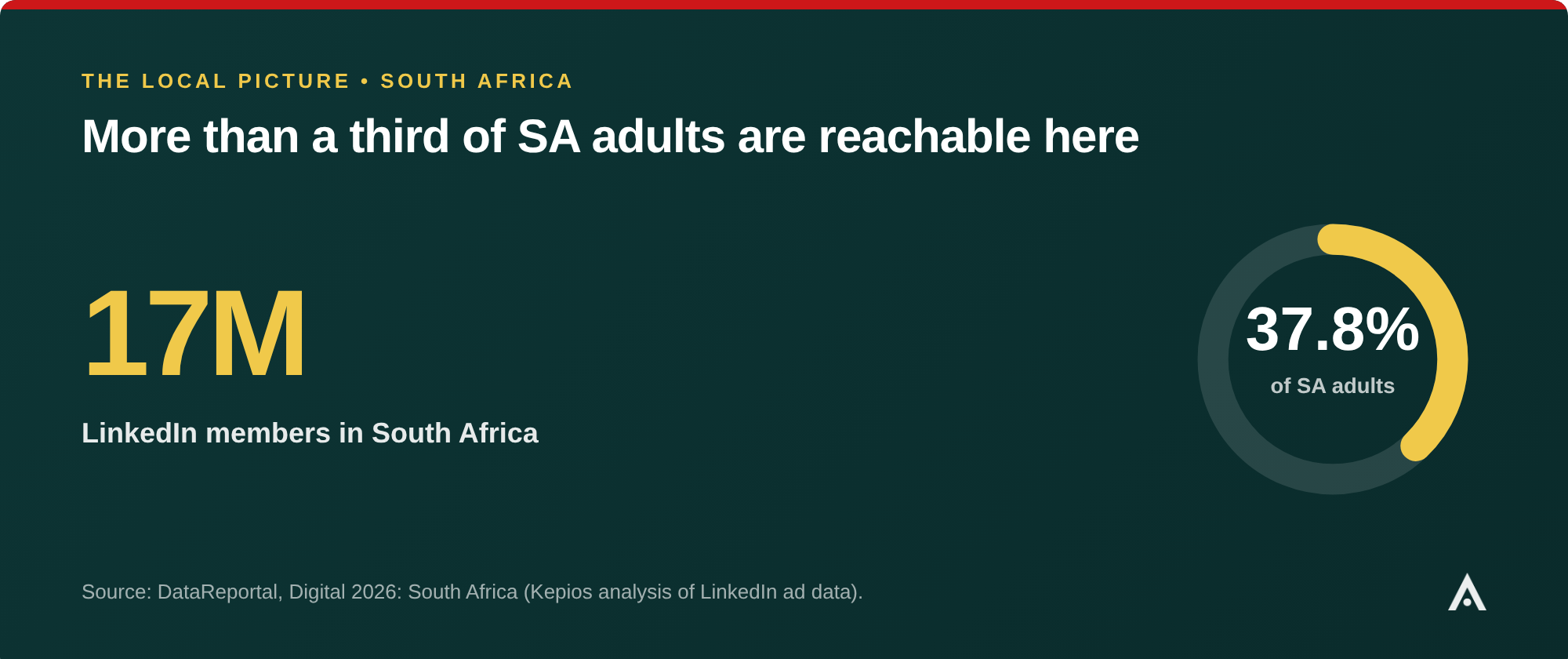
Our take: the global lesson holds locally and the competition for trust is often thinner. A South African B2B brand that commits to genuine thought leadership now can own a credible position before the crowd catches up.
So what should a marketer do now?
Look honestly at whether your marketing is built for reach or for trust. Most is quietly built for reach, and that is the gap between a busy 2026 and a strong 2027. The stats all point the same way: your buyers are here, they are stalling on trust rather than awareness, and the credibility that moves them takes months to build.
That is exactly what a Marketing Audit is for. We look at whether your LinkedIn presence, content and voices are actually building credibility that converts, or just adding to the noise, and we show you where the fixable gaps are before you spend another quarter’s budget. See our LinkedIn marketing services and B2B content marketing pages for how we approach this, or read our guide to LinkedIn video for a closer look at format.
Take the LinkedIn Assessment Email us
The Marketing Audit and the LinkedIn Assessment are paid services, live now.
Why listen to us: our own proof
We do this ourselves, not just for clients. Working this way, we generated 784 webinar registrations, 102,187 organic LinkedIn impressions, and we did it on R0 ad spend. Credibility over reach is not a theory for us, it is how we show up. Curious where you stand? Start with a Marketing Audit.
Editorial note: every figure above is credited inline to its named source, drawn from LinkedIn’s own reporting and from independent analysts including the Content Marketing Institute, Kepios and DataReportal, Statista, Dreamdata, and the LinkedIn and Ipsos Credibility Code research. Benchmark and lab-tested figures vary with industry, offer and creative, so we have flagged those in the text. Confirm the fastest-moving platform numbers against the live sources on the day you act on them.