How to Turn One Blog Post into 10 Pieces of LinkedIn Content (The B2B Content Multiplier)
Published Friday, 25 September 2026 | By LadyBugz Marketing
A practical look at why one well-researched blog post can carry a B2B (business to business, meaning you sell to other companies rather than to individual consumers) brand’s LinkedIn presence for weeks, not just a single share, and what that actually takes.
Key Insights
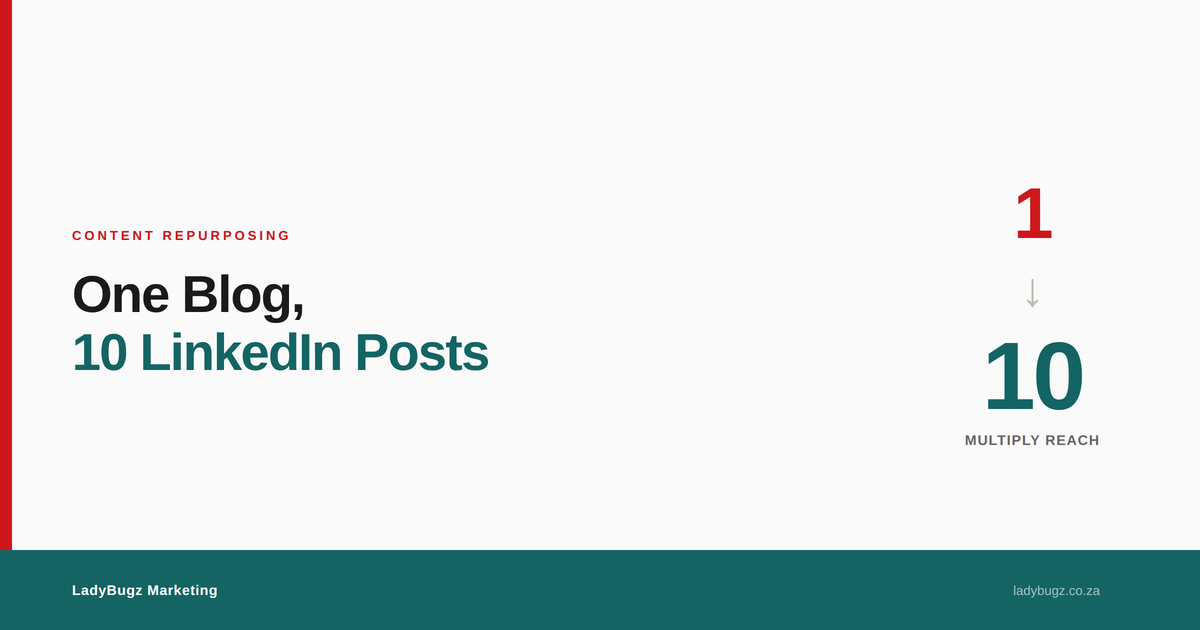
- One blog, roughly ten angles. A solidly researched 1,000 to 1,500 word blog post usually contains enough raw material (a stat, an argument, an example, a lesson, a quote) to seed around ten separate LinkedIn posts, spread over several weeks rather than posted all at once.
- Document posts win the format race. Native document posts (PDFs you upload directly to LinkedIn, which display as a swipeable carousel) recorded a 7.00 percent engagement rate in 2026, the highest of any format, across 1.3 million business posts analysed (source: Socialinsider 2026 LinkedIn Benchmarks report, confidence high; the report itself flags a smaller sample size for this format as a caveat worth keeping in mind). Engagement rate here means the percentage of people who liked, commented on, or shared a post out of everyone who saw it.
- Depth beats spread. LinkedIn’s algorithm now favours accounts that stay narrow on a handful of topics over accounts that post about everything, which is exactly the effect that repurposing one strong blog produces (source: Richard van der Blom, LinkedIn Algorithm Report 2026, confidence high).
- It feeds AI search too. Individual expert profiles are cited roughly three times more often than company pages when AI (artificial intelligence) tools answer B2B questions, so more posts under a real person’s name means more chances of being the answer a buyer sees (source: Meltwater 2026 analysis of 9.5 million citations, confidence high).
- The idea is simple, the execution is not. Most businesses that try this burn through all ten ideas in three days flat, in the same tone, then go quiet again for a month.
You turn one blog post into ten pieces of LinkedIn content by treating the blog as raw material rather than a finished product: pulling out its stat, its argument, its example and its lesson, then giving each one its own post, in its own format, spread across several weeks. Content repurposing, in plain terms, just means taking one piece of work and reshaping it into several different posts instead of writing something new from scratch every time. Do it properly and one afternoon of research and writing can outlive the blog itself by months.
Why one blog post is worth more than one LinkedIn post
A good B2B blog post is dense by design. It usually has a headline argument, two or three supporting points, at least one number worth remembering, and a real example or client story tucked somewhere in the middle. Most businesses use all of that once, in a single post with a link attached, then wonder why LinkedIn “doesn’t work” for them.
When we pull a client’s cornerstone article apart properly, instead of just linking to it, the blog tends to keep picking up steady traffic on its own. The posts built from it often do more in the following weeks: more comments, more shares, and we often find that the repurposed posts reach people who never click through to the original blog at all. Same research, same expertise, several different doors into it.
How many LinkedIn posts can one blog post actually become?
Around ten, if the blog was researched properly in the first place. A thin blog post gives you two or three posts before you start repeating yourself. A blog built on a genuine framework, a real client example, and at least one number worth quoting gives you a stat post, an argument post, a story post, a myth-busting post, a question post, and several more besides, without any of them reading like an advert for the blog.
What types of posts should you create from a blog?
Roughly ten categories of post live inside a good blog. Here is what they look like, at a conceptual level:
The headline number. Your best statistic, standing alone, with the context that makes it matter.
The core framework. The blog’s central idea, laid out step by step as a document post.
The myth-buster. Whatever the blog corrects or pushes back on, sharpened into a single contrarian point.
The client story. The example buried in paragraph six, told properly, with the outcome upfront.
The quotable line. One sentence from the blog, pulled out and given room to breathe.
The open question. Whatever the blog assumes the reader already agrees with, turned back into a genuine question for the comments.
The mistake. The wrong way to do the thing, described honestly, before the blog’s better way.
The behind-the-scenes note. Why you wrote the piece, in your own voice, tied to a real person’s profile rather than a company page.
The follow-up thought. Something you believe but could not fit into the blog without derailing it.
The newsletter mention. A short, personal take on the same topic for anyone who reads your LinkedIn newsletter rather than your feed.
None of these need the blog mentioned by name, and most of them should not be. The moment a post reads as “here is my blog again,” it stops doing its job.
The multiplier mindset: why repurposing beats a fresh idea every day
Most B2B marketers assume LinkedIn rewards volume, so they default to needing a brand-new idea every single day. That assumption is exactly what leads to burnout and a content calendar that quietly empties itself by month two. The stronger approach is picking one well-researched idea and mining it properly, rather than chasing ten separate topics at once.
Why does repurposing work better than writing something new every day?
Because you have already done the hard part once. Research, thinking, and structure are the expensive parts of content, not the typing. A blog post that took real effort to get right has already survived that scrutiny, so every post pulled from it inherits that quality instead of starting from a blank page under deadline pressure, which is usually when the forgettable, templated posts get written.
There is an algorithm reason too. LinkedIn’s own research shows the platform now rewards accounts that stay narrow and consistent on a small number of topics, distributing posts to people outside your existing followers based on subject matter rather than connections alone (source: Richard van der Blom, LinkedIn Algorithm Report 2026, confidence high). Ten posts from one topic, spread over weeks, teaches LinkedIn what you are genuinely expert in far faster than ten posts on ten different subjects ever will.
How do you keep repurposed content from feeling repetitive?
By changing the entry point and the format, not just the wording. A stat leads one post. A question leads another. A client story leads a third. Readers scrolling their feed never see the blog these came from, so they never experience it as repetition. They just see one company that consistently has something useful to say. The repetition only becomes visible if you skip the disassembly step and simply reshare the same paragraph five times with a different opening line.
What actually performs once you have made the ten pieces
That single number tells you something useful: your “core framework” post from the list above, built as a short document rather than a wall of text, is probably the strongest single asset from the whole exercise. It is also the one most businesses skip, because it takes more effort than typing a paragraph and hitting post. If you want the fuller picture of which organic content types work best for B2B, we have covered that separately.
Where the real skill lives, and why we keep the detail in-house
Turning one blog into ten ideas is the easy part. We have just given you the categories above for free. The harder part, choosing which of the ten to run first for a specific brand, how far apart to space them out so they do not cannibalise each other, and how to keep the tone consistent without it reading like a formula, is where our actual process lives. We do not publish that part. Not because it is a secret in the dramatic sense, but because it is the work our clients pay us for, and it took years of trial and error across dozens of B2B accounts to get right.
What is the biggest mistake B2B companies make when repurposing content?
Doing it once. A business posts the blog link with a caption, gets a modest response, and concludes that “content does not work for us.” That single post was never the ten pieces. It was only the announcement that the ten pieces exist. The value sits in the disassembly, not in telling people you wrote something. Companies that treat organic content as their main growth channel, rather than an occasional extra, are the ones who actually see the compounding effect play out.
Your next blog post is worth more than one LinkedIn share. Read it back once it is finished and ask what is hiding in it: the stat, the story, the argument, the mistake. That is not busywork. It is the difference between a business that goes quiet on LinkedIn for weeks at a time and one that has something worth saying every week, without writing something new every week. If you would rather have someone else do the mining, that is the conversation to have with us.
Book a marketing strategy discovery call with LadyBugz and we will show you exactly what is hiding in your existing content, and how far it can actually stretch.
Talk to us: noleen@ladybugz.co.za
LadyBugz Marketing
Editorial note
What is described here comes from our own client work and current LinkedIn research as of late 2026. Engagement rates and platform behaviour move around from one quarter to the next, so it is sensible to sanity-check the specific numbers before relying on them. The approach, mining one well-built blog post for several weeks of content, is what we expect to keep working even as the exact figures shift.
Keep reading