LinkedIn vs Facebook for B2B Marketing in South Africa: Where Should You Spend Your Time?
Published Friday, 25 September 2026 | By LadyBugz Marketing
A straight, sourced comparison of audience, intent and organic reach for South African B2B (business to business, meaning you sell to other companies rather than individual consumers) teams deciding where limited time is best spent.
Key Insights
- If you sell to other businesses in South Africa, LinkedIn deserves the bulk of your organic time. Facebook still has a role, just a smaller and more situational one.
- LinkedIn had 17.0 million members in South Africa by late 2025 (26.2 percent of the population), while Facebook had 27.9 million users (42.9 percent) (source: DataReportal, Digital 2026: South Africa report, confidence high).
- LinkedIn reports that around 80 percent of B2B leads generated through social media come from its own platform (source: LinkedIn Marketing Solutions, a LinkedIn-published figure, treat as directional rather than independently audited).
- B2B buyers now complete the large majority of their purchase journey independently before a salesperson gets involved. Gartner-derived research is commonly cited putting this between 70 and 83 percent, though the exact figure varies by study.
- Organic reach on Facebook business pages has fallen to roughly 0.5 to 4 percent of a page’s followers per post in 2026, and falls further still as a page grows (source: Socialinsider’s 2026 Facebook benchmarks, confidence moderate to high).
What is the real difference between LinkedIn and Facebook for B2B marketing?
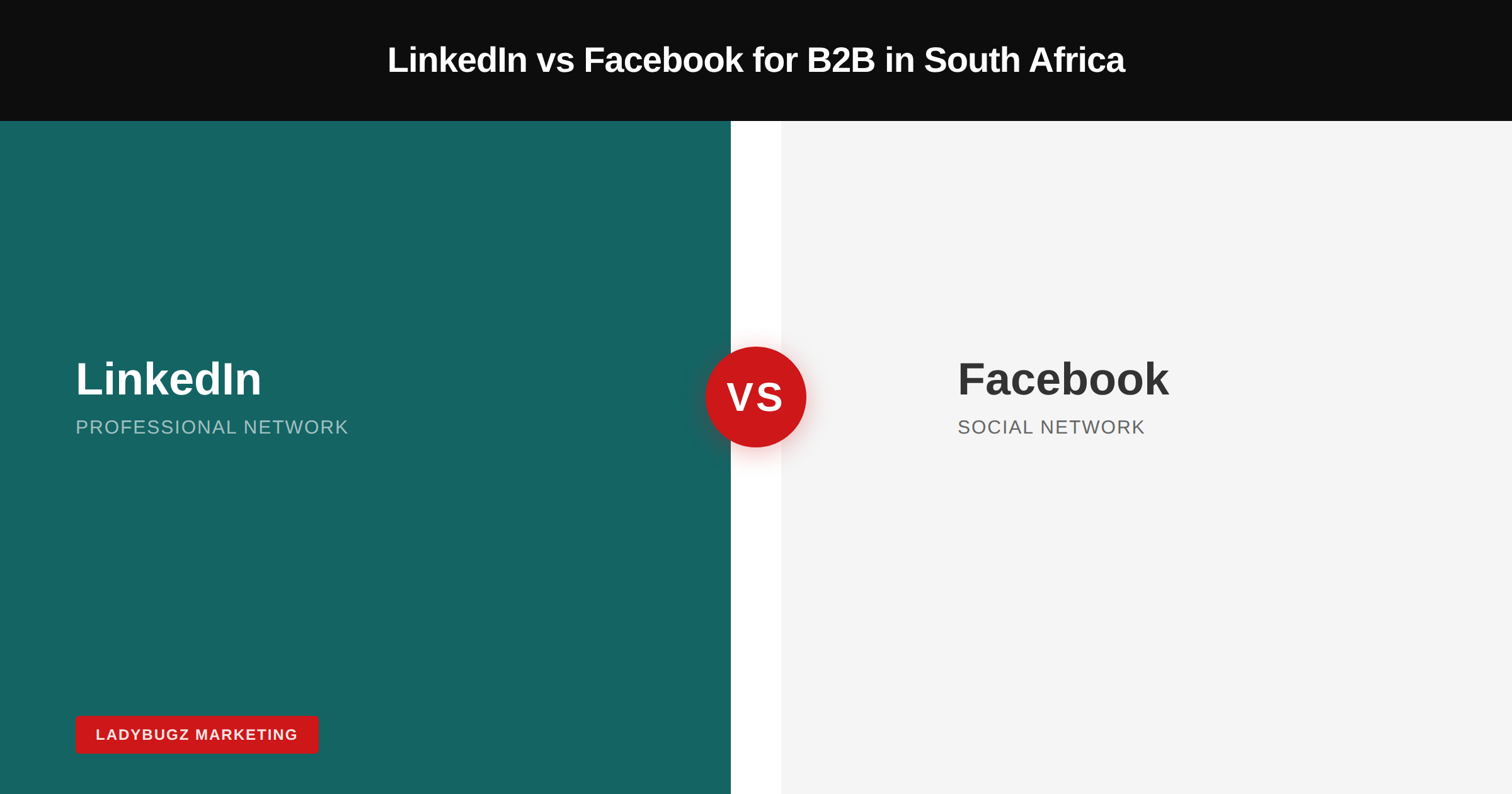
What separates LinkedIn and Facebook for B2B marketing comes down to who is paying attention, and why. LinkedIn is where people show up in a professional headspace, thinking about their job, their industry, and problems they need to solve at work. Facebook is where those same people go to see family photos, community groups, marketplace listings and entertainment. You can technically reach a business decision maker on both. Only one of them already has that person thinking about work when they arrive.
We get asked “should we bother with Facebook at all” almost every month by a South African B2B client, usually because a competitor is posting there and getting attention. The honest answer depends entirely on who that competitor is actually selling to. So rather than pick a side and defend it, here is what actually holds up when you look at the numbers.
Is LinkedIn or Facebook better for B2B in South Africa?
For most South African B2B companies, LinkedIn is the better platform, because it is where buyer intent (how ready someone is to act, based on what they are searching for, reading and engaging with) shows up naturally, in a work context. Facebook can still support a B2B brand in specific situations, but it rarely produces the buying-stage engagement that LinkedIn does.
Where South African B2B buyers actually spend their attention
By late 2025, LinkedIn had grown to 17.0 million members in South Africa, 26.2 percent of the population, while Facebook still held the larger raw base at 27.9 million users, 42.9 percent of the population (source: DataReportal, Digital 2026: South Africa). On paper, Facebook wins on reach. But raw audience size was never the right measure for B2B. What matters is whether the people inside that audience are in a buying mindset when they see you.
This is where Gartner’s research is useful. B2B buyers now complete the large majority of their purchase journey independently, researching options, comparing vendors, forming a shortlist, before a salesperson is ever involved (Gartner-derived research, commonly reported between 70 and 83 percent, exact figure varies by study). If that research happens on LinkedIn, in comments under an industry post, on individual profiles, inside a professional group, and your company is invisible there, you have already lost ground before the first sales call happens.
How many people in South Africa use LinkedIn compared to Facebook?
LinkedIn reached roughly 17.0 million registered members in South Africa by late 2025 (26.2 percent of the population), while Facebook reached about 27.9 million users (42.9 percent), according to DataReportal’s Digital 2026: South Africa report. Facebook’s audience is bigger in raw numbers, but LinkedIn’s is more concentrated with working professionals and decision makers.
Why LinkedIn’s organic reach still favours B2B right now
LinkedIn itself states that around 80 percent of B2B leads generated through social media come from its platform (source: LinkedIn Marketing Solutions). Take that with a pinch of salt, it is LinkedIn’s own number and no platform undersells itself. But it lines up with what we see consistently in our own client work: organic LinkedIn activity keeps producing enquiries long after a single post goes up, because comments and shares put you in front of a second and third audience who never saw the original post.
Facebook has moved the other way. Organic reach on Facebook business pages has slid to somewhere between 0.5 and 4 percent of a page’s followers per post in 2026, and falls further still as a page’s follower count grows (source: Socialinsider, 2026 Facebook benchmarks). If a page has 5,000 followers, that can mean as few as 25 to 200 people actually seeing an unpaid post. For a B2B page without much personal-profile activity feeding it, that number gets thinner still.
Is organic reach really better on LinkedIn than Facebook for B2B content?
Yes, for professional, work-related content aimed at other businesses, LinkedIn’s organic reach mechanics currently reward B2B content more than Facebook’s do. LinkedIn’s algorithm favours the personal profiles and comment activity that B2B buyers actually engage with, while Facebook’s feed is built to prioritise broad, personal engagement rather than professional discussion.
When Facebook still makes sense for B2B
We are not going to pretend Facebook has nothing to offer a B2B business. That would not be honest, and it would not serve you. Facebook earns its place in a few specific situations.
- Employer branding and recruitment. If you are hiring in South Africa, Facebook’s reach into general job-seeking audiences, especially outside the major metros, can outperform LinkedIn, which still skews toward white-collar, office-based professionals.
- Local, community-anchored B2B. If your buyers are small business owners, tradespeople, farmers or independent retailers who run their day-to-day through personal Facebook profiles and local groups, that is genuinely where they are. LinkedIn will not reach them there.
- Staying visible to people who already know you. Facebook, and Instagram under the same Meta umbrella, remains useful for reinforcing familiarity with an audience that has already visited your site or engaged with your brand elsewhere, keeping a relationship warm that LinkedIn may have started.
- Company culture and behind-the-scenes content. Facebook’s more relaxed tone suits team moments, events and community involvement that would feel out of place on a LinkedIn feed built around professional insight.
When does Facebook still make sense for B2B?
Facebook still makes sense for B2B when your actual buyers, not just your general industry, are small business owners or tradespeople who run their day-to-day through personal Facebook profiles and local groups, when you are recruiting broadly, or when you are reinforcing brand familiarity with an audience that already knows you from somewhere else.
Where should a small South African B2B team spend limited time?
Most South African B2B teams do not have unlimited hours for content and social media, so the honest advice is to choose one primary platform based on where your specific buyers make decisions, not on where your industry generally “should” be. If your buyers are managers, directors or specialists researching a purchase at work, LinkedIn earns the majority of your time. Facebook, if you use it at all, should become a smaller, deliberate channel with its own clear reason for existing, not a lower-effort copy of whatever you posted on LinkedIn that week.
Where should a small B2B team in South Africa spend limited time, LinkedIn or Facebook?
A small South African B2B team with limited hours should default to LinkedIn for anything aimed at decision makers, and only add Facebook where there is a specific, named reason for it, such as recruitment or a genuinely Facebook-native buyer group, rather than splitting effort evenly between both platforms.
The hybrid approach that actually works
You do not have to choose one platform forever. The South African B2B businesses getting this right treat LinkedIn as the main channel for reaching decision makers and building the kind of organic presence that generates real enquiries without ad spend, while using Facebook narrowly, for recruitment, community, or staying visible to people who already know them. What does not work is spreading the same generic content thinly across both platforms and hoping one of them sticks. Organic content earns attention when it is built for the platform and the person reading it, not repurposed on autopilot.
The other thing worth saying plainly: this is not a once-off decision. It needs someone treating it as an ongoing discipline, because personal presence on LinkedIn compounds over months, not days, and stopping and starting resets that momentum every time you pause.
Book a LinkedIn training session with LadyBugz and we will show your team how to turn organic LinkedIn into real B2B pipeline, without spending on ads.
Talk to us: noleen@ladybugz.co.za
LadyBugz Marketing
Editorial note
This comparison draws on published platform and industry data from late 2025 and 2026, alongside our own results running LinkedIn for B2B clients in South Africa. Membership numbers and reach percentages move around every few months, so it is worth rechecking the current figures before you quote them elsewhere. The comparison itself, intent beating raw audience size, is what we expect to hold up regardless of what the numbers do next.
Keep reading