Published 17 November 2026 | By Noleen Thompson, Managing Director and Founder, LadyBugz
One webinar gives you five separate chances to start a conversation with a buyer. Most teams plan for one of them, the live hour, and treat the rest as an afterthought.
Key Insights
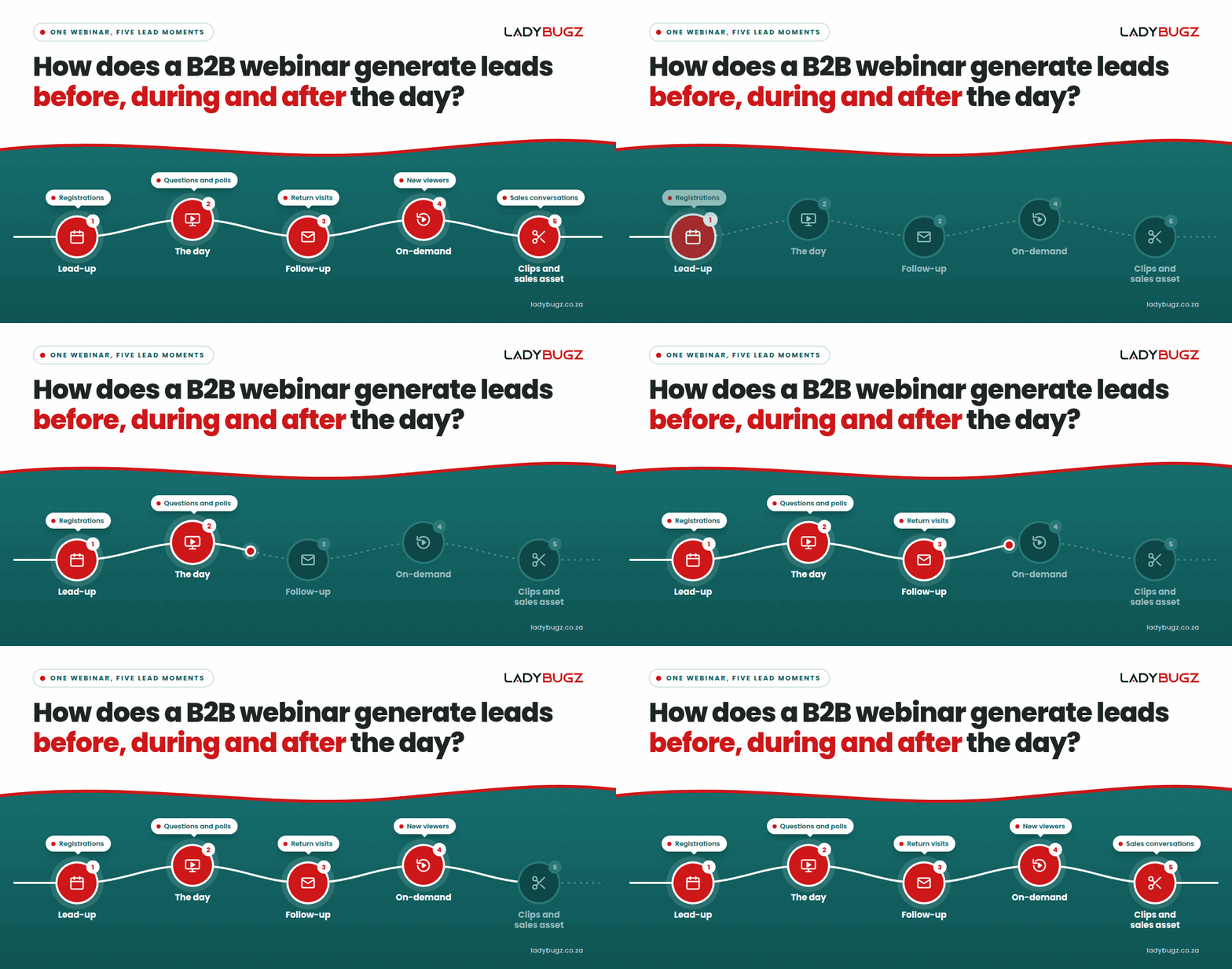
- Five lead moments, not one: a B2B (business-to-business) webinar creates leads in the lead-up, on the day, in the follow-up, on its on-demand page, and through the clips and sales assets cut from it afterwards.
- Most registrants don’t join live: Goldcast’s 2026 B2B Webinar Benchmark Report puts the average attendance rate at 40% across 26,190 webinars run in 2025. Across the client webinars we’ve run, live attendance has ranged from 20% to 68%, and the 68% came from our best thought-leadership session. The rest are still leads.
- Sign-ups come late, so trust has to come early: Livestorm’s 2026 Webinar Benchmarks found that 49.7% of registrations happen in the final week and 15.3% on the day itself.
- Recordings need a push: Goldcast found that 89.1% of webinars were made available after the live event, yet almost one in three of those recordings got no on-demand views at all.
- Thought leadership earns the trust: 73% of B2B decision-makers find an organisation’s thought leadership (a useful point of view on the reader’s problems, not a product pitch) a more trustworthy guide to its capabilities than its marketing materials and product sheets (2024 Edelman and LinkedIn B2B Thought Leadership Impact Report).
- The payoff is real: clients reported 47 sales opportunities from one webinar we ran for them and 47 requests for a security assessment from another, with no paid advertising behind either.
How many chances to generate leads does one webinar really give you?
One B2B webinar gives you at least five chances to generate leads, and only one of them happens during the live hour. When I look back at the webinars we’ve run for clients, a surprising number of the sales conversations started before the session or in the weeks after it.
Lead moment 1: The lead-up. Weeks of useful content draw registrations, and every person who registers on a LinkedIn Event (LinkedIn’s built-in event page) is someone you can connect with.
Lead moment 2: The day itself. The people who join live show you what they care about, through what they ask, how they vote in polls and how long they stay.
Lead moment 3: The follow-up. Everyone who registered, whether they came or not, gets a reason to come back.
Lead moment 4: The on-demand page. The recording lives on your own website, where people who missed it, and people who never heard of it, can find it.
Lead moment 5: Clips and the sales asset. Short clips lead people to the on-demand page, and your sales team gets something useful to send prospects who are wrestling with the same problem.
Each moment feeds the next. Skimp on the lead-up and the day is thin; skip the follow-up and the recording sits there unwatched.
If you’d like a hand planning all five moments for your next webinar, this is the work we do with our clients.
Why does the lead-up matter more than the invitation?
The lead-up matters because people register for a webinar when they already trust the person behind it, and that trust is built by the content they see in the weeks before the invitation arrives.
Reach data from Richard van der Blom’s Algorithm Report 2026 (November 2026 update) shows why the invitation can’t do the work alone. A webinar invitation post reaches about 40% fewer people than the same person’s typical post, while a personal story reaches about 39% more. Useful points of view on the problem your webinar solves travel further than “join us on Thursday”, and they make the invitation feel like the obvious next step.
Here the research and my own view part ways a little. Livestorm found that nearly half of all registrations (49.7%) arrive in the final week, and its report advises concentrating promotion spend in that window. I read the same number differently. My view is that many of those late sign-ups come from people who’ve been reading your content for weeks and finally made up their minds. Take the lead-up content away and I’d expect the late rush to shrink. Two of our published webinar case studies describe the same approach: promotion started weeks ahead, not days.
The lead-up is also where lead generation starts. LinkedIn’s Help Centre confirms that attendees of a LinkedIn Event can see the list of members attending, and calls that list “a great place to start interacting with other attendees, by inviting them to connect.” When someone says they’re coming, a connection request from one of your speakers, with a short note about the session, starts a relationship before the webinar has even begun.
For one business outsourcing firm, four executives promoted the webinar from their own profiles and built new connections with decision-makers in its target industries. Overall, 83% of registrants came from outside the firm and its global network. The business outsourcing webinar case study tells that story.
A connection request is an introduction. Save the pitch. South Africa’s POPIA (the Protection of Personal Information Act, our data privacy law) applies to LinkedIn messages as much as to email, which we unpack in Webinars That Sell Without Selling.
Getting into the diary
A registration only counts if the hour is blocked in the person’s calendar. Senior people live by their diaries, and if your webinar isn’t in there, something else will take the slot.
LinkedIn Events lets attendees add an event straight to their calendar, and the confirmation email can carry a calendar file (an .ics attachment, which most calendar apps open) that LinkedIn says can be used “to add a reminder to your preferred calendar.” Make that step easy to find in every confirmation and reminder. Goldcast’s report is blunt about where attendance goes missing: when registrations are strong but attendance lags, “the gap is usually in your pre-event communication.”
What happens on the day if attendance is lower than you hoped?
Lower live attendance than you hoped is normal. The live hour has a different job: it’s where your most engaged prospects show you, in real time, what they care about.
Goldcast’s benchmark, drawn from 522 B2B organisations, puts average attendance at 40%; Livestorm’s 2025 figure is 47.7%. Across the client webinars we’ve run, live attendance ranged from 20% to 68%. Most of the ones promoted organically, mainly through LinkedIn, sat below those platform averages. My guess at the reason is that organic LinkedIn promotion reaches a lot of curious people who aren’t yet ready to give up an hour. That’s our reading, not a measured fact, and it’s exactly why we put so much weight on what happens after the live session.
The top of that range came from a different kind of session. We ran a practical thought-leadership session for a corporate training and IT skills group that drew more than 900 registrations, and 68% of those people joined live, well above both platform averages. It matches what I’ve seen across our earlier webinars: attendance was highest when clients took our advice and let the session be thought leadership on the audience’s problem, not a pitch for their product.
What matters more than the headcount is what the room tells you:
- Poll answers. In one HR (human resources) technology webinar we ran, 84% of poll respondents said HR should own the talent platform. For a firm selling to HR teams, that was market research on the spot.
- How long people stay. In the same session, 68% of the live audience stayed for 45 minutes or more of a session that ran just over an hour.
- Requests in the chat. Attendees used the chat to ask for a demonstration and for a follow-up session. Your sales team should hear about requests like these the same day.
- A short question at the end. Asking whether people would like to be contacted gives you a list of people who asked to hear from you.
All of this is first-party data, meaning information people give you directly. The HR technology webinar case study has the full results.
How do you follow up with people who registered but did not attend?
Registrants who missed the live session deserve a follow-up as warm as the one you send to those who came. They’re usually the bigger group, and they’ve already told you the topic matters to them.
If 30% of your registrants joined live, 70% didn’t. A meeting ran over, or they forgot, or they always meant to watch later. They still care about the problem. The follow-up works best in two streams:
- People who attended get a thank-you, the recording to rewatch or share with a colleague, and anything you promised during the session.
- People who couldn’t make it get a short note that acknowledges it, one line on what they’ll take away, and a link to the on-demand page.
Then watch who comes back. Goldcast found that more than one in ten live attendees returned to watch the recording afterwards, and it advises treating these returning viewers “as high-intent leads, not passive replays.” Somebody who gives you a second hour of their time is worth a personal follow-up.
Follow-up works best when it’s personal. In one technology consultancy’s webinar series, follow-up for the client’s sales team was planned around how each person had engaged, and the client reported 47 sales opportunities from its February session: nearly one in five of the people who attended live.
If your last webinar left you with a long list of people who registered but never came, we’re happy to help you plan the follow-up for the next one.
What makes a webinar on-demand page work as a lead source?
A webinar on-demand page works as a lead source when it lives on your own website, tells people in a few lines what they’ll learn, and asks for a little information in return for the recording.
Most teams already keep their recordings: Goldcast found 89.1% of 2025 webinars were made available after the event. Keeping a recording isn’t the same as getting it watched, though. Almost one in three of those recordings received no on-demand views at all, and just 2.62% of registrants skipped the live session and watched only the recording. So “I’ll watch it later” mostly stays a good intention unless you bring people back.
That raises the big decision. Should the recording be gated (behind a short form) or public? The data pulls both ways. Livestorm found that public replays get 3.7 times as many views as gated ones, yet 62% of teams gate theirs. Gating trades reach for leads. Our approach is a light gate on the full recording page, just a name and a work email, while the clips, the summary and any article built from the session stay public so they can travel. Our own webinar on AI search works this way: people add their details on the page and the recording opens straight away.
There’s one more reason to give the recording a proper page on your own site. AEO (Answer Engine Optimisation, making your content easy for AI tools such as ChatGPT and Google’s AI Overviews to find and quote) rewards pages that machines can read. A video on its own tells an AI tool very little. A page with a clear title, a summary, the questions the session answered and the speakers’ names gives it something specific to cite when a buyer asks about your topic.
How do short clips and a sales asset keep the webinar selling?
Short clips and a sales asset keep a webinar selling for weeks: the clips lead people to the on-demand page, and the sales asset gives your sales team something useful to send a prospect who has the problem the webinar covered.
Clips. A 60-minute session usually holds a handful of strong moments, like a sharp answer to a hard question. TwentyThree’s State of Webinars 2026 survey of 133 webinar makers found that 68% of organisations now repurpose webinar content into clips and articles, although Livestorm’s own survey puts the share cutting social clips at about one team in three. For our HR technology client, we cut short, captioned highlight clips so the insight reached people who couldn’t attend live.
Decide what each clip is for. Richard van der Blom’s Algorithm Report 2026 found that a link in the post costs reach, so clips meant to build reach do better without one. Clips meant to send people to the on-demand page are a different job, and there the link belongs in the post, where anyone who wants to watch can do it in one click.
The sales asset. This is the stage almost everyone skips. In Livestorm’s late-2025 survey of B2B marketing, sales and leadership professionals, only 9.5% said they cut sales snippets for follow-ups from their webinars. Yet your sales team talks to prospects every week who are struggling with something your webinar covered. Give them a short clip and the on-demand link, with a note they can make their own: “You mentioned supplier risk on our call. Our panel covered exactly this, and the four minutes from minute 22 are worth a look.”
A note like that shows the prospect how your experts think about their problem before anyone asks for a meeting. It matters because buyers decide early. Forrester’s Buyers’ Journey Survey 2025 found that 68% of B2B buyers already have a front-runner vendor in mind at the very start of their purchase, and that the front-runner wins 80% of the time. A useful recording, sent at the right moment, is one of the best ways I know to become that front-runner.
Why should a webinar be about the client, not your product?
A webinar built around the client’s problem is what makes all five lead moments possible, because each one depends on people wanting to be there and wanting to come back.
People connect with a speaker whose thinking they value, and they forward a recording that helped them. A sales rep can send a clip about a prospect’s challenge without it feeling like a pitch. A product demo gives people far less reason to do any of that.
The research supports the approach. Beyond the Edelman and LinkedIn findings on trust, the Content Marketing Institute’s B2B Content and Marketing Trends 2026 research found that marketers rank speaking events and webinars (52%) among their three most effective thought leadership channels, alongside LinkedIn and email newsletters.
I see it in our own attendance figures too. Looking back over our earlier webinars, the sessions where clients kept to thought leadership rather than their product had the highest attendance rates, including the practical session I mentioned earlier, where 68% of more than 900 registrants joined live. The results that followed tell the same story:
- A technology consultancy’s session on third-party and supply chain risk, rather than its software, drew 621 registrations, and the client reported 47 sales opportunities.
- A cybersecurity firm put its own security specialists on stage instead of its marketers. The client reported 47 requests for a security assessment afterwards.
- A business outsourcing firm talked about strategy rather than savings, and prospects then approached it about strategic advisory work, not only task outsourcing.
If you’re shaping a topic and want people to clear their diaries for it, Crafting Engaging B2B Webinar Topics is a good place to start.
Frequently asked questions
How far in advance should you promote a B2B webinar?
Plan in weeks, not days. Livestorm’s data shows nearly half of registrations arrive in the final week, but in my view many of those late sign-ups come from people who’ve been seeing your content for weeks. Early notice also gets the session into busy diaries before they fill.
What is a good webinar attendance rate?
Platform benchmarks for 2025 put the average at 40% (Goldcast) to 47.7% (Livestorm) of registrants. Our own client webinars have ranged from 20% to 68%. Most of the ones promoted organically, mainly through LinkedIn, landed below those averages, while our best thought-leadership session, a practical one with more than 900 registrations, reached 68%. In my experience, attendance is highest when the session tackles the audience’s problem rather than pitching a product. Judge a webinar by the conversations it starts across all five lead moments, not by the live headcount alone.
Should you gate your webinar recording?
Lightly. Ask for a name and work email on the full recording and keep clips and summaries public, so you get both reach and leads.
What should a webinar on-demand page include?
Enough for a stranger to decide in a few seconds whether the recording is worth their hour: what the session covers, who is speaking and what viewers will take away. Add a short form and one clear next step after the recording, and write it all as text on the page so AI tools can read it too.
We tried webinars and they didn’t work. Should we try again?
Usually, yes, but not in the same way. Recently a founder and CEO told me her company had run webinars and they weren’t successful. I suggested she join one of our webinars as a guest first, to see the impact for herself, and she’s agreed. Watch this space for the outcome next year. We’re giving it time on purpose, because so much of a webinar’s result is built in the lead-up, and that takes weeks of useful content, not a single invitation.
Editorial note
Client figures come from our published case studies, where clients are anonymised; some were reported to us by the clients themselves. The one exception is the practical session with more than 900 registrations, which comes from my own records. Benchmarks come from each platform’s own data, and platforms define attendance slightly differently, so treat them as a guide rather than a target.
My advice, over lunch
If I were sitting across the table from you, I’d ask you to plan all five moments before you pick a date. Start the useful content weeks ahead. Get the session into people’s diaries, connect with the people who say they’re coming, and follow up with everyone, including the ones who didn’t show. Then give the recording a proper home on your own website and hand your sales team something they’re proud to send. Run it that way and a webinar keeps working long after the live hour is over.
Plan your next webinar with LadyBugz
Prefer to talk it through first? Email me at noleen@ladybugz.co.za.
Noleen Thompson, Managing Director and Founder, LadyBugz
Keep reading