Published 17 November 2026 | By Noleen Thompson, Managing Director and Founder, LadyBugz Marketing
LinkedIn now says on its own Marketing blog that AI tools cite individual members far more often than company pages. Here’s why, and what it means for your leaders and what they post, and for your customers’ voices.
Key Insights
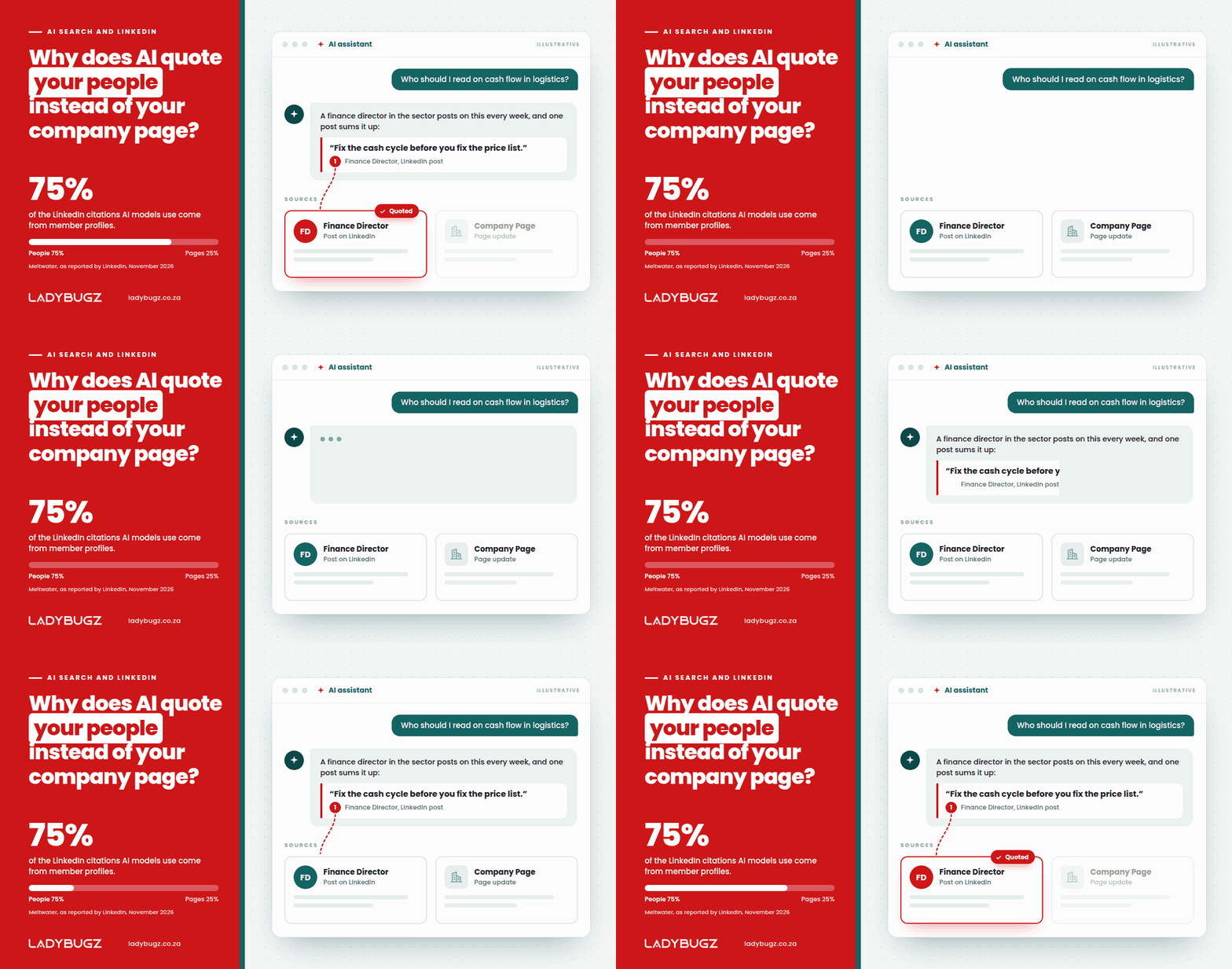
- People are cited three times as often as Pages: 75% of the LinkedIn citations AI models use come from member profiles and 25% from Company Pages (Meltwater 2026, as reported on LinkedIn’s Marketing blog, November 2026).
- Your title counts as authority: LinkedIn says title, company and industry act as “a direct authority signal” for AI models, and C-suite and VP-level articles earn more citations per article.
- You don’t need a huge following: members with fewer than 10,000 followers who post consistently account for 35% of LinkedIn citations in AI answers (Meltwater, as reported by LinkedIn).
- A post’s words help find its readers: LinkedIn’s Engineering blog (9 November 2026) describes a feed system, Profile Relevance, that matches what a post says, plus the author’s country, to an AI summary of each reader’s profile.
- Recommendations outweigh price: in LinkedIn and Bain & Company research with 750 senior B2B buyers, being heavily recommended by customers and colleagues was more than three times as influential as a lower price or a better product in moving a vendor from shortlist to purchase.
AI tools cite your people more than your company page because, as LinkedIn explains it, a named professional with a title, an employer and a track record looks more credible to an AI model than a brand talking about itself. For a B2B (business-to-business) company, that makes your leaders’ and experts’ profiles, and what they post, part of how buyers find you.
I’ve been on LinkedIn since 2009. In June we looked at what 9.5 million AI citations say about LinkedIn content, using Meltwater’s research. In November LinkedIn went further. Its Marketing blog explained why people out-cite company pages, and its Engineering blog showed one of the ways it picks posts for people outside the author’s network. Together they tell a leadership team where to put its effort.
Why does AI quote people more than company pages?
AI tools cite people more than company pages, and LinkedIn’s explanation is that each member’s post is tied to a real, named professional, which AI models read as credibility. In LinkedIn’s words, it “ties every post to a verified identity, complete with employer history, skills, and a professional network”. A company page post doesn’t carry that context.
When an AI tool such as ChatGPT, Gemini or Copilot answers a question, it often names or links the sources it relied on. That’s a citation. Answer engine optimisation (AEO) is the work of making sure AI tools can find you, trust you and cite you.
LinkedIn’s Marketing blog, reporting Meltwater’s 2026 analysis, splits the citations like this:
- Established members with more than 10,000 followers and deep expertise: 40%
- Everyday members with fewer than 10,000 followers who post consistently: 35%
- Company Pages: 25%
That doesn’t make the company page pointless. LinkedIn calls its share “a meaningful supporting role”, and I agree. It just isn’t the voice AI tools cite most.
Curious how your own profile reads to LinkedIn’s AI, and to a buyer who finds it?
What makes a person’s profile count as authority?
A person’s LinkedIn profile counts as authority when it says clearly who they are, where they work and which field they know. LinkedIn’s Marketing blog says title, company and industry act as “a direct authority signal that AI models use to judge credibility”. Articles by the C-suite (chief executives, chief financial officers and other “chief” roles) and vice presidents earn higher citation rates per article than non-executive content.
Reach matters less than you might think. LinkedIn’s summary is short: “expertise and title signals outperform reach”. It adds that AI models favour “topically consistent, active voices over one-off contributions”.
When I looked at my own profile analytics in October, the list LinkedIn calls “Job titles you were found for” showed Search Manager, Client Partner, Recruiter, Service Consultant and Founder. LinkedIn search was matching me to recruiters and search managers, not to the work I do for CEOs and sales and marketing heads. If a profile can drift like that after 17 years on LinkedIn, it can drift for your leadership team too.
On each leader’s profile, check that:
- the headline gives their real title and company, and says who they help
- the About section and skills name the two or three topics they want to be known for
- each current and recent role has a description, not just a title and dates
If your executives don’t have time, our LinkedIn profile management team does this for leaders.
Your posts reach new readers through what they say
LinkedIn now also matches what a post says to each reader’s own profile, as one of the ways it picks posts for people outside your network. Its Engineering blog described this system, Profile Relevance, on 9 November 2026. It works alongside LinkedIn’s other feed signals, such as your network and engagement. It builds an AI summary of each reader from their headline, About section, skills, work history and education, leaving out name and gender. It reads each post from its text, titles and transcripts, adds the author’s country where it has it, and looks for a match. To test the system, LinkedIn grades how well each post fits a reader’s topic, location, job title, company, industry, seniority and education.
Two details matter:
- A post needs one like, comment or share from outside first. It must have “a single viral action (like, comment, or share) from an unconnected member” before this system recommends it.
- Country counts. LinkedIn adds the reader’s and the author’s country so members see more of their “local professional context”.
In LinkedIn’s online tests of the system, the rate at which people hid posts fell 18.8%. And LinkedIn says it now has more than 1.4 billion members, which is a big room to be found in.
Our view: for readers outside your network, the words in the post do much of the targeting. Use your buyers’ own language: their job titles, their industry, the problems they’d recognise. “Financial directors at logistics firms” gives LinkedIn far more to match than “businesses like yours”. Your profile still matters, because it’s what people judge when they click through and what AI tools weigh as authority.
If a leader is about to post more often, check the profile people will land on first.
Why do customer voices matter more now that buyers start with AI?
Customer voices matter more because more buyers now start by describing their own situation to an AI tool, and the proof that holds up is someone like them vouching for you. Research by LinkedIn and Bain & Company with 750 senior B2B buyers found that “being heavily recommended by customers and colleagues” was more than three times as influential as “a lower price” or “a better product” in moving a vendor from shortlist to purchase.
Mimi Turner of the LinkedIn B2B Institute wrote on 30 October that, for the first time, buyers “can front-load AI assistants with their own use case, business context and success criteria”. She advises taking customer stories out of gated white papers and sales decks and organising each one around a situation buyers recognise, such as sector, size and pressures.
People carry a message further than a page does, and we’ve seen it in our own work. For a business outsourcing client, we promoted a webinar through the company page and through four of its executives, who each built new connections with decision-makers in the firm’s target industries. Not a rand went on advertising. As our case study records, 83% of the people who registered came from outside the firm and its global network.
What should a B2B leadership team do about it?
Treat your people’s profiles and posts as part of how buyers find you, and give the right people a reason to show up. The principles we work from:
- Pick the voices. LinkedIn suggests starting with “two or three credible employees”. Senior people carry the strongest title signals; specialists carry the detail.
- Agree the themes. LinkedIn advises choosing “three or four themes” to own and returning to them.
- Fix the profiles first, so title, industry, About and roles point at those themes.
- Write for the reader you want. Name their role, industry and problem in the post.
- Bring customers in. Ask a happy client to tell their story in their own words, somewhere public.
- Keep the page. It carries the brand’s point of view, and Company Pages still earn a quarter of LinkedIn citations.
How often each person posts, and in what mix, depends on the company. That’s the part we work out with each client.
Frequently asked questions
Does our LinkedIn Company Page still matter for AI search?
Yes. Company Pages account for 25% of the LinkedIn citations AI models use, according to Meltwater as reported by LinkedIn, which calls it “a meaningful supporting role”. The page sets the brand’s point of view for your people to build on.
Do you need a big following to be cited by AI?
No. Members with fewer than 10,000 followers who post consistently account for 35% of LinkedIn citations in AI answers, according to Meltwater as reported by LinkedIn.
Does my LinkedIn profile decide who sees my posts?
LinkedIn’s Engineering blog describes one system, Profile Relevance, that matches what a post says, plus the author’s country (taken from the location on their profile), to the profiles of people who might read it. It doesn’t say your profile picks your readers. Your profile matters for credibility when people click through, for LinkedIn search and for AI answers.
A word over lunch
Over lunch, I’d ask you one thing. When a buyer asks an AI tool who knows your field best, whose name would you want it to give? Open that person’s LinkedIn profile and read it the way a stranger would. If it doesn’t say what they know and who they help, start there, before the next company page update.
Start with one profile. Our team reviews it section by section and gives specific recommendations, suggested headlines and About text, and your top three priorities, including how LinkedIn’s AI reads profiles and posts.
Prefer to talk it through first? Email me at noleen@ladybugz.co.za.
Noleen Thompson, Managing Director and Founder, LadyBugz Marketing
Keep reading