Published Thursday, 22 October 2026 | By Noleen Thompson, LadyBugz Marketing
Few B2B (business-to-business) companies lose their brand in one go. They grow past it, one new service and one new market at a time. Here is how to tell when that has happened, and what to fix first.
Key Insights
- Your brand is a reputation: a B2B brand strategy shapes what buyers, your own people and artificial intelligence (AI) assistants such as ChatGPT say about your company when you aren’t there to explain. The logo is one way that reputation shows up.
- Watch for the signs: you have probably outgrown your brand when sales has to explain away the website, or when your directors each describe the company in different words.
- The shortlist is set early: around 90% of buyers purchase from the shortlist they had when they started looking, according to research cited in Bain & Company’s June 2026 report with LinkedIn.
- AI assistants now shape that shortlist: in a March 2026 survey of 1,076 business software buyers by G2, a software review site, 69% had chosen a different supplier from the one they first planned because an AI assistant recommended it.
- Fix consistency before the logo: when your website, LinkedIn page and leaders say the same thing, buyers and AI assistants get one clear answer. On LinkedIn alone, lining up a South African telecoms provider’s company page, its leaders’ profiles and a year of steady posts helped grow its following by 45.5% in 12 months, with no ad spend.
A growing B2B company needs a new brand strategy when the story it tells no longer matches the business it has become, in what it sells and who it sells to. After more than 28 years in sales and marketing, I’ve seen this as both the seller and the buyer. As a buyer, I have moved on to another company or service provider because the website looked old, or because no new articles had been published. When a brand looks like it has stopped, it’s easy to assume the business has too.
What is a B2B brand strategy?
A B2B brand strategy is the set of decisions about what your company stands for and who it is for, written down so that everyone uses the same words. You’ll also hear it called a B2B branding strategy. Same thing. Your logo, colours and fonts (your visual identity) carry those decisions once someone has made them.
People often describe a brand as what others say about you when you’re not in the room. In B2B, more people are in that conversation than most directors realise. Buyers compare you with the alternatives, and your staff describe you to clients and recruiters. Then there are AI assistants such as ChatGPT, or the AI answers at the top of Google, which now summarise your company for anyone who asks.
B2B brand marketing is the work that puts the strategy in front of people, through your website, articles and posts, events and your leaders’ presence on LinkedIn. Strategy comes first. Without it, marketing tends to say something slightly different every quarter.
What are the signs a B2B company has outgrown its brand?
The clearest sign is a gap between how the company sells today and how it presents itself. Five signs to look for:
1. Sales explains the brand away. Salespeople add context before they send the website or company profile, or build their own slides because the official presentation undersells the company.
2. You’ve moved to bigger clients, but your story hasn’t. The business that once sold to smaller firms now wins contracts with large corporates and government departments. The website still speaks to the first kind of buyer.
3. Your directors describe the company in different words. Ask each of them for one sentence on what you do and why clients pick you. If the answers don’t match, buyers are hearing mixed messages too.
4. New services sit awkwardly on the old story. Acquisitions and new offerings get added one by one, until the brand reads like a list of services and the reason to choose you gets buried.
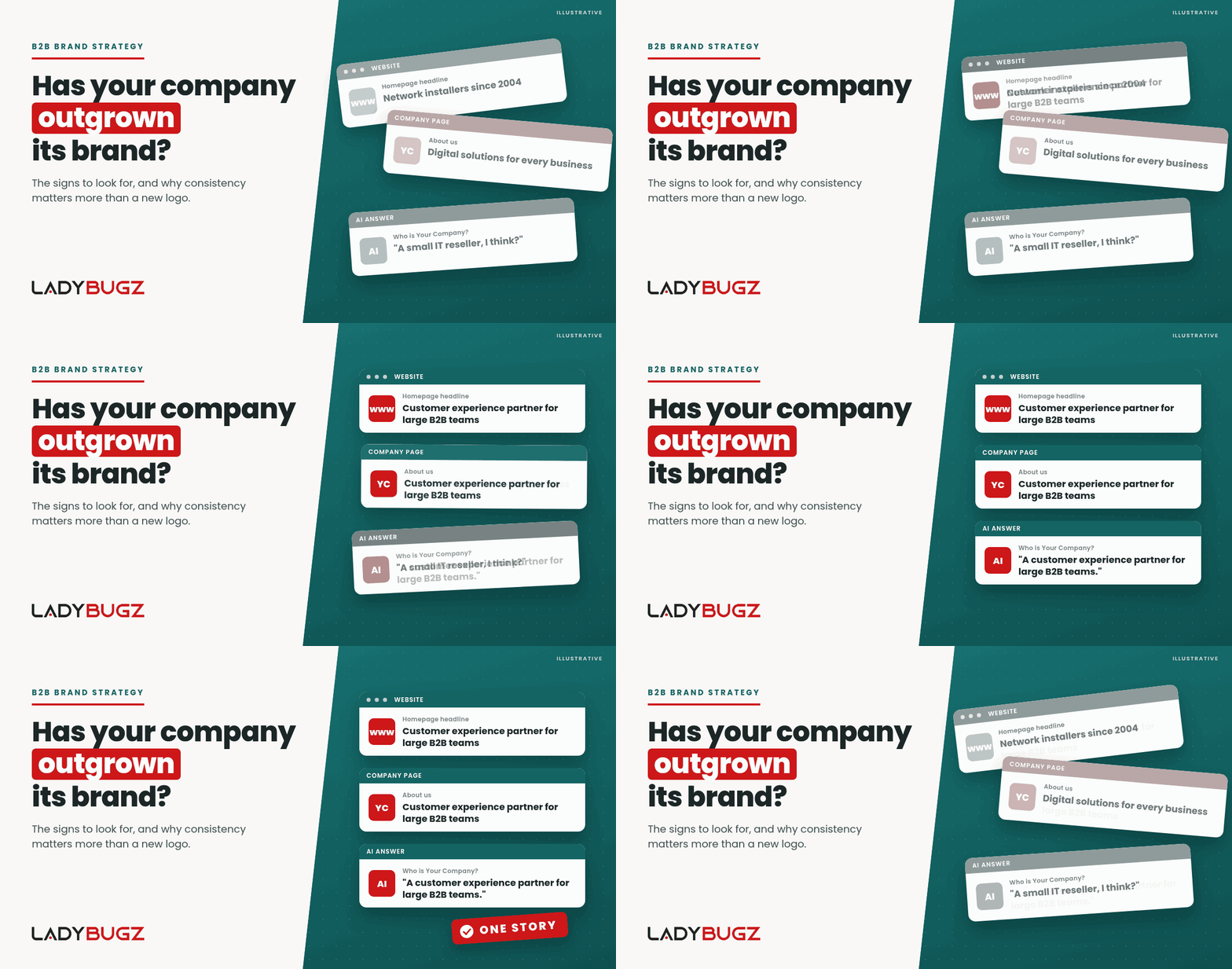
5. AI assistants get you wrong. Ask an AI assistant who your company is and what it’s known for. If it describes the business you were five years ago, or mixes you up with someone else, buyers doing the same research get that answer as well.
None of these is fixed by a new logo. Each one needs a decision about what the company stands for now.
Why does brand matter when B2B buyers compare specifications?
Brand matters in B2B because buyers decide who makes the shortlist before they compare specifications, and that first list usually decides the deal. The management consultancy Bain & Company published “Raising the Odds on a Deal” with LinkedIn in June 2026. It notes that research continues to show around 90% of buyers purchase from their “Day 1 list”, the shortlist they have when the buying process starts.
The same Bain and LinkedIn analysis found that the buying committee (the group of colleagues who decide on a purchase together) often weighs brand reputation and trust above product features, and perceived risk counts too. Anyone who has sat through a big buying decision will recognise this. The person signing a multi-year contract wants a choice they can defend if things go wrong, and a supplier they already know and trust is easier to defend.
Brand awareness means the right people know your name and what you do well before they need you. A B2B brand awareness strategy is the plan for getting there, so you’re on that first list when the need arrives.
What do AI assistants say about your company?
AI assistants say whatever they can piece together from your website, your LinkedIn presence, your people’s profiles and what others publish about you. When those sources agree, the answer is clear. When they don’t, the answer comes out vague or out of date, and sometimes plain wrong.
This is changing fast. G2 surveyed 1,076 B2B software buyers for its March 2026 report “The Answer Economy”. 51% said they now start their research with an AI chatbot, G2’s word for an AI assistant you type questions into, more often than with Google. In G2’s 2025 survey that figure was 29%. The same report found that 85% of buyers think more highly of a supplier when AI includes it in an answer, and 69% had chosen a different supplier from the one they first planned because a chatbot recommended it. These are software buyers, so use the numbers as a sign of where buying is heading rather than a South African benchmark.
Making your company easy for AI assistants to find and describe correctly is called answer engine optimisation (AEO). Our answer engine optimisation work starts with a consistent brand for that reason. An AI assistant can only repeat a clear story if you tell one.
Consistency matters more than a new logo
For a growing B2B company, getting every place a buyer meets you to say the same thing does more than a new logo. When a brand feels tired, the first instinct is often to redesign the logo. In my experience the bigger win is consistency. Put a new logo on an inconsistent brand and you get a fresher-looking version of the same confusion.
Lay these four side by side and read them as a buyer would.
- Your website. Does the homepage describe the company you are today, in words a buyer would use? Look at how it’s laid out as well. Some companies now build their own sites with AI, but the layout and formatting aren’t always right. How easy a site is to read and use shapes how buyers see the business behind it. Our B2B website design projects settle the message before any design starts.
- Your sales material. Company profiles and sales presentations are often among the oldest brand material in a business, and proposals can be just as dated. Potential clients read these before they decide. Updating your marketing collateral (the documents and presentations your sales team hands over) is often where an updated brand shows up first.
- Your LinkedIn company page. Same message, same look, kept up to date.
- Your leaders’ LinkedIn profiles. For many buyers, your directors are the brand. If their profiles say something different from the company page, buyers notice.
We’ve seen what this does in practice. For a South African B2B technology group, we gave the LinkedIn company page a visual identity that matched how the company wants to be seen in its market, and lined up its senior leaders’ profiles with that message. Then, alongside training the team to engage, we kept the posts consistent for a year. The page grew from 16,638 to 24,204 followers in 12 months. That’s a 45.5% increase in LinkedIn followers, with no money spent on ads.
The people part matters as much as the page. When directors and client-facing staff know the story and feel confident telling it, the brand travels further than any company page can take it. Our B2B brand ambassador programme, which helps your people represent the company on LinkedIn, builds that confidence from the person outward.
How to build a B2B brand on what you already have
You build a B2B brand strategy for an established company by starting with what buyers already believe about you. Decide what to keep and what to drop, then say the rest more clearly. Many established companies have more trust and recognition built into their name than they realise, and throwing that away is expensive.
These steps look easy on paper. Getting the directors to agree on one sentence is usually the hard part.
- Listen first. Talk to recent clients, and to a couple of potential clients who chose someone else, and ask why. Their words are usually sharper than anything a workshop produces.
- Agree one sentence. Who you are for, and why they choose you. The directors sign it off, so sales and marketing stop improvising.
- Bring your people with you. Leaders and client-facing staff need the words, and the confidence to use them.
- Fix what buyers see, starting with whatever sits closest to a sale, and leave the visual identity until last. Change it only if it’s holding you back.
Keeping a brand human while the business scales is its own challenge. We explored it with global experts in our Branding Bootcamp webinar, on growing a brand without losing the human touch. You can watch it on demand.
Does a new brand strategy mean a full rebrand?
A new brand strategy doesn’t usually mean a full rebrand. A rebrand changes the name or the logo, sometimes the whole visual identity. A brand strategy refresh changes what you say and how consistently you say it, and often keeps the look you already have.
In my experience, most growing B2B companies need the refresh. A full rebrand earns its place after a merger or a big move into a new market. It can also make sense when the old name confuses buyers.
Frequently asked questions
What is the difference between a B2B brand strategy and a B2B marketing strategy?
A B2B brand strategy decides what your company stands for and how it shows up, and it should hold for several years. A B2B marketing strategy decides how you reach buyers and turn their interest into sales, and it usually changes every year. The marketing strategy should be built on the brand strategy.
How do you build B2B brand awareness without paid advertising?
Show up consistently where your buyers already spend time. For most B2B companies that means LinkedIn, through both the company page and the leaders’ own profiles. One South African telecoms provider grew its LinkedIn following from about 16,600 to 24,200 in a year this way, with an aligned company page, leaders’ profiles and steady posts, and no ad spend.
Who should own the B2B brand strategy?
The managing director and the executive team should own it, with marketing running it day to day. Sales and client service use the brand every day, and so does human resources, so it can’t sit with marketing alone. When only marketing owns the brand, the rest of the business tends to drift from it.
How can we check what AI assistants say about our company?
Ask one directly. Type “Who is [your company] and what are they known for?” into an AI assistant such as ChatGPT, then compare the answer with the first line of your website and your LinkedIn company page. If the three don’t match, the assistant is working from mixed or old information about you.
Here’s a test you can run this week. Ask two of your directors, your newest salesperson and an AI assistant to describe your company in one sentence. If the four answers line up, your brand is in good shape. If they don’t, the gap between them is where your brand strategy starts. If you’d like someone outside the business to run that test properly, across your website, LinkedIn and AI search, that’s what our audit does.
Book your B2B marketing strategy audit
Want to talk through your brand? Contact us at noleen@ladybugz.co.za
Noleen Thompson, Managing Director and Founder, LadyBugz Marketing
Keep reading