Published 20 November 2026 | By Noleen Thompson, Managing Director and Founder, LadyBugz Marketing
Budget season has started for many South African companies. Here’s how marketing and finance, including the CFO (chief financial officer), can agree the numbers that matter before next year’s budget is set.
Key Insights
- CEOs and marketers keep different scorecards: 70% of chief executive officers (CEOs) judge marketing on year-on-year revenue growth and margin, but only 35% of chief marketing officers (CMOs) track those as a top measure (McKinsey & Company, The CMO’s comeback, June 2025).
- Few CMOs see a clear definition of marketing return: only 30% of CMOs believe there is a clearly defined view of what counts as marketing ROI (return on investment), down from 40% in McKinsey’s previous survey (McKinsey & Company, June 2025).
- Marketing is often among the first costs cut: when profits fall short, 53.1% of US companies focus on cutting expenses, and when they do, marketing is cut ahead of other areas 45.4% of the time (The CMO Survey 2026 of US companies, Duke University’s Fuqua School of Business, Deloitte and the American Marketing Association).
- Finance and marketing work together only half the time: at US companies, marketing and finance work together on growth just 49.5% of the time, up from 29.9% three years earlier (The CMO Survey 2026).
- Agree the measures with finance: McKinsey recommends that the CFO and CMO prioritise the KPIs (key performance indicators) together and agree how they’ll be measured and used. In our view, three to five business measures is enough, agreed before the budget is set.
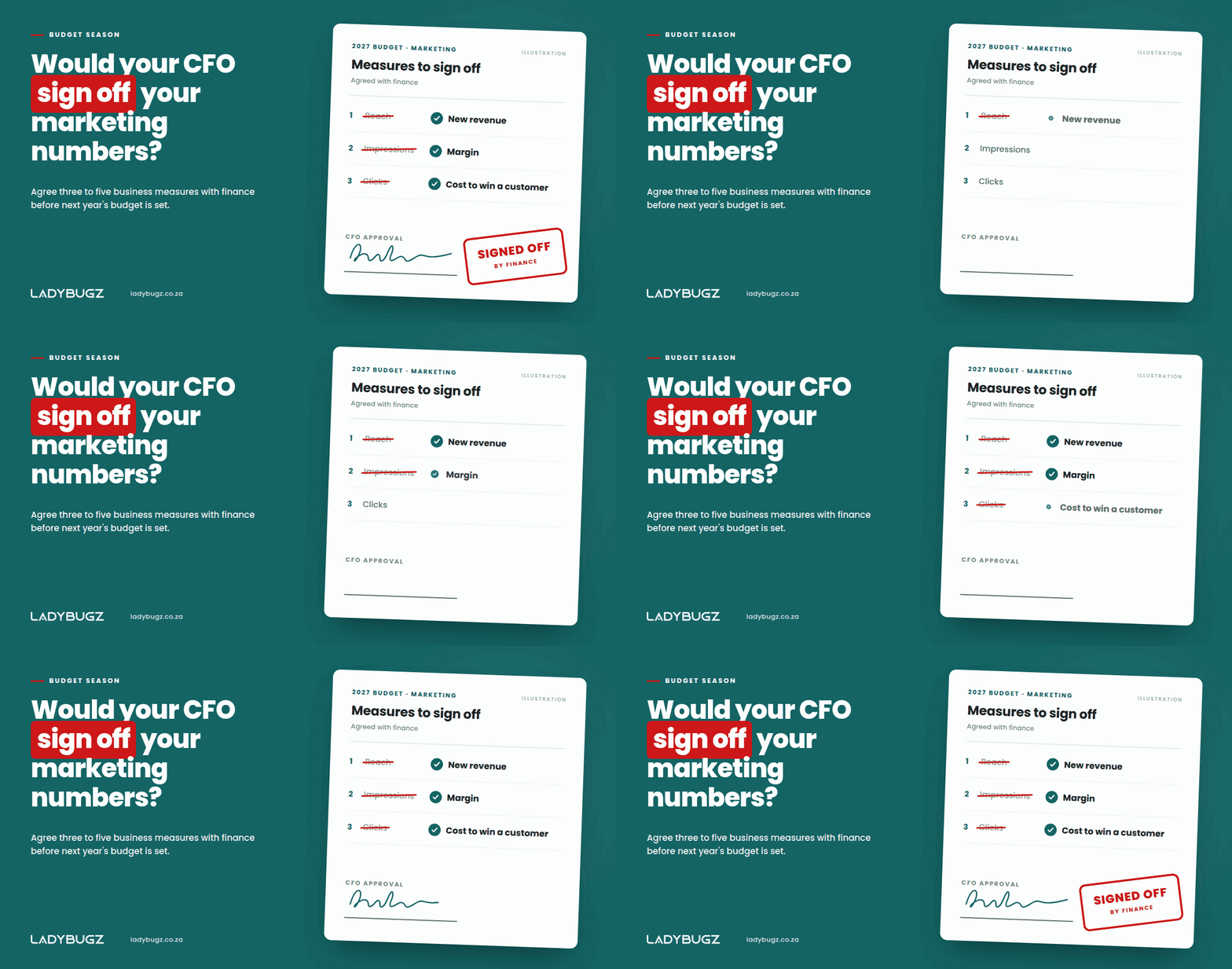
Your CFO will sign off your marketing numbers when they’re the CFO’s numbers too: three to five business measures, such as new revenue, margin and the cost of winning a customer, agreed with finance before the budget is set, with every marketing measure linked to one of them. Reach and clicks still count as early signals. They can’t carry a budget on their own.
I’ve spent more than 28 years in sales and marketing. For many South African companies, next year’s budget conversations start around November, and we’re doing this in our own house too. LadyBugz only started running its own Google Search Console (Google’s report on how a website shows up in search) in June 2026, so as we plan 2027, our own Search Console reports go back only to June. Our client reports are now adding a slide called “what this meant for the business”.
Why does marketing get cut first when budgets are tight?
Marketing is often among the first costs cut, and in our view it’s most exposed when it reports activity, such as reach, impressions (the number of times something was shown) and clicks, while the CEO and CFO judge it on revenue and margin. With two different scorecards, marketing looks like a cost, and costs are what get cut when profits fall short.
McKinsey & Company’s June 2025 report, The CMO’s comeback, found that 70% of CEOs measure marketing on year-on-year revenue growth and margin, while only 35% of CMOs track that as a top measure. One CFO McKinsey interviewed was blunt: “I don’t want to hear about brand awareness if that’s not what we agreed upon as a company goal.”
The CMO Survey 2026 asked 308 marketing leaders at US companies what happens when profits disappoint. At 53.1% of companies, executives focus on cutting expenses, up from 46% a year earlier.
Closer to home, The Growth Equation, a study by the Independent Agency Search & Selection Company (IAS) built on interviews with 40 senior marketers at some of South Africa’s largest organisations, found budget allocation still under pressure, with the demand for measurable short-term returns pushing spend towards performance marketing (advertising judged on immediate clicks and sales), The Media Online reported in July 2026. If your board is already asking hard questions, see how to answer them when your CEO and board have blind spots.
Want an outside view of where your marketing stands before the budget meeting?
Book your Marketing AI Visibility Audit
What does a CFO want to see from marketing?
A CFO wants to see marketing spend turn into revenue, margin and customers who are worth more than they cost to win. Finance judges every investment that way. Marketing is one more on the list.
McKinsey’s report describes an international hospitality company whose marketing team brought in record numbers of new guests, with no idea what happened after a guest’s first stay. It was spending more than US$100 to win each customer, whose expected value was only US$80. Every new customer was destroying value.
The CFO’s question is whether you’re paying more for customers than they’re worth. Customer lifetime value (the total a customer is worth to you over the whole relationship) answers it. A click count can’t.
Click-through rates (the share of people who click after seeing an advert or listing), cost per click and sales-qualified leads (enquiries that sales has accepted as real buying interest) still matter for running marketing day to day. McKinsey’s point is that most executives don’t fully understand how to turn a click-through rate into extra revenue. “Why should they?” the report asks.
A CFO once turned the tables on me. He told me he knew why we need LinkedIn. “Yes, I know why,” I said, “but why do you think we need it?” He said it was because he knows which proposals, RFPs (requests for proposal) and tenders are happening. “Of course you do,” I said. “You’re the CFO, and it’s reported at EXCO (the executive committee).” “No,” he said. “It’s because executives and procurement are looking at my LinkedIn profile.” Branding is a long-term investment, and everyone has to play their part.
How do marketing and finance agree three to five business measures?
Marketing and finance agree their business measures by sitting down together before the budget is set, choosing three to five numbers the business already runs on, and agreeing how each will be measured and used. McKinsey’s advice is that the two prioritise the KPIs together, align on how they’re measured and, most importantly, agree how they’ll be used.
Step 1: Start from the company’s goals. Next year’s revenue and margin targets come first. The marketing plan follows.
Step 2: Pick three to five business measures. For a B2B (business-to-business) company, good candidates include new revenue from new customers, revenue from existing customers, margin, qualified enquiries or tender requests, and the cost of winning a customer.
Step 3: Agree where each number comes from. The CRM (customer relationship management system, where sales records its deals), the accounts or the website. If finance and marketing pull different figures, the meeting stalls.
Step 4: Agree how the numbers will be used. Decide up front what a change in each measure means for the budget, and when you’ll review them together.
Why only three to five? More than that and nobody remembers them, and the budget meeting becomes a debate about which number counts. For the plan these measures sit in, see what a board-ready B2B marketing plan includes.
Want a second pair of eyes on your marketing before you sit down with finance?
Book your Marketing AI Visibility Audit
Link every marketing number to a business number
Every marketing measure should sit on a chain that ends in one of the agreed business measures. If a number can’t be linked, it belongs in marketing’s own working reports rather than the budget meeting. We’ve written about numbers that look good but don’t connect to revenue in why your marketing report is lying to you.
In a simple chain, search impressions lead to website visits, visits to enquiries, enquiries to sales-qualified leads, and some of those to revenue. Report every step of the chain.
Some links take time. The CMO Survey 2026 found that marketing’s effect on customers lasts a median of six months, longer than in 2022, so agree leading indicators (early signals that tend to move before revenue does) with finance up front. McKinsey reports that Norm de Greve, who became General Motors’ CMO in 2023, built a shared measurement framework with the finance team, including what he calls “fast-twitch metrics”, quick-response measures that have become leading indicators for GM.
More steps make the chain harder to see, and a report that credits only the last click before an enquiry undercounts everything before it. In a November 2026 case study in The Media Online, Discovery’s business insights head, Karl Vermeulen, described the problem: “We had strong reporting on delivery and platform-level performance but struggled to disentangle correlation from causation particularly in a complex, multi-channel environment.”
What should you set up now for next year’s budget?
Set up the tracking now, so that by the next budget round you have a full year of numbers finance already trusts. Most of it is simple.
- Capture how every enquiry found you, on the contact form and in the CRM.
- Record each deal’s stage in the CRM, so an enquiry can be traced to revenue.
- Connect Google Search Console and your website analytics if they aren’t running. Analytics history can’t be filled in later.
- Add one page to each monthly report on what the month meant for the agreed measures. It’s the slide our client reports are now adding.
- Diarise a review with finance well before the next budget.
Frequently asked questions
What marketing measures does a CFO care about?
Revenue growth, margin and the cost of winning a customer compared with what that customer is worth. McKinsey & Company found that 70% of CEOs measure marketing’s impact on year-on-year revenue growth and margin (June 2025).
What is marketing ROI?
Marketing ROI (return on investment) compares what marketing helps the business earn with what the marketing cost. Only 30% of CMOs believe there is a clearly defined view of it, McKinsey & Company reports, so agree the definition with finance first.
How many measures should marketing and finance agree on?
In our view, three to five business measures, taken from the company’s own goals, with every marketing measure linked to one of them.
A word over lunch
Over lunch, I’d ask you to do one thing before the budget meeting. Book an hour with your CFO and ask which three numbers they’d use to judge marketing next year. Then show how your plan moves each one. If you can’t yet, that’s the work to do first, and it’s far easier now than in the meeting itself.
Our audit gives you an outside view of your whole B2B marketing strategy, including how visible you are in AI search, reviewed by a LadyBugz strategist.
Book your Marketing AI Visibility Audit
Prefer to talk it through first? Email me at noleen@ladybugz.co.za.
Noleen Thompson, Managing Director and Founder, LadyBugz Marketing
Keep reading