Published Friday, 28 August 2026 | By Noleen Thompson, LadyBugz Marketing
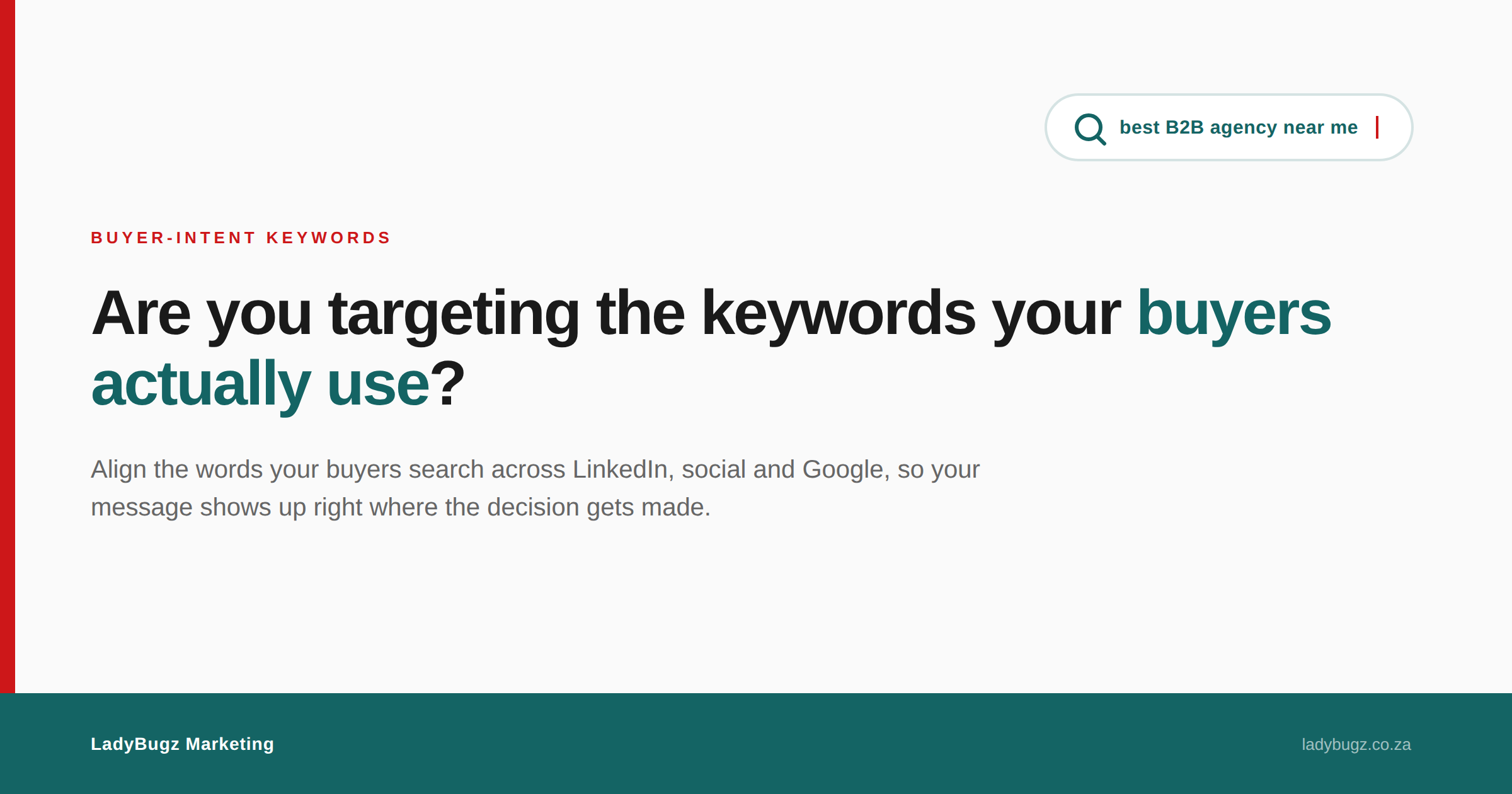
Most B2B companies are not, and it is quietly costing them meetings. They still chase the keywords with the biggest search numbers, when the words that actually win business are the ones a decision-maker types when they are close to buying. Get those words right, then say them the same way on your website, your LinkedIn, and everywhere else a buyer meets you, and the whole thing starts to pull in one direction.
B2B means business to business: you are selling to other companies, not to consumers. It matters here because a B2B buyer rarely buys on impulse. They research quietly for weeks, often without ever filling in a form, so the language they run into along the way does a lot of the selling before you ever speak to them.
Key insights
- High volume is a vanity metric. A keyword with thousands of searches does little for you if the searchers are students, job-seekers, or rivals rather than buyers.
- Buyer intent beats reach. The phrase a decision-maker types near a purchase is lower in volume but far higher in value.
- The shift is real and current. Global Sources set it out well in “How B2B marketers are transforming keyword strategies with buyer intent focus” (2026).
- The miss is channel alignment. Most brands optimise these words on the website only, and forget LinkedIn and their other channels.
- Misaligned channels confuse buyers. When your site and your LinkedIn describe the same service in different words, you sound like two separate companies.
Editorial note: the client examples here are composites drawn from work across several B2B accounts, not any single business.
What is a buyer-intent keyword, and why is B2B moving towards it?
A buyer-intent keyword is a search phrase that signals someone is close to a decision, not just browsing. “What is marketing automation” is curiosity. “Marketing automation setup for a 30-person sales team” is someone with a budget and a problem they want gone.
The idea rests on what marketers call keyword intent: the reason behind a search, not just the words in it. Early, casual searches are top-of-funnel, where the funnel is simply the path from first curiosity to final purchase. The top is wide and vague. The bottom-of-funnel is narrow and serious, the point where someone is comparing real options and almost ready to talk. Buyer intent, sometimes called purchase intent, lives down near that bottom.
For years the standard game was SEO, search engine optimisation, which means shaping your content so it ranks well on a SERP, the search engine results page you get back after a search. The instinct was to win the biggest numbers. Global Sources, in “How B2B marketers are transforming keyword strategies with buyer intent focus” (2026), describes the change well: B2B marketers are moving away from raw search volume and towards the smaller set of phrases that reveal a real buyer. Our reading builds on that, because the volume you see in a keyword tool tells you how many people search. It never tells you who they are.
Why isn’t optimising your website enough?
Because your buyer does not live on your website. They meet your brand in a dozen small moments before they ever reach your homepage, and most of those moments happen somewhere else entirely.
This is the part most companies miss, and it is the heart of how we see it at LadyBugz. Getting your buyer-intent language right on the website is a good start. The real gap is channel alignment: using that same language, consistently, across the website, LinkedIn, and the other places your buyers spend time. A buyer should hear one coherent message whether they find you through a search, a founder’s LinkedIn post, or a colleague’s offhand recommendation.
When we audit a client’s channels, the pattern is almost always the same. The website talks about “managed IT services.” The founder’s LinkedIn talks about “keeping your systems running when everything breaks at 4pm on a Friday.” A prospect reads both and cannot quite tell they belong to the same firm. Each channel might be perfectly good on its own. Put together, they cancel out, because the buyer never assembles a single, clear picture of what you actually do.
There is a bonus to getting this right, and it grows more useful every month. AI search tools, the ones a buyer now asks instead of scrolling a page of blue links, tend to trust brands that say the same thing in more than one place. Earning those AI mentions has a name, AEO, answer engine optimisation, which means being cited by AI search rather than just ranking on it. Consistent language across your channels is one of the plainest ways to earn that trust. We will not push further down that road here, because for most companies the basics come first.
What does channel-aligned buyer-intent language actually look like?
It looks like one short set of buyer-intent phrases that every channel draws from, so your website, your posts, and your profiles all reach for the same words when they describe the same problem.
The principle is easy to state and harder to do well. You work out the handful of phrases a real buyer uses when they are close to deciding. You check that those phrases show up where buyers actually look, not only on a service page nobody visits. You make sure the language on LinkedIn matches the language on the site, so nothing jars as the buyer moves between them. That is the whole idea, in plain terms.
The detailed version, which phrases to choose, how to map them to each stage of the buyer’s journey, and how to weave them into a profile without sounding like a robot, is where we earn our keep for clients. It takes judgement rather than a template, and it is honestly the difference between a tidy keyword list and a set of channels that quietly sell for you while you sleep. That part we do hands-on.
How do you know if your channels are aligned or working against each other?
Honestly, most companies do not know, and that is the real problem. It is very hard to see your own brand the way a buyer sees it, hopping between a LinkedIn post, a Google search, and your website in the space of a single week.
That blind spot is exactly what a LadyBugz marketing audit is built to reveal. We follow your channels the way a buyer moves through them, and we show you where the language lines up, where it clashes, and where a ready buyer is quietly slipping through the gap. Sometimes the finding is reassuring. Often it is the thing nobody in the business had spotted. Either way, you stop guessing.
Every good audit ends with one clear CTA, a call to action, the single next step we ask you to take. Ours is usually small and specific, because a fix you can start this week beats a grand strategy that sits in a drawer.
Frequently asked questions
Are buyer-intent keywords just long-tail keywords?
Not quite. Long-tail keywords are simply longer, more specific phrases. A buyer-intent keyword is defined by the intention behind it, that the searcher is close to buying. Many buyer-intent phrases are long-tail, but length alone does not make a keyword valuable. Intent does.
Does this mean search volume no longer matters?
Volume still has a place, mostly for top-of-funnel content that builds awareness. The point is not to ignore it, but to stop treating it as the main measure. A smaller phrase that a buyer uses will do more for your pipeline than a popular one they never type.
We are a small B2B company. Is this worth it for us?
Often it matters more for smaller firms. You do not have the budget to be everywhere, so the few places you do show up need to say the same clear thing. Channel alignment is one of the cheapest ways to punch above your size.
How is this different from ordinary SEO?
Traditional SEO tends to chase rankings and volume on the website. This approach starts from the buyer’s intent and carries the same language across every channel, not just the site. It is less about ranking for everything and more about being coherent where it counts.
Marketing terms, in plain language
- B2B: business to business, selling to other companies rather than to consumers.
- SEO: search engine optimisation, shaping your content so it shows up well in search results.
- AEO: answer engine optimisation, being mentioned or cited by AI search tools when someone asks them a question.
- Keyword intent: the reason behind a search, not just the words used.
- Buyer intent (or purchase intent): a search that signals someone is close to buying.
- Top of funnel / bottom of funnel: the funnel is the path from first curiosity to purchase; the top is casual browsing, the bottom is a ready buyer.
- SERP: search engine results page, the list of links you get back after a search.
- CTA: call to action, the one thing you ask the reader to do next.
I have lost count of the number of times a client’s LinkedIn and their website read like two different companies. It is one of the most common problems we find, and one of the most fixable.
Noleen Thompson, LadyBugz Marketing
Keep reading