Published Wednesday, 26 August 2026 | By Noleen Thompson, LadyBugz Marketing
Filling the registration list is the easy part. Getting senior decision makers to actually show up, and stay, is where most B2B webinars quietly fall apart, and it is fixable.
Key Insights
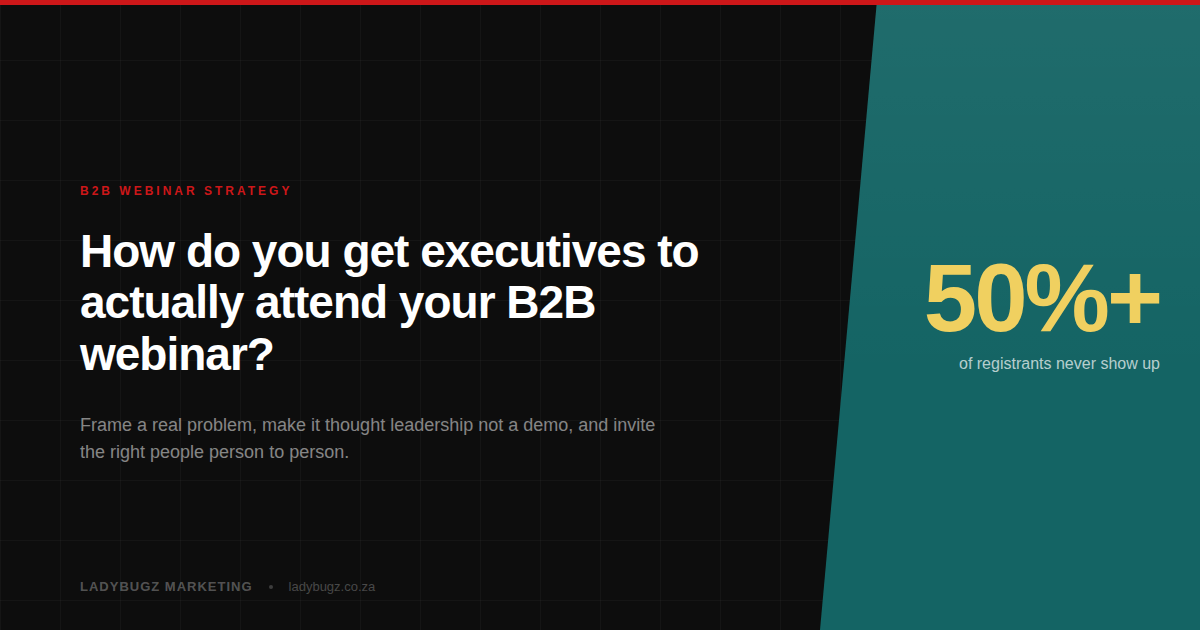
- Registration is not attendance: More than half of the people who register never attend (MarketingProfs), so a big list flatters you and tells you very little.
- Executives attend to make a decision: They clear an hour to fix a broken process or gain confidence in a call they already know they need to make (Logistics Viewpoints), not for a trends update.
- Interactivity is the multiplier: 48 percent of B2B marketers say interactive experiences make thought leadership more impactful (TopRank Marketing).
- Most of the value comes later: Around 43 percent of viewers watch the replay rather than the live event, so plan the on-demand version from day one.
- The topic earns the click, the invitation earns the attendance: Reach senior people person to person and through a segmented sequence, not one broadcast post.
Why do most B2B webinars fail to reach executives?
Because they are built for a general audience, not for the specific decision an executive is trying to make.
A webinar can pull a respectable crowd and still make almost no impression on senior decision makers (Logistics Viewpoints). The usual reasons:
- No executive relevance. The topic speaks to practitioners, not to the person who owns the outcome.
- It is a product pitch in disguise. Executives can smell a demo dressed up as education, and they leave.
- It promises trends. Senior people do not clear an hour for a trends update. They clear it to solve something.
- Virtual fatigue. After years of back to back calls, a long, passive webinar is an easy no.
What kind of webinar will an executive actually attend?
One that frames a real problem they own, and helps them make a decision with more confidence.
Executives attend to figure out how to fix a broken process, or to gain confidence in a decision they already know they need to make (Logistics Viewpoints). That points to a few formats that work:
- The problem-framed panel. Open with a market issue the executive is wrestling with, then bring two or three credible voices to give perspective, not a sales pitch.
- The executive roundtable. Ten to 20 senior leaders in a closed, peer-level discussion. People who would never join a 500-person webinar will accept a small, off the record conversation with peers.
- The thought-leadership session. A genuine point of view on where the industry is heading and what to do about it.
How do you make the topic thought leadership, not a demo?
Build it around the audience’s problem and the decision they face, and keep the product out of the title entirely.
This is a rule we hold to at LadyBugz: the topic must solve a problem, not promote a product. Problem-focused webinars consistently outperform product-focused ones. A few practical tests:
- If your title names your product, rewrite it. Name the problem instead.
- Host under the brand your audience trusts, and give the session a strong facilitator whose job is to represent the audience and keep it useful.
- Ask yourself: would a senior person forward this invitation to a peer? If not, the topic is not sharp enough.
How do you actually invite the right audience?
With a system that combines LinkedIn organic reach and a segmented email or CRM sequence, not a single please-register post. This is the part most people skip, and it is where we spend real effort. Here is the approach we run.
On LinkedIn, organically:
Step 1: Publish the LinkedIn Event early. Early publishing gives the algorithm time to work, and it lets speakers and hosts send personal invitations from their own profiles, which land far better than a company-page post.
Step 2: Warm the audience with build-up content. In the weeks before, the host and speakers post thought-leadership pieces on the exact problem the webinar solves. By the time the invitation goes out, the audience already trusts the voice.
Step 3: Invite person to person. A personal-profile invitation from a credible individual outperforms any broadcast. This is the difference between reach and relationship.
On email and your CRM:
Step 4: Segment first. Do not blast the whole list. Invite the specific personas who own this problem. A smaller, right-fit audience beats a large, mismatched one, and some of the best-performing programmes intentionally limit attendance.
Step 5: Run reminders, not a single email. A well-timed set of reminders in the days and the final hour before the session recovers a meaningful share of the no-show gap.
The point is simple: the topic earns the click, but the invitation system earns the attendance.
What happens after the webinar matters as much as the webinar
Plan the replay and the follow-up before you go live, because most of the value arrives after the session.
- Plan for on-demand from day one. Record it properly and give it a home so the replay audience can find it.
- Repurpose it. One good session becomes five or more pieces: short clips, an article, a quote graphic, an email, a LinkedIn post.
- Give one specific call to action. Not contact us. A booking link, an assessment, a resource. Make the next step obvious and small.
The takeaway
If your webinars fill the room but never move a senior decision maker, the problem is rarely the platform. It is that the topic was built for a general audience and the invitation was a single post. Frame a real problem, make it thought leadership rather than a demo, and invite the right people person to person and through a segmented sequence. Fewer, better-fit attendees will always beat a big list that never shows.
Marketing terms, in plain language
- B2B: business to business, selling to other companies rather than to consumers.
- CRM: customer relationship management, the system or list where you keep your contacts and their history.
- On-demand: the recorded webinar people watch later, in their own time.
- Thought leadership: content that shares a genuine, useful point of view, positioning you as a trusted expert rather than a salesperson.
- CTA: call to action, the one thing you ask the reader or attendee to do next.
Noleen Thompson, LadyBugz Marketing
Keep reading