Published Sunday, 30 August 2026 | By Noleen Thompson, LadyBugz Marketing
Free access to the LinkedIn Social Selling Index (SSI) is closing. Here is what changed, what free users see now, and what to measure instead.
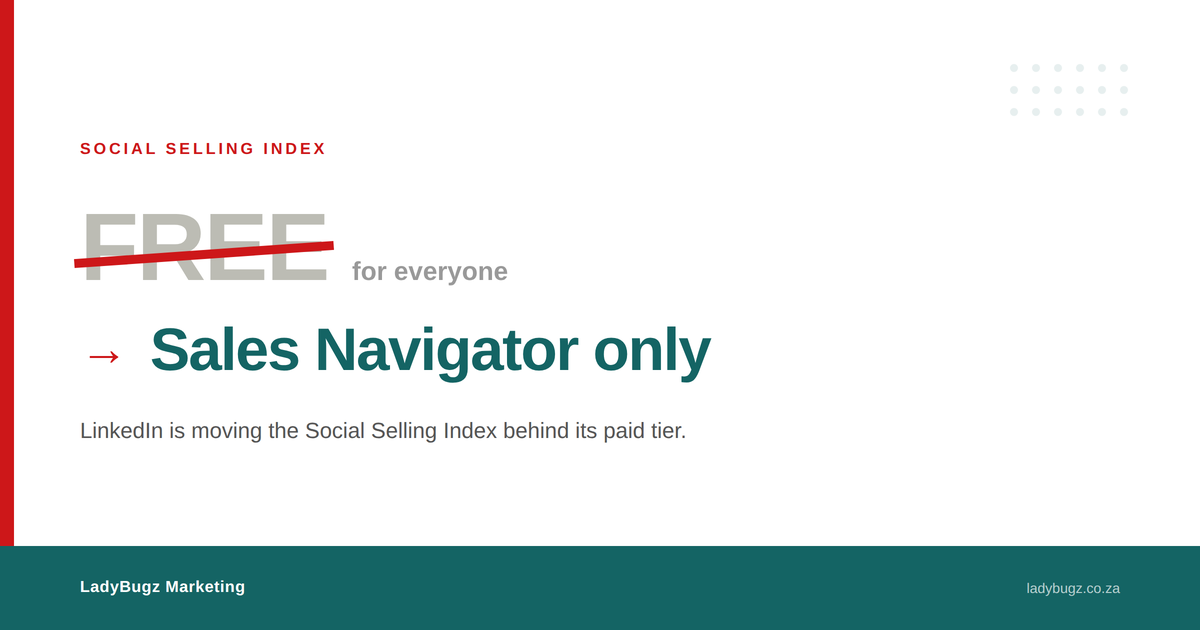
Short answer: free access to the LinkedIn Social Selling Index (SSI) is being taken away. As of the week of 30 August 2026, LinkedIn accounts without a paid subscription are seeing a notice that SSI is becoming a Sales Navigator feature, and the free dashboard has stopped showing a score. If you have leaned on that number to judge your LinkedIn performance, that free window is closing.
Key Insights
- Free SSI is going away: LinkedIn is moving the Social Selling Index behind Sales Navigator, its paid subscription.
- Free users already see less: on a non-premium account this week, the SSI page shows a deprecation banner and no score (LadyBugz first-hand observation, August 2026).
- The score was always a proxy: SSI measures activity, not outcomes, so a high number never guaranteed pipeline or revenue.
- What to do: measure signals you own in your CRM and analytics, and connect LinkedIn effort to replies, calls booked, and opportunities created.
The Social Selling Index (SSI) is LinkedIn’s own 0 to 100 score. It rates you across four areas (establishing your professional brand, finding the right people, engaging with insights, and building relationships) based on your activity over the last 90 days. For a long time you could check it free at linkedin.com/sales/ssi. That is what is changing.
What is the LinkedIn Social Selling Index (SSI)?
The Social Selling Index (SSI) is LinkedIn’s own 0 to 100 score for how well you use the platform to sell. It is built from four components, each worth up to 25 points: establishing your professional brand, finding the right people, engaging with insights, and building relationships. LinkedIn works it out from your activity over a rolling 90 day window, so the number moves as your behaviour moves.
For years it lived at a free URL, and plenty of B2B (business to business) sellers treated it as a quick health check. Hit 70 and you felt good about yourself. Slip to 45 and you told yourself to post more. It was never a revenue figure, but it was easy, visible, and free, which is exactly why so many teams anchored to it.
What changed in 2026?
LinkedIn is moving SSI behind a paywall. Free access is being discontinued, and the score is becoming a feature of Sales Navigator, which is LinkedIn’s paid sales subscription.
This did not come out of nowhere. Back in 2025, LinkedIn rebranded its own SSI resource page to “From SSI to AI”, arguing that a single activity score no longer reflects how modern selling actually works (LinkedIn’s own “From SSI to AI” resource, 2025). The company had been quietly playing the metric down for a while. What we are seeing now looks like the next step: not just talking the score down, but gating it.
Can you still see your SSI, and what do free users see now?
On a non-premium account this week, no. I checked our own free LinkedIn account on 30 August 2026 and the SSI page no longer showed a score (LadyBugz first-hand observation, August 2026). Instead of the familiar dashboard, two things appeared.
If you can still see your SSI, you may already be on Sales Navigator, or the rollout simply has not reached your account yet. Either way the direction is clear. The free number that a lot of people have quoted in reports and pitches is on its way out for anyone not paying for Sales Navigator.
Why an activity score was never the full picture
Here is the uncomfortable part, and it has nothing to do with the paywall. SSI measures activity, not outcomes. It rewards you for showing up: posting, making connections, leaving comments. It says nothing about whether any of that turned into a conversation, a meeting, or a signed deal.
You can score 80 and close nothing. You can sit at 50 and build a pipeline that pays your salary. I have watched both happen. A high SSI can even flatter a busy team into thinking the LinkedIn work is handled, while the real question, did this create demand, goes unasked. LinkedIn’s own “From SSI to AI” framing more or less concedes the point: the score was a proxy for good habits, and proxies drift away from the thing you actually care about.
So the loss of a free SSI is not really the problem worth losing sleep over. The habit of steering by a vendor’s proxy score is.
What B2B teams should measure instead
The principle is simple to say and harder to live by: measure signals you own and that connect to outcomes, rather than a number a platform can rename, gate, or switch off.
In practice that means tying your LinkedIn effort to things further down the funnel. Are the right people from your target accounts actually engaging? Are those interactions turning into replies, calls booked, and opportunities created? Is your content moving people you can name closer to a buying decision, or just collecting applause from peers? Those answers live in your own systems, your CRM, your analytics, your inbox, which means no platform can take them away from you.
We will not lay out our full measurement framework here, because building it for a specific business is the work we get paid to do. But the shift itself is open to anyone: treat your own outcome data as the scoreboard, and let a borrowed vendor score fade into the background where it belongs.
How LadyBugz helps you build measurement that survives platform changes
This is exactly the kind of change we watch for. When a platform quietly moves a free metric behind a paywall, the teams that get caught out are the ones who built their reporting on it. The teams that shrug it off are the ones already measuring what matters to their business.
At LadyBugz Marketing, we help B2B teams design a LinkedIn measurement approach that does not depend on any single vendor score, so the next time a platform changes the rules, your reporting still stands. We connect your activity to outcomes you own, and we keep the method yours.
If your LinkedIn reporting leans on SSI, now is a sensible moment to look again, before the free number disappears from your account too. Take the LadyBugz LinkedIn Assessment, a paid review that shows you how your profile and presence are really performing, and where to focus now that SSI is going premium.
Keep reading