Published Tuesday, 12 August 2026 | By Noleen Thompson, LadyBugz Marketing
LinkedIn has released its official guide to AI search visibility for B2B marketers. Here’s what it means for your business, and what to do about it right now.
Key Insights
- AI is replacing traditional search: 94% of B2B buyers now use generative AI for research, and traditional search volume is projected to drop 50% by 2028 (6sense; Gartner).
- LinkedIn is the #1 cited professional source: LinkedIn is the most-cited domain for professional queries in AI search results, according to Profound’s 2026 analysis.
- People beat company pages: 75% of AI citations come from individual member profiles, not company pages (Meltwater, 2026). Your team’s personal profiles matter more than your brand page.
- Articles massively outperform posts: LinkedIn articles generate approximately 60% of all citations, with Meltwater’s research showing articles earn 6.5x more AI citations than standard posts.
- Expertise trumps follower count: 51% of AI citations come from members with fewer than 10,000 followers (Meltwater, 2026). Demonstrated knowledge wins over audience size.
- AI picks up content fast: The median time to citation is just 6.81 days, with 90% of citations happening within 37 days of publication (Profound, 2026).
Why Has LinkedIn Published an AI Search Visibility Guide Now?
Because the shift is already happening, and most B2B marketers aren’t ready for it. LinkedIn’s own non-branded search traffic has declined by up to 60%, according to Davang Shah, VP of Marketing at LinkedIn. That’s not a future prediction; that’s happening right now.
The B2B buying cycle has compressed from 11.3 to 10.1 months (6sense, 2025), and buyers are increasingly turning to AI tools like ChatGPT, Perplexity, and Google’s AI Overviews to do their research. Gartner projects that traditional search volume will drop 50% by 2028. Meanwhile, 90% of CEOs already identify AI search as a priority (Forrester), but only 34% of B2B tech marketers feel prepared for it (eMarketer, 2026). Over half (51%) cite limited internal knowledge as the main barrier.
LinkedIn’s guide is essentially an admission: the platform itself is being disrupted by AI search, and it’s telling its users how to stay visible in this new landscape.
What Makes LinkedIn Content Visible to AI Search Engines?
Structure and specificity. AI answer engines don’t browse content the way humans do; they extract structured information they can cite with confidence.
Meltwater’s analysis of 9.5 million AI citations across six major AI models reveals a clear recipe for citable content:
- Lists and bullet points: Present in 100% of highly cited content
- H2/H3 headings: Found in 92% of cited content
- Named entities (specific people, companies, tools): Present in 75%
- Hard data (percentages, figures, research citations): Found in 67%
The formats that get cited most are “Best X” listicles (54% of citations), comparison guides (50%), and “How to Choose” frameworks (33%). If your LinkedIn content reads like a vague thought piece with no specific claims, AI engines will skip right past it.
One critical finding from LinkedIn’s guide that many marketers will miss: company page articles are visible to AI search, but company page newsletters are not. If you’ve been investing heavily in LinkedIn newsletters for your brand, that content is invisible to AI answer engines. Articles are the format that gets picked up.
Do You Need a Big Following to Get Cited by AI?
No. This is one of the most important findings in both LinkedIn’s guide and the supporting research. Follower count matters far less than demonstrated expertise.
Meltwater’s 2026 research found that 51% of AI citations come from LinkedIn members with fewer than 10,000 followers. That’s a fundamental shift from how social media has traditionally worked. You don’t need to be an influencer; you need to be a knowledgeable professional who publishes structured, specific content.
This levels the playing field for South African B2B professionals. A specialist consultant in Johannesburg with 800 followers who publishes data-backed articles about their niche has the same chance of being cited by ChatGPT as a thought leader in New York with 50,000 followers, provided the content is structured for AI extraction.
What Should B2B Marketers in South Africa Do Right Now?
LinkedIn’s guide, combined with the Meltwater and Profound research, points to a clear action plan:
Step 1: Shift from posts to articles. Articles generate approximately 60% of LinkedIn’s AI citations, and Meltwater’s data shows they earn 6.5x more citations than posts. If you’re only posting short updates, you’re invisible to AI search. Start publishing long-form articles on LinkedIn with clear headings, specific data, and structured lists.
Step 2: Invest in personal profiles, not just the company page. With 75% of citations coming from individual members, your team’s personal LinkedIn presence is your biggest AI search asset. Help your sales team, consultants, and subject matter experts publish under their own names.
Step 3: Structure every piece of content for extraction. Use H2 headings as questions. Open each section with a direct answer. Include specific numbers, name your sources, and use bullet points. This is exactly how AI engines decide what to cite.
Step 4: Publish articles, not newsletters, from your company page. LinkedIn newsletters from company pages are not indexed by AI search. If you want your brand content visible to AI, publish it as an article instead.
Step 5: Be consistent and specific. The median time to AI citation is just 6.81 days (Profound, 2026), and 90% of citations happen within 37 days. AI search rewards recency and specificity. Publishing one well-structured, data-rich article per week will build your AI search presence faster than sporadic thought leadership posts.
Why Does AI Search Visibility Matter for South African Businesses?
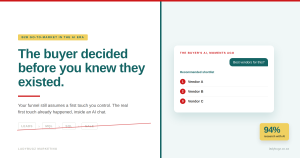
Because your potential clients are already using AI to research suppliers, consultants, and service providers. With 94% of B2B buyers using generative AI for research (6sense), the question isn’t whether your prospects will search for you using AI; it’s whether AI will find you when they do.
South African B2B businesses have historically relied on Google search, referrals, and LinkedIn connections. All three channels are being disrupted. Google’s own AI Overviews are changing how search results appear. Referral networks are going digital. And LinkedIn’s algorithm now favours expertise signals over connection-based distribution.
The businesses that adapt their LinkedIn strategy now, structuring content for AI extraction, investing in personal profiles, and publishing consistently, will be the ones AI recommends when buyers ask “who can help me with X in South Africa?”
How Does LinkedIn Training Help With AI Search Visibility?
Most LinkedIn training still focuses on engagement tactics: how to write posts that get likes, how to grow your follower count, how to use hashtags. That approach is becoming less relevant as AI search reshapes how buyers discover businesses.
At LadyBugz Marketing, our LinkedIn training already covers AI search visibility as a core module. We train teams on how to structure profiles and content so that AI answer engines can find, extract, and cite their expertise. This includes article writing frameworks, profile optimisation for AI extraction, and content planning that builds cumulative AI search presence.
LinkedIn’s own guide validates what we’ve been teaching: the future of B2B visibility isn’t about gaming an algorithm. It’s about being genuinely useful, structured, and specific, so that when AI tools answer professional questions, your expertise is what they recommend.
Want to get your team’s LinkedIn presence ready for AI search? Contact us at noleen@ladybugz.co.za for LinkedIn training that covers AI search visibility, content structuring, and profile optimisation for the new search landscape.
Noleen Thompson, LadyBugz Marketing
Keep reading