Published Wednesday, 13 August 2026 | By Noleen Thompson, LadyBugz Marketing
AI isn’t just changing how people find your business. It’s changing how they decide to buy from you. Here’s why most B2B companies are optimising for the wrong signals on both fronts, and what to do about it.
Key Insights
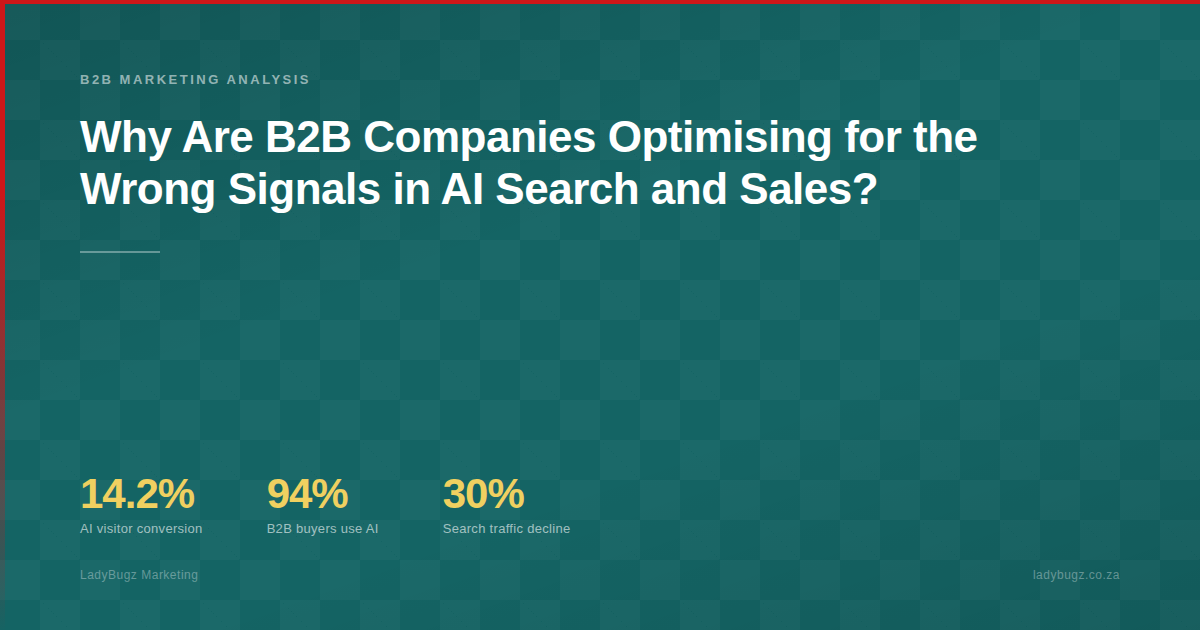
- AI visitors convert 5x higher: AI-referred visitors convert at 14.2% versus 2.8% for traditional organic search, yet 62% of brands are still optimising for old SEO signals (Fuel AI Index, 2026).
- B2B buying is going autonomous: 80% of B2B tech buyers now use AI agents in purchasing, and 74% of companies plan to assign procurement decisions to AI within two years (IDC, 2026).
- Search traffic is collapsing: Traditional search volume dropped 30% year-on-year, the largest decline ever recorded, with Gartner predicting a 50% drop by 2028 (HubSpot/Gartner, 2026).
- LinkedIn dominates AI citations: LinkedIn is the #1 most-cited domain for professional queries, with articles earning 6.5x more AI citations than posts (Profound/Meltwater, 2026).
- Content quality crisis: 49% of consumers say generative AI has made content quality worse, and 65% detect AI content within seconds. Original research converts at 5.7% versus 1.6% for standard blog posts (Gartner/HubSpot/B2B Marketing, 2026).
- The human seller is disappearing: 75% of B2B buyers now prefer a rep-free experience, while only 28-43% of salespeople hit quota (Gartner/Salesforce, 2024-2026).
What Does “Optimising for the Wrong Signals” Actually Mean?
Most B2B companies are still pouring budgets into traditional SEO: keyword density, backlink profiles, meta descriptions. The problem? AI answer engines don’t use those signals the same way Google’s old algorithm did.
According to Meltwater’s analysis of 9.5 million AI citations across six models, AI engines prioritise structured content with lists (found in 100% of cited content), H2/H3 headings (92%), named entities (75%), and hard data points (67%). That’s a fundamentally different recipe from traditional SEO.
Meanwhile, the Fuel AI Index found that AI-referred visitors convert at 14.2%, compared to just 2.8% for organic search. That’s a 5x difference. Yet 62% of brands are still optimising for the old signals.
The numbers paint a clear picture: search engines used for brand research have dropped from 51.3% to 45.8% in just 18 months (DataReportal, 2026). HubSpot reports a 30% year-on-year decline in traditional search traffic. And 30-60% of US searches now trigger AI Overviews, meaning Google itself is replacing the links you’ve been optimising for.
How Is AI Changing B2B Buying Decisions?
The disruption goes far beyond search. IDC research shows that 80% of B2B tech buyers now use AI agents in their purchasing process, and 74% of B2B tech companies plan to hand procurement decisions to AI within two years. These aren’t humans browsing your website. They’re algorithms evaluating your content, pricing, and credibility programmatically.
Forrester confirms the trend: 94% of B2B buyers use AI in purchasing decisions, and AI answer engines now outrank both websites and sales reps as the number one research source. The typical B2B purchase involves 22 people (Forrester, 2026), and buyers consume 13.4 pieces of content before contacting sales (B2B Marketing, 2026). Two-thirds of that buyer journey, 67%, is entirely self-directed.
This means your content isn’t just competing for a human reader’s attention. It’s competing to be the content that AI agents select, summarise, and recommend to procurement committees. If your content doesn’t follow the structure that AI can parse and cite, you’re invisible to both the human and the algorithm making the shortlist.
Why Is Traditional Sales Failing at the Same Time?
While marketing teams optimise for the wrong search signals, sales teams face their own crisis. Only 28-43% of salespeople hit quota (Salesforce, 2024). 84% of sales training is forgotten within 90 days. And 75% of B2B buyers now prefer a completely rep-free experience (Gartner).
The follow-up problem is staggering: 48% of sales teams never attempt a single follow-up after initial contact (Invesp). Of those who do, 88% stop at two or fewer attempts, even though 80% of sales require at least five follow-up interactions. Leads contacted within five minutes convert 21x higher than those contacted after 30 minutes (B2B Marketing, 2026), but most teams aren’t even close to that response time.
What Should B2B Companies Optimise for Instead?
The companies winning right now have shifted from SEO to AEO: Answer Engine Optimisation. They’re structuring content so AI can cite it directly, not just index it.
Signal 1: Structure over keywords. AI engines grab lists, headings, named entities, and data points. Every section of your content should open with a direct answer, then unpack with evidence. Think FAQ format, not essay format.
Signal 2: LinkedIn over your blog. LinkedIn is the #1 most-cited domain for professional queries (Profound, 2026) and #2 most cited B2B source overall across 9.5 million AI citations (Meltwater, 2026). Articles earn 6.5x more AI citations than posts. And here’s the surprise: 75% of citations come from individual profiles, not company pages. Expertise beats audience size too; 51% of citations come from members with fewer than 10,000 followers (Meltwater, 2026).
Signal 3: Original research over recycled content. Original research converts at 5.7% versus 1.6% for standard blog posts (B2B Marketing, 2026). Meanwhile, 49% of consumers say generative AI has made content quality worse (Gartner), and 65% detect AI content within seconds (HubSpot). Hybrid AI-plus-human content scores 23% higher satisfaction than either alone (Forrester). The message is clear: use AI as a tool, not a replacement for thinking.
Signal 4: Thought leadership as sales infrastructure. Social sellers are 45% more likely to hit quotas (LinkedIn/HubSpot). Individual profiles get 8x more engagement than company pages (HubSpot). LinkedIn generates 80% of all B2B social leads. Your people’s expertise, published consistently, is now your most effective sales channel.
What Does This Look Like in Practice?
The companies getting this right aren’t doing anything exotic. They’re doing four things consistently:
- Publishing structured, data-rich articles on LinkedIn under individual profiles, not just company pages. Each article answers a specific question their buyers are asking AI right now.
- Embedding original data and named frameworks into every piece of content. AI engines cite specifics, not generalities. If your content contains a unique stat, a proprietary framework name, or a specific comparison, it gets cited.
- Connecting content directly to the sales process. Every article links to a next step. Every post positions expertise. Every piece of thought leadership is designed to get you onto the shortlist before the buyer ever speaks to sales.
- Responding to inbound leads within minutes, not days. With 67% of the journey already complete by the time a buyer reaches out, speed is everything. The 21x conversion advantage for five-minute response times isn’t a nice-to-have; it’s the difference between winning and losing the deal.
Is It Too Late for Companies Still Using Traditional Approaches?
Not yet, but the window is closing fast. Gartner predicts traditional search volume will drop 50% by 2028. Only 34% of B2B tech marketers feel prepared for AI search (eMarketer, 2026). And 84% of companies are stuck in what Gartner calls the “Brand Doom Loop,” producing content that neither humans nor AI find valuable.
The shift from SEO to AEO isn’t optional. The shift from traditional sales to thought-leadership-driven selling isn’t optional either. Both are happening simultaneously, and the companies that treat them as connected problems (rather than separate marketing and sales issues) will be the ones that survive.
The good news? You don’t need a massive budget to start. You need structured content, published consistently, under real people’s names, with real data and genuine expertise. The AI doesn’t care about your ad spend. It cares about whether your content actually answers the question.
Need help repositioning your B2B strategy for AI search and sales? Contact us at noleen@ladybugz.co.za
Noleen Thompson, LadyBugz Marketing
Keep reading