By LadyBugz Marketing | Friday, 21 August 2026
You have probably read the argument by now: your personal LinkedIn profile has quietly become one of your most valuable marketing assets, and AI search engines tend to quote real people more often than company pages. That is the why. This piece is the how. It is a checklist you can work through today, field by field, to make your own profile readable, credible and quotable to the AI tools your buyers increasingly ask first.
Editorial note: The five-step spine below is the playbook we run when we audit LinkedIn profiles. We have taken five moves that make personal branding work and pointed each one at a goal most branding advice never set out to solve: being found and cited by AI search. The way each step maps to how an AI actually reads a profile is ours, drawn from the LinkedIn profiles we audit every week.
First, three plain-English words you will need
AI search, also called an “answer engine”: any tool that reads the web and writes you a direct answer instead of handing you a list of links. ChatGPT, Google AI Mode, Perplexity, Microsoft Copilot and Gemini all work this way. AI, by the way, stands for artificial intelligence, and we will write it in capitals throughout.
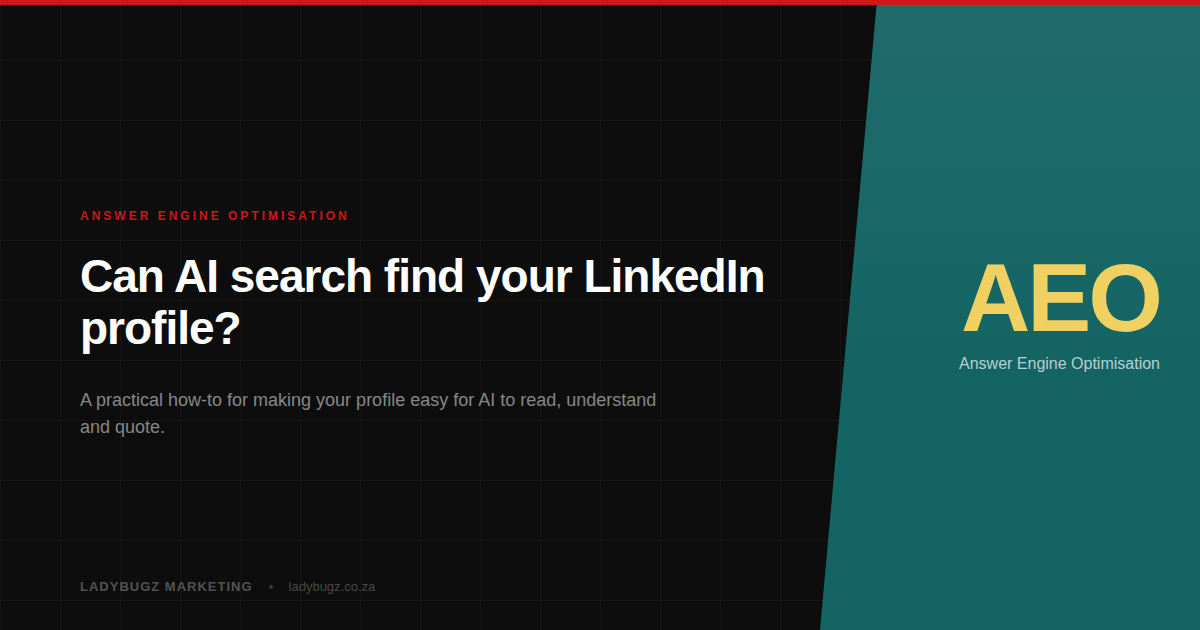
AEO, which stands for Answer Engine Optimisation: the practice of writing and structuring your content so those answer engines can read it, trust it and quote it. It is the younger sibling of SEO, or Search Engine Optimisation, which was about ranking a page high on Google. SEO chased the click. AEO chases the citation, the moment the AI names you as its source.
Keep those two ideas in mind, because every step below is really answering one question: can the AI read this part of my profile, and does it give the AI a reason to trust me?
Our playbook runs in five steps: optimise your profile, define your content pillars, set up a system, commit to consistency, and measure success. Here is each one, turned toward AI visibility, with something concrete to do before you close the tab.
Step 1: Rewrite your profile so a machine can read it
The move: optimise your profile so your target audience is ready to view it. That means the headline, the About section and the Featured area.
Here is what most people miss. An AI does not look at your profile the way a colleague does. It reads the text layer, the actual words in your headline, your About section and your job descriptions. It cannot read the words you baked into your banner image, and it does not care how nicely your photo is lit. When I audit a profile, I try to read only the plain text, the same way a machine would, and I am always struck by how much meaning is trapped inside a banner graphic where no answer engine will ever find it.
So write the important things out, in words, in these places:
- Your headline. This is the first line the AI reads. Skip the job title. Say who you help, in what field, and how. “Helping manufacturing firms cut supply-chain costs with data” tells a machine, and a human, exactly what you are about. “Regional Director” tells neither anything useful.
- Your About section. The first two or three lines matter most, because that is what gets indexed and previewed. Write them as full sentences, not a pile of keywords. Answer plainly: what do you do, who do you do it for, and what proof do you have. Name your industry, your specialisms and the tools you use. Those named things, a real company, a real product, a real place, are anchors an AI uses to work out what you are an authority on.
- Your Featured section. Pin one strong article, case study or booking link. It is the easiest evidence for both a buyer and an AI to reach.
- Your experience entries. Fill in real descriptions, not just titles and dates. Each line of genuine detail is another sentence the AI can read and cite.
- The small settings. Set a custom profile URL with your name, fill in your location, and list skills that match the work you actually want. These are quiet signals, and they add up.
Do this today: read your own headline and the first three lines of your About section out loud. If a stranger could not tell what you do and who you help, rewrite them before you touch anything else.
Step 2: Choose two or three topics, and own them
The move: define your content pillars. We recommend two to three core topics, five at the very most.
Content pillars are simply the handful of subjects you want to be known for. They matter for AI search because of something we call topic authority. An answer engine does not just ask “is this person real”; it asks “what is this person an authority on”. It works that out by looking for a consistent, repeated signal across your profile and your posts. If you write about leadership one week, cryptocurrency the next and your holiday after that, the AI cannot place you, so it does not quote you. If everything you publish circles two or three clear themes, the machine files you neatly under those themes and reaches for you when someone asks about them.
Two or three is not a limitation. It is how you become the obvious answer to a specific question instead of a vague answer to none.
Do this today: write down the two or three topics you want an AI to associate with your name. Then check that your headline and About section actually mention them. If they do not, your profile and your ambitions are pointing in different directions.
Step 3: Build a post template the AI can lift from
The move: set up a system, meaning repeatable templates and a planning routine so posting does not depend on inspiration.
For AI visibility, the most useful system is a simple structure for the posts themselves, one that gives an answer engine a clean, quotable passage. AI tools tend to lift content that is laid out for lifting: a clear question, a direct answer, a short list, real names, a number. A wall of opinion with no structure is hard to quote, so it rarely gets quoted.
Keep a reusable shape for your longer posts and articles:
- Open with the question your reader is actually asking, in words they would use.
- Answer it directly in the first sentence or two, before you elaborate.
- Break the rest into short sections with plain subheadings.
- Use a list where it fits, name real tools, companies or places, and back a claim with a number where you honestly have one.
That is AEO in practice: you write for the human reader first, and you shape the structure so the machine can carry a clean quote to someone who never reaches your page.
Do this today: save that four-line shape somewhere you write. It turns “I should post something” into a form you can fill in ten minutes.
Step 4: Keep showing up, because AI favours a living profile
The move: commit to consistency. Start at once a week and build toward two to five times a week as your routine settles.
Freshness is a real ranking signal for answer engines. They lean toward recent, active sources, because recency is a rough proxy for “still true”. A profile that last posted in the spring reads as abandoned, and an abandoned profile is a weak thing to cite. A profile that publishes steadily, inside its chosen topics, keeps giving the AI new, current material to trust.
Start smaller than you think you should. One genuinely useful post a week, held for three months inside your two or three pillars, will do more for your visibility than a heroic fortnight followed by silence. Consistency compounds. Bursts do not.
Do this today: put one recurring slot in your calendar for a weekly post. Protect it the way you would a client call.
Step 5: Go and check whether the AI can actually see you
The move: measure success. The usual measures are profile views, inbound enquiries and follower growth.
All of that is worth watching, and LinkedIn hands you most of it: profile views, search appearances, post analytics. But add one measurement those usual metrics leave out, because it is the whole point of this article. Go and ask the AI directly.
Open ChatGPT, Perplexity or Google AI Mode and type in a question a good prospect might ask in your field, the kind where you would hope to be a sensible answer. See who and what the tool surfaces. Then search your own name and see how the AI describes you, if it can describe you at all. It is a plain, slightly uncomfortable test, and it tells you the truth faster than any dashboard. If you are nowhere, you now know exactly which of the four steps above to go back to.
Do this today: run one real query in one answer engine, and search your own name. Write down what you find. That is your baseline, and every improvement from here is measured against it.
The short version
Make your profile readable in plain text, point it at two or three clear topics, publish in a shape the AI can quote, keep the profile alive, and check the answer engines to see if any of it is landing. None of it needs a marketing degree. It needs an afternoon and the willingness to write like a person who knows their field, because that, in the end, is exactly what the AI is looking for.
Want to know where your profile stands before you start?
LadyBugz Marketing. Based in South Africa, working internationally.
Keep reading