Published Thursday, 20 August 2026 | By Noleen Thompson, LadyBugz Marketing
New research shows the majority of LinkedIn citations that AI search engines surface come from individual profiles, not company pages. Here is what that means for your marketing.
Editorial note: The headline figure below comes from published industry research (WeRSM and Meltwater), not from LadyBugz. We have cited every source at the point we use it. Read this as a strategic interpretation of other people’s data, not a claim of our own study.
Key Insights
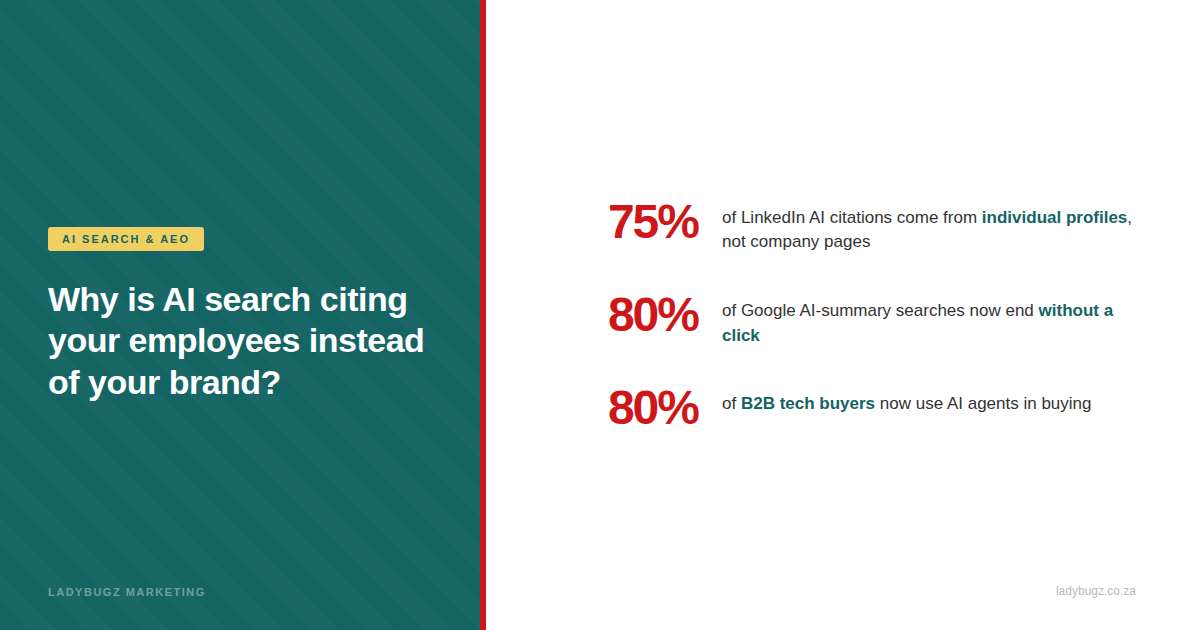
- Roughly 75% of the LinkedIn citations that AI search engines surface come from individual member profiles, not company pages (WeRSM, “AI Search Is Turning LinkedIn Employee Expertise Into Brand Infrastructure”, August 2026; Meltwater analysis of 9.5 million AI citations, 2026).
- About 80% of Google searches that show an AI summary now end without a single click to any website (Campaign US, 2026).
- Around 80% of business-to-business technology buyers now use AI agents somewhere in their purchasing process (MarketScale, 2026).
- The content AI engines cite most reliably uses lists (100% of top-cited pieces), H2 and H3 headings (92%), named companies and tools (75%) and hard data (67%) (Meltwater GenAI Lens, 2026).
- On LinkedIn, expertise beats audience size: 51% of cited posts came from members with fewer than 10,000 followers (Meltwater, 2026).
What does it mean that AI search cites individual profiles, not company pages?
It means the single most-cited marketing asset your organisation owns may be your people, not your website. When someone asks ChatGPT, Google AI Mode, Copilot or Gemini a professional question, those tools answer in their own words and then cite a handful of sources they trusted. New research from WeRSM, titled “AI Search Is Turning LinkedIn Employee Expertise Into Brand Infrastructure” (August 2026), reports that roughly 75% of the LinkedIn citations AI engines surface come from individual member profiles rather than official company pages. That figure is echoed by Meltwater, which analysed 9.5 million AI citations across six AI models and found the same 75% split between individual experts and company pages (Meltwater GenAI Lens, 2026).
We audit LinkedIn profiles every week, and the pattern is almost always the same: a polished company page, and the people behind it close to invisible.
Before we go further, two quick definitions, because the language here is new. “AI search”, also called an “answer engine”, is any tool that reads the web and writes you a direct answer instead of a list of blue links. “AEO” stands for Answer Engine Optimisation: the practice of structuring your content so those answer engines can read it, trust it and quote it. Think of AEO as the successor to SEO (Search Engine Optimisation), which was about ranking a page on Google. AEO is about being the source the AI names.
Why does this matter right now, and not next year?
Because the click is disappearing. About 80% of Google searches that trigger an AI summary now end without anyone clicking through to a website (Campaign US, 2026). In plain terms: the AI reads the sources, writes the answer, and the searcher never visits your site. If your brand is not one of the sources the AI trusts, you are invisible at the exact moment a buyer forms an opinion.
And buyers are already there. Around 80% of business-to-business technology buyers now use AI agents somewhere in their purchasing process (MarketScale, 2026). “Business-to-business”, or B2B, simply means selling to other companies rather than to consumers. So the people deciding whether to shortlist you are increasingly asking an AI first, and acting on whichever names it repeats back to them.
AI answer engines trust people over brand pages.
AI models are looking for evidence of real, first-hand expertise, and individuals signal that more convincingly than a corporate “About us” page. A named professional writing about their own field, with specific examples and numbers, reads like someone who actually knows the work. A company page reads like marketing. AI models are trained to prefer the former.
The WeRSM research frames this as professional authority becoming “distributed” across the people inside an organisation. Discoverability is no longer won by the brand with the biggest ad budget or the most followers. It is won by the individuals who publish credible, structured, genuinely useful knowledge under their own name. Meltwater’s numbers back this up: 51% of the LinkedIn content AI engines cited came from members with fewer than 10,000 followers (Meltwater, 2026). Expertise, not reach, is the currency.
What kind of content actually gets cited by AI search engines?
Structured, specific, expert content wins, and there is a measurable recipe for it. When Meltwater examined the pieces AI engines cited most, clear patterns emerged: 100% used bulleted or numbered lists, 92% used clear H2 and H3 headings (the on-page subheadings that break an article into sections), 75% named specific companies or tools, and 67% included hard numbers and data (Meltwater GenAI Lens, 2026). “Named entities” is the technical term for those specific people, companies and products; AI models use them as anchors to decide what a piece is really about.
Vague, opinion-only posts rarely get cited. AI engines quote content that answers a clear question, lays the answer out in a scannable structure, names real things, and supports claims with data. That is exactly what AEO is: writing for the reader first, and shaping the structure so the answer engine can lift a clean, quotable passage.
How do you turn employee expertise into brand infrastructure?
You treat your people’s profiles as a managed marketing channel, not a personal hobby. Here is the practical sequence we use with clients.
Step 1: Find the expertise. Identify the three to five people in your organisation with genuine domain knowledge, and the topics they can speak to with authority. These are your future citation sources.
Step 2: Optimise the profiles. Rewrite each person’s LinkedIn profile so it clearly states who they help, in what field, and with what expertise. The AI reads the profile before it trusts the post.
Step 3: Publish structured, expert content. Have each expert publish LinkedIn articles and posts built the AEO way: a question-style title, a direct answer near the top, subheadings that map to real questions, lists, named tools and companies, and hard data. Favour long-form articles: on LinkedIn they earn far more AI citations per piece than short posts (Meltwater, 2026).
Step 4: Keep a rhythm and measure. A steady cadence of two to three posts a week, plus a few articles a month, keeps the profiles fresh, and freshness matters because AI models favour recent content. Then track which topics and people get cited, and do more of what works.
Done consistently, this is what “brand infrastructure” means: your reputation stops living only on your website and starts living inside the answers your buyers receive, carried by the credible humans on your team. This is also where LadyBugz sits. We are based in South Africa and work internationally, and we build exactly this kind of AEO-driven, people-first LinkedIn presence for organisations and for individual professionals.
What does this shift mean for your marketing budget?
It means spending shifts from paying for reach to building durable authority. “ROI” here stands for Return on Investment: what you get back for every rand or dollar you put in. When 80% of AI-summarised searches end without a click, buying more clicks makes less sense than becoming the source AI cites for free, every time someone asks.
A well-structured expert article can be quoted by answer engines for months, without further spend. That is a compounding asset, not a disposable campaign. The organisations that win the next few years will be the ones that recognised early that their most valuable, most-cited marketing channel was already sitting inside the company: their people.
Book your LinkedIn profile audit
Noleen Thompson, LadyBugz Marketing
Keep reading