Published Monday, 17 August 2026 | By LadyBugz Marketing
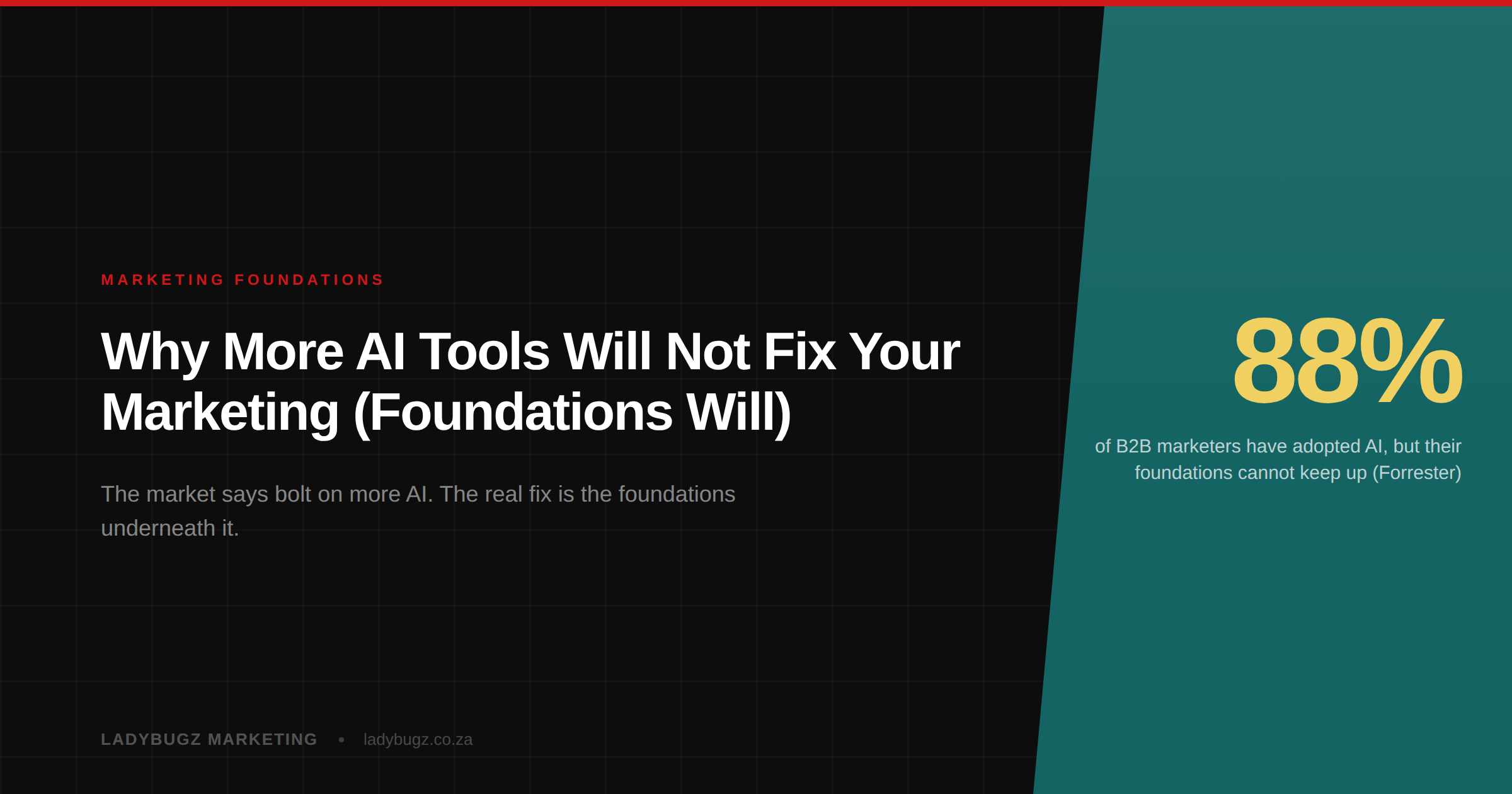
Nearly nine in ten B2B (business to business) teams have already adopted AI tools, yet most cannot say whether those tools are working. The problem is not access to technology. It is the foundations underneath it, and no new subscription will fix that.
Key Insights
- The tools are ahead of the foundations: The research and advisory firm Forrester, through analyst Mark Ogne, reports that 88% of B2B (business to business) marketing organisations have adopted or built AI tools, yet leaders still struggle with unclear AI strategy, difficulty measuring impact, and weak data (Forrester, 2026). Capability, not access to tools, is the bottleneck.
- Integration is claimed more than it is achieved: 85% of marketers say they run integrated campaigns (campaigns where all the channels, from email to social to events, work together as one joined-up effort) and 90% say those campaigns deliver more value, but the same leaders cite siloed budgets, internal competition, and operational complexity as the reasons execution stalls (Forrester, 2026).
- More budget will not fix a misaligned model: Nearly 90% of B2B marketing leaders expect bigger budgets, yet Ogne argues that “more budget won’t fix a marketing model that no longer fits how buyers discover, evaluate, and decide” (MarTech, 2026). Optimising a broken system just preserves the complexity.
- Patching adds cost and hides the real gap: Marketers already waste roughly 26% of their budget, one rand in every four (Rakuten and eMarketer, 2026), and only 41% can prove their AI ROI, the return on investment they get for every rand they spend, down from 49% a year earlier (Jasper, State of AI 2026). Adding tools on a weak base multiplies the waste.
- An audit tells you where you actually stand: Before you add anything, a full marketing audit (a structured health check of your marketing) scores your data, measurement, alignment, channels, and maturity, then maps the specific path to your next level. You cannot improve what you have never honestly measured.
Why is B2B marketing moving faster than its foundations can handle?
Because the tools became easy to buy long before the foundations became strong enough to hold them.
That is the argument Mark Ogne makes in his piece for the research firm Forrester, “B2B Marketing Is Moving Faster Than Its Foundations Can Handle” (Forrester, 5 August 2026). His headline finding is stark: 88% of B2B marketing organisations have already adopted or developed AI tools. On paper, that looks like progress. Underneath it, Ogne reports that leaders are still wrestling with unclear AI strategy, difficulty measuring impact, shaky data systems, and genuine uncertainty about where AI should even be applied.
Read that again. Nearly nine in ten teams have the tools. Most of them cannot yet say where the tools should sit, whether the tools are working, or whether the data feeding the tools is any good.
Ogne’s diagnosis is that marketers are advancing faster than their organisations can actually support. Teams reach for ambitious plans before the basic plumbing exists to carry them. The same report shows how this plays out in campaigns: 85% of marketers say they run integrated campaigns, and 90% say those campaigns deliver more value than running everything separately. Yet the barriers they name are not creative or technological. They are foundational: budgets locked in separate silos, different product teams competing with each other, weak backing from senior leadership, and day-to-day complexity that grinds things down.
The tools are not the problem. The base underneath them is.
Why does adding more AI tools make the problem worse, not better?
Because a new tool on a weak foundation does not fix the weakness. It compounds it, adds cost, and hides the real gap behind a shiny dashboard.
Think about what a tool actually needs to earn its keep. It needs clean, connected data to run on. It needs a way to measure whether it worked. It needs a strategy that says where it belongs and what it is meant to change. Ogne singles out exactly these as the missing pieces: poor data quality and access, and difficulty measuring marketing performance, are the obstacles leaders raise most often (Forrester, 2026). Bolt a clever AI layer on top of bad data and no measurement, and you have simply automated your confusion. You will produce more, faster, with less idea than ever of what is actually working.
The numbers on waste tell the same story. Marketers waste roughly 26% of their budget, one rand of every four, according to the retail and analytics group Rakuten and the research firm eMarketer (2026). Teams operating without a documented plan waste an average of 847,000 dollars a year on scattered, vanity activity, according to KEO Marketing. And the measurement gap is getting wider, not narrower: only 41% of marketers can prove their AI ROI, down from 49% the year before (Jasper, State of AI 2026). The research firm Gartner describes 84% of marketers as stuck in a measurement “doom loop”, which leaves them roughly half as likely to hit their growth targets (Gartner, 2026).
Now add another tool to that picture. You have not closed the measurement gap; you have added a new thing you cannot measure. This is what patching looks like in practice. Each new subscription feels like momentum. Collectively they raise your costs, fragment your data further, and postpone the one conversation that would actually help: an honest look at the base.
Ogne’s framing is the useful one here. Strong foundations, he argues, work as multipliers. Investment in good data, solid measurement, internal alignment, and the right technology is what lets a team adopt new capability quickly, run it consistently, and prove it made a difference. Without that base, every tool you add is a multiplier of nothing.
Is the 2027 planning challenge really about budget?
No. It is about capability and maturity, in other words how developed and well-run your marketing actually is. Budget is the easy thing to argue about because it is the easy thing to measure.
Ogne makes this case directly in his article for MarTech, a marketing technology news publication: “The 2027 CMO planning challenge is bigger than the budget” (MarTech, 2026). The CMO, or Chief Marketing Officer, is the executive who leads marketing for a business. Nearly 90% of B2B marketing leaders expect their investment to grow. And yet, as Ogne puts it, “more budget won’t fix a marketing model that no longer fits how buyers discover, evaluate, and decide.” Pouring more money into an outdated system does not modernise it. It funds the old habits at a larger scale.
His sharpest line is the one worth sitting with: “optimisation can preserve the complexity that prevents adaptation.” Put plainly: when the way you market no longer matches how buyers actually behave, getting more efficient at doing it just cements the wrong approach in place. You become excellent at the wrong thing. Ogne’s recommended sequence is not “spend more”. It is to focus first, which lets you cut the things that no longer earn their place (he calls this divestment), which frees up time and money, which lets you adapt faster and build resilience. In plain terms: work out what to stop before you decide what to add.
That requires a specific, uncomfortable kind of honesty. Ogne urges marketing leaders to look hard at which activities “continue because they’re familiar, measurable, or politically difficult to stop” rather than because they deliver real business impact. Most teams have a handful of programmes running purely on inertia. You cannot spot them from inside the day-to-day. You need to stand outside your own marketing and assess it against how buyers behave now, not how they behaved when the plan was written.
That standing-outside-and-assessing is precisely what an audit is for.
What does a real marketing audit actually assess?
A real audit is not a quick opinion or a surface-level website review. It is a structured, scored assessment of five things: your data, your measurement, your alignment, your channels, and your overall maturity.
At LadyBugz we build the audit on frameworks that have earned their reputation over decades, then add the layer most audits still miss. The backbone is a planning framework called SOSTAC, which stands for Situation, Objectives, Strategy, Tactics, Action and Control. In plain terms, that means: where you are now, what you want to achieve, how you will get there, what you will actually do, and how you will keep it on track. We pair it with RACE, which stands for Reach, Act, Convert and Engage, a simple way to map the customer journey from a stranger first noticing you, to taking an action, to buying, to becoming a loyal repeat customer. We then check that nothing is missing against the marketing mix, the classic 7Ps: Product, Price, Place, Promotion, People, Process and Physical evidence (the visible proof, like your website, packaging or reviews). On top of that sits a scored Marketing Maturity Model, which is simply a way to rate how developed each part of your marketing is, on a scale from basic to advanced. We score six pillars from one to five and plot them on a radar chart, the spider-web style diagram, so you can see at a glance where you are strong and where you are exposed.
Here is what each of the five areas is really testing:
Data: Is your customer and campaign information clean, connected, and easy to get at, or scattered across tools that do not talk to each other? Ogne names poor data quality and access as a top obstacle for a reason (Forrester, 2026). Everything downstream, every AI tool included, is only as good as this.
Measurement: Can you prove what your marketing returns in actual money? In a year when only 41% of marketers can prove their AI ROI (Jasper, 2026) and 84% are caught in a measurement doom loop (Gartner, 2026), being able to show the numbers is a competitive advantage, not a nice-to-have.
Alignment: Do budget, teams, and leadership pull in the same direction, or are you living the separate-budgets and internal-competition problem Ogne describes? Joined-up campaigns fail on organisation far more often than on ideas.
Channels: Which channels (search, email, social, events, advertising and the rest) earn their place, and which just run on habit? This is where Ogne’s “familiar, measurable, or politically difficult to stop” test gets applied honestly, one channel at a time.
Maturity and AI-search visibility: This is the layer standard audits skip, and it has a name: AEO, or Answer Engine Optimisation. That simply means being found and cited when people ask an AI assistant, like ChatGPT, Claude, Perplexity or Google’s AI answers, to recommend a supplier. Buyers have moved to this kind of research: 72% of B2B software buyers now use ChatGPT to evaluate vendors (G2 Research, 2026), yet you can rank first on Google and still be invisible in AI, where the overlap between what AI tools cite and Google’s top ten results is only about 12% (Ahrefs, 2026). When an AI summary appears at the top of a search, people click through to a website just 8% of the time, and to the actual source it quoted only 1% of the time (Pew Research Center, 2025). A traditional SEO audit, one that only checks how you rank on Google (SEO stands for search engine optimisation, the work of getting found in ordinary search results), will not catch any of this. Ours is built to.
The output is not a 60-page document that dies in a drawer. It leads with the conclusions: a short executive summary with your score and top findings, the radar chart as the centrepiece, then each area laid out as current state, the gap, the evidence, and the opportunity. It ends with an impact-and-effort view (a simple chart that sorts every recommended fix by how much it will help versus how hard it is to do) and a phased 30, 60, and 90 day plan, with an owner, a timeline, and a target on every single item.
How does an audit map the path to your next level?
By turning a vague sense that “something is off” into a clear score you can point to and a step-by-step plan, so you know exactly what to fix first, second, and third.
This is the difference between patching and progressing. Patching answers the question “what tool should we buy?” An audit answers the questions that actually move a business: Where are we today, honestly and on the record? Which gaps are costing us the most right now? What is the highest-impact, lowest-effort fix we can make this quarter? And what has to be true before another AI tool would even pay for itself?
The maturity score gives you a starting line you can come back to. Re-run the audit in six months and you can see, in the shape of the radar chart, whether you actually moved. The plan gives you the right order, because a strong marketing operation is built in sequence, not all at once. You fix the data before you trust the dashboard. You build the measurement before you scale the spend. You get budget and teams aligned before you launch the big joined-up campaign. Ogne’s multiplier only kicks in when the base is solid, and the audit is how you find out whether it is.
There is a South African urgency to this too. This country is Africa’s leading user of generative AI, the AI tools like ChatGPT that create text and images: 23.1% of people aged 15 to 64 used it in the first quarter of 2026, up from 19.3% (Microsoft, 2026), and Google’s AI answers are already live in local search results. Your buyers are researching in AI right now. The businesses that win the next two years will not be the ones with the most tools. They will be the ones who fixed their foundations first, so that every tool they add actually multiplies.
Where should you start?
Start by finding out where you stand. Not with another subscription, not with a bigger budget, but with an honest, scored assessment of your foundations and a clear plan to strengthen them.
That is the work we love at LadyBugz, and it is why we are offering it free. We will assess your data, measurement, alignment, channels, and maturity, including the AI-search visibility layer that most audits ignore, and we will hand you back a scored picture of where you are and a step-by-step roadmap to your next level. No pitch, no jargon, no pressure. Just the clarity that has to come before any tool can help you.
If the market is telling you to bolt on more AI, this is the more useful move: understand the base first.
Ready to see where your marketing actually stands?
LadyBugz Marketing
Keep reading