Every week I speak to a South African business owner who is doing genuinely good work and still cannot tell me where their next client is coming from. They know their trade. They have customers who would happily refer them. What they do not have is a dependable way to turn strangers into conversations. That gap is the real reason people search for “B2B lead generation in South Africa”, and it deserves an honest answer about how it actually gets solved in our market, on a normal budget.
A quick note on the jargon, because I promised myself I would write this for a busy owner and not for other marketers. B2B means business-to-business, which is simply selling to other companies rather than to the general public. If that is you, keep reading.

What does B2B lead generation in South Africa actually look like?
At its plainest, generating B2B leads in South Africa means getting the right decision-makers to know you, trust you and reach out before they are ready to buy from anyone. Notice what that is not. It is not buying a list and emailing it. It is not a burst of paid ads that goes quiet the day you stop paying. Those tactics can produce activity. They rarely produce a pipeline you can rely on next quarter.
The South African market has its own shape, and it changes the answer. Our B2B world is small and closely connected. People move between firms, they talk, and reputation travels fast in both directions. Referrals
still do a lot of the heavy lifting here. That is a strength, but it is also a ceiling, because a business that lives only on word of mouth cannot control when the next introduction arrives. The work of lead generation is really the work of making that reputation visible and searchable, so it keeps introducing you even when nobody is in the room to do it for you.
Why does organic beat ad spend for most South African B2B firms?
Because the thing you are actually selling is trust, and you cannot rent trust by the click. When you pay for an ad, you rent attention for exactly as long as the budget lasts. The moment it stops, so does the attention. Organic marketing, which means the visibility you earn rather than pay for, works the other way around. A useful article or a strong post keeps working long after you publish it.
I can show you this from our own numbers rather than a textbook. Working entirely organically, with R0 in ad spend, LadyBugz generated 784 webinar registrations, 102,187 organic LinkedIn impressions and 23,397 organic search visitors. Those are our own marketing results, not a client case study, and I share them because I would rather prove the point on my own business than someone else’s. The compounding is the whole argument. Content you own keeps earning. A campaign you rent stops the day the invoice does.
But does organic not take forever to work?
It used to. That is the honest objection, and for years it was fair. A new website could sit invisible for six months before Google took it seriously. What has changed is that a properly built site now surfaces far faster, especially for the buying-intent questions people actually type.
Two real examples from sites we manage, with the client names kept private and only the industries named. A mobile dog-grooming brand went from near-invisible to roughly 900 monthly impressions and its first page-one rankings within about six weeks of launch, ranking number one for “best mobile dog groomers near me” (Google Search Console). A training and immersive-simulation provider we rebuilt saw its clicks rise 118% and its impressions 106% in 28 days, with its question-format articles indexing on page one within weeks (Google Search Console). Both were fresh sites ramping from a standing start, not year-long turnarounds, and I want to be precise about that rather than dress it up. The point is the speed to visibility, reached fast, from zero.
Where do the best B2B leads in South Africa actually come from?
From being present in the two places your buyers now look: search, and each other’s feeds. Increasingly there is a third place, and it is the one most firms have not checked. Buyers ask AI.
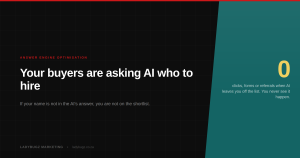
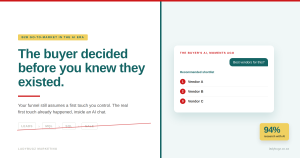
Here is a piece of the shift, sourced properly. Gartner, drawing on the earlier CEB research, found that 57% of a B2B purchase decision is already made before a buyer contacts a supplier. More than half the decision, done, before your phone rings. Forrester’s 2025 research found that 94% of B2B buyers now use generative AI somewhere in their buying process. So the early, decisive part of research happens where you cannot see it, often inside a chat window, and the businesses that show up in those answers get onto the shortlist while the rest are left off. We wrote a full piece on this shift, on how your buyers are asking AI who to hire, and it is worth reading alongside this one.
The practical version for a South African firm is calmer than it sounds. You need to be clear enough that both a person and a machine can understand who you are and who you help. You need content that answers the real questions your buyers ask, in plain words. And you need a credible presence on LinkedIn, where our decision-makers genuinely spend time. South Africa has around 17 million LinkedIn members, about 37.8% of the adult population (DataReportal, 2026), so the room is bigger than most local owners assume. If LinkedIn is where you want to start, our companion guide on LinkedIn lead generation for B2B walks through the how.
What about the buyers who are not ready yet?
They are most of them, and they are the reason patience pays. The Ehrenberg-Bass Institute, with the LinkedIn B2B Institute, gave us the 95-5 rule: at any moment only about 5% of B2B buyers are actively in-market. The other 95% will need you eventually, just not today. If you only market when you need work, you are shouting at the 5% and ignoring the 95% who decide later. Organic B2B lead generation is really the discipline of being useful to that 95% long before they are ready, so you are the name they already trust when their moment comes.

So where should a South African B2B company start?
Start by finding out whether you are visible at all. Open ChatGPT and Perplexity and ask the questions a real buyer would ask to build a shortlist in your category. See whether you appear, and what is said about you when you do. It takes twenty minutes and it is often a genuine shock. Then fix your own clarity before you chase anything clever, because a website that plainly says who you are and who you serve is the cheapest, highest-return move you own.
I will be straight about where I have stopped short here. I have shown you the principles because you should understand what is happening to your own visibility. The exact channel mix, the sequencing and the way we run this week to week is the execution we do hands-on, and it is what clients pay us for. The map is here. The driving is the work.
Quick questions I get asked
How long before organic B2B lead generation works? Visibility can come within weeks for a well-built site, as the examples above show. Steady lead flow builds over months, because trust does.
Do I still need ads? They can have a place for a specific push. As a foundation, organic is more affordable and it keeps working after the spend stops.
Is LinkedIn enough on its own? It is a strong start for B2B in South Africa, best paired with search and AI visibility so buyers find you wherever they look.
A real audit of your whole B2B marketing strategy, reviewed by a person, not a generic scorecard. R995, and it includes the AI-search visibility most audits still miss.
Editorial note: this article was researched and written by the LadyBugz team, with sources credited inline. Our own results are first-party figures. We publish this as guidance, not as a guarantee of any specific outcome.
Keep reading