Published Wednesday, 21 October 2026 | By Noleen Thompson, LadyBugz Marketing
Most B2B (business-to-business) marketing plans are lists of activities. Here is what goes into a plan that an executive committee will actually back, and why each part is there.
Key Insights
- Start with revenue: a board-ready B2B marketing plan opens with the commercial goal it supports, then shows who you target, what you say, where you show up, how you measure and what happens in the first 90 days.
- Budgets are tight, even at large companies: marketing budgets average 7.8% of company revenue, and 56% of chief marketing officers say that is not enough to deliver their strategy (Gartner’s 2026 CMO Spend Survey of 401 marketing leaders at mostly large companies in North America, the UK and Europe, May 2026).
- Brand and leads both need a share: research by Les Binet and Peter Field for LinkedIn’s B2B Institute found B2B budgets work best split roughly 50/50 between building the brand and chasing short-term sales (reported by LinkedIn in 2020).
- Set the timeline up front: in our experience, organic (unpaid) B2B marketing shows engagement (buyers responding to your content) in 4 to 8 weeks and leads (potential buyers who have shown interest) in 3 to 6 months, so the plan should say what the board will see, and when.
- Write it in plain English: board members are experts in their own fields, and marketing usually isn’t one of them. Spell out every term and report marketing in business language such as revenue, cost and pipeline (the value of deals sales is working on), or the plan is hard to approve.
- Plan 2027 now: a B2B marketing plan agreed before the December break gets a full first quarter of delivery.
A board-ready B2B marketing plan is a short document that ties marketing to revenue: the commercial goal, the buyers you will target, the message they will hear, the channels you will use, the numbers you will report and a 90-day roadmap. I’ve spent more than 28 years in sales and marketing, and the plans I’ve seen get signed have one thing in common. They answer the question every executive committee (exco) asks, whether or not they say it out loud: what will this do for the business?
What is a B2B marketing plan, and why do so many get sent back?
A B2B marketing plan is the agreed route from your company’s sales targets to the marketing work that will help reach them. In my experience, the plans that get sent back are usually activity lists. Four webinars, two posts a week, a new website, a stand at an expo. Nothing on the list is wrong. The trouble is that nobody can see how any of it adds up to revenue.
Picture the finance director reading that list. They see cost, and no return, because the plan never made the link. So the budget gets trimmed, and a year later everyone agrees marketing “didn’t work”.
A plan the board will back flips the order. Start with the business goal, then show the marketing choices that serve it and how you’ll prove they did.
What does a board-ready B2B marketing plan include?
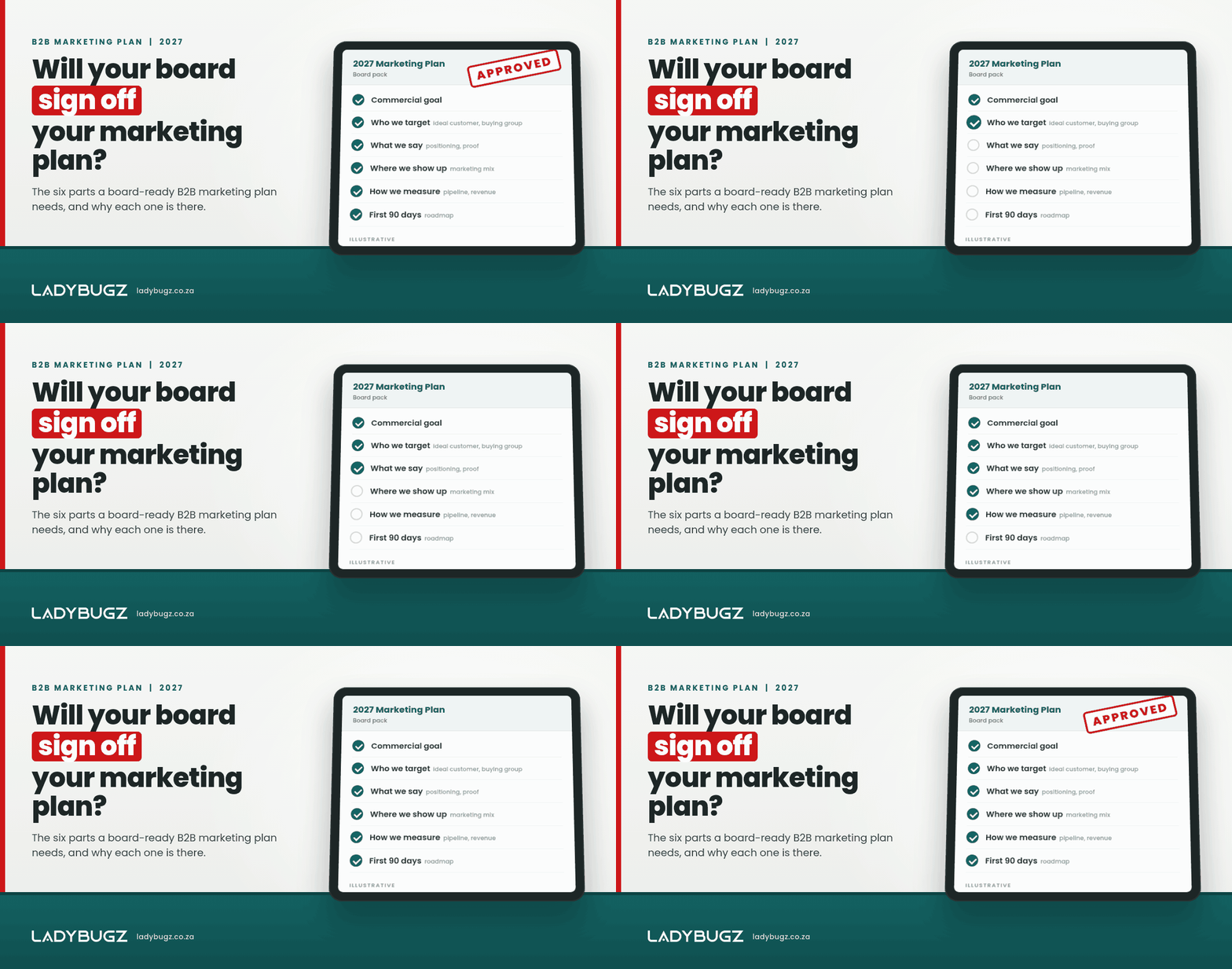
A board-ready B2B marketing plan includes six parts, in this order, and each one answers a question the board will ask. Think of it as a B2B marketing strategy framework for the people signing off the budget. The detail behind each part is where the real work sits, but the structure itself is simple.
1. The commercial goal. One or two sentences on the revenue or market-share target this plan supports. If sales and marketing don’t agree on this line, fix that first. Our piece on aligning sales and marketing explains why.
2. Who we target. Your ideal customer profile (ICP), meaning the type of company most likely to buy from you and keep paying well, plus the people inside it who decide. In B2B that’s rarely one person. Name the roles in the buying group, the colleagues who decide on a purchase together. For high-value accounts, an account-based marketing approach targets named companies one by one.
3. What we say. Your positioning: why a buyer should pick you over the alternatives, including doing nothing. Back it with proof: case studies and results, plus the client names you’re allowed to use.
4. Where we show up. This is your B2B marketing mix, the set of channels you’ll use and roughly how the effort splits between them. Think LinkedIn, your website, email, events and search, which now includes artificial intelligence (AI) assistants such as ChatGPT. A B2B digital marketing plan is this part with the online channels drawn in more detail.
5. How we measure. A short list of numbers that lead from marketing activity to revenue, agreed with finance before the year starts.
6. The first 90 days. What happens in weeks 1 to 12, who owns it and what the board will see at the first review.
How much should a B2B company spend on marketing?
A B2B company should spend what its growth goal needs, and a useful benchmark is about 7.8% of company revenue. That is the average in Gartner’s 2026 CMO Spend Survey, published in May 2026, which asked 401 chief marketing officers (CMOs) and marketing leaders. Budgets barely moved from 7.7% in 2025, and most respondents worked for companies with more than 1 billion US dollars in revenue, in North America, the United Kingdom and Europe.
Use that 7.8% as a reference point. Your own number depends on where the business is going. A South African manufacturer defending a mature market needs a different budget from a financial services firm launching into a new province. The board needs a clear line from the money to the outcome, so it can weigh marketing against every other request on the table.
How should a B2B plan balance brand building and lead generation?
A B2B plan should give brand building and lead generation a fair share each, because each one feeds the other. Research by Les Binet and Peter Field, two well-known advertising effectiveness researchers, for LinkedIn’s B2B Institute found that to grow most effectively and profitably, B2B marketing budgets were best split roughly 50/50 between brand and activation (reported by LinkedIn in 2020). Activation is the work that asks for a response now, such as a demo request or a webinar sign-up.
Brand building is the work that makes buyers remember you and trust you before they need you.
Plans built only for this quarter’s leads tend to stall. Leads are far easier to win from people who already know your name, and if nobody is building that familiarity, the pool of people ready to talk gets smaller over time. This matters even more in sectors such as mining or logistics, where a long sales cycle (the time from first contact to a signed deal) and a few large buyers make being known before the tender goes out especially valuable. It’s also why our own organic B2B marketing strategy work puts a lot of weight on the company’s people being visible on LinkedIn, not only the company page.
Measure what the board cares about
A board-ready plan measures marketing in the same terms the board uses: pipeline (the total value of deals sales is working on) and revenue, and what it costs to win a customer. Likes and impressions (the number of times a post was shown) can sit in the team’s own dashboard. They don’t belong on the board slide, and we’ve written about why in why your marketing report is lying to you.
Agree two kinds of numbers before you start:
- Early signals that show the plan is working before sales close, such as the right people engaging and meetings being booked. Website visits from your target companies count too.
- Business results such as qualified opportunities (deals sales agrees are real) and, in the end, deals won.
Then be upfront about timing. With organic B2B marketing, what we usually see is engagement within 4 to 8 weeks and leads from about month three to month six. Putting that in the plan protects everyone: marketing isn’t judged on month-twelve numbers in month two.
Why does plain language get a marketing plan approved?
Plain language gets a plan approved because a board can only back what it understands on the first read. The people around that table are experts in their own fields, whether that’s finance, technology, operations or human resources. Marketing is usually not one of them, and it shouldn’t have to be.
I believe this is one of the most overlooked reasons a plan stalls. The slides fill up with MQL, CAC, ROAS and ABM, and nobody wants to be the person who stops the meeting to ask what half of it means. So the questions go unasked. A director who can’t follow the plan straight away is not going to approve it, and I don’t blame them. It’s no reflection on them as leaders. We keep adding acronyms to everyday business life, and marketing adds more than most. Explaining ourselves in plain English is our job.
So spell out every term the first time you use it, or drop it altogether. Then turn each marketing measure into something the business already counts, like revenue, cost, pipeline or risk. A few examples of the switch:
- Instead of “MQLs up 30%” (marketing qualified leads), say “30% more interested buyers asked to talk to us.”
- Instead of “CAC down 15%” (customer acquisition cost), say “It now costs us 15% less to win each new customer.”
- Instead of “4:1 ROAS on LinkedIn” (return on ad spend), say “Every R1 we spent on LinkedIn ads brought in R4 of sales.”
- Instead of “An ABM programme for 20 tier-one accounts” (account-based marketing), say “We’ll focus on the 20 companies most likely to become our biggest clients, with marketing made for each one.”
The numbers in those examples are made up to show the wording. A good test: if your finance director could explain the plan to the CEO (chief executive officer) in their own words, it’s ready.
When should you start planning for 2027?
You should start your 2027 B2B marketing planning now, in the final quarter of 2026. Many companies only write their plan once the new year has started, and every week spent in planning meetings in January is a week of delivery lost from the first quarter.
Agree the plan before the December break and January is spent doing the work. If your buyers have changed how they research suppliers, our guide to go-to-market strategy in the AI era is a useful read before you start. A go-to-market strategy is how you take what you sell to the buyers you want.
Frequently asked questions
Is there a B2B marketing plan template we can use?
Templates help with headings, but they can’t make the choices for you. The value of a plan sits in the decisions, such as who you target and, just as important, what you stop doing. Use the six parts of a board-ready plan (goal, target buyers, message, channels, measures and a 90-day roadmap) as your outline, then spend your time on the decisions.
What is the difference between a B2B marketing plan and a B2B digital marketing plan?
A B2B digital marketing plan covers only online channels such as LinkedIn, your website, email and search. A B2B marketing plan covers everything, including events and partner marketing. For most medium to large companies, the digital plan should sit inside the main plan, not beside it.
How long does a B2B marketing plan take to show results?
In our experience, organic B2B marketing shows engagement in 4 to 8 weeks and leads in 3 to 6 months. Long sales cycles in sectors such as mining or energy can push closed deals further out, so the plan should report early signals along the way.
Who should write the B2B marketing plan?
Marketing should write it, with sales and finance in the room. Sales confirms the targets and the buyers. Finance agrees how results will be measured. A plan written by marketing alone is far easier for the board to send back.
Should a marketing plan for the board use marketing acronyms?
Use as few as you can. Board members are experts in their own fields, such as finance or operations, and a plan they can’t follow straight away is hard to approve. Spell out any term the first time it appears, and report results in business terms such as revenue, cost and pipeline.
If I were sitting across from you at lunch, I’d say this: before you add a single activity to next year’s list, write the one sentence that says what marketing will do for revenue in 2027, and get sales and finance to agree with it. Everything else gets easier once that line is settled. For an outside read of where your marketing stands before you plan, start with an audit.
Book your B2B marketing strategy audit
Want to talk through your 2027 plan? Contact us at noleen@ladybugz.co.za
Noleen Thompson, Managing Director and Founder, LadyBugz Marketing
Keep reading