Published Friday, 23 October 2026 | By Noleen Thompson, LadyBugz Marketing
Ask a sales director who their customers are and you’ll often get a list of industries. Ask which companies they should chase next year, and why those ones, and the answers get vaguer. Here’s how B2B (business-to-business) leaders can get a sharper answer.
Key Insights
- Segment by need as well as industry: B2B market segmentation groups the companies you could sell to by the business problem they need solved. Two firms in the same sector can need very different things, and firms in different sectors can need the same thing.
- Your ideal customer is a type of company: an ideal customer profile describes the kind of organisation that gets the most value from you and is worth the most to you. A buyer persona describes one person inside that organisation.
- You are selling to a group: in a Gartner survey of 632 B2B buyers, published in May 2025, buying groups ranged from five to 16 people across as many as four business functions, whose members may have different priorities.
- Procurement is there from the start: Forrester’s State of Business Buying 2026 report found that procurement professionals are decision-makers in 53% of business buying cycles.
- Reach the wider committee: a South African business-technology consultancy needed business leaders, as well as information technology (IT) teams, to see it as a strategic adviser. We promoted its webinar on SAP, the business software many large companies run on, to those leaders on LinkedIn without paid ads. The webinar drew 621 registrations and 47 qualified sales opportunities (prospects who showed real interest).
You segment a B2B market by grouping companies by the business problem they need solved and the people who make the buying decision. Then you choose the segment where you solve the most valuable problem and win most often. That segment becomes your ideal customer. In my view, a list sorted only by industry tells you who exists and very little about who is ready to buy.
What is B2B market segmentation?
B2B market segmentation is the process of splitting all the companies you could sell to into smaller groups that share something important. You can then decide which groups to focus on and speak to each one in its own terms. (Some call it B2B marketing segmentation.)
Your B2B target market is the group, or groups, you decide to go after. Most companies split their market in one or more of these ways:
- Company facts. Industry, size, number of staff, turnover and location. This information is easy to find, so it’s where most target lists begin.
- Business need. The problem the company is trying to solve, or the goal it’s working towards this year.
- Buying situation. Whether the company is buying for the first time, replacing a supplier it’s unhappy with, or expanding something that already works.
- Buying committee. Who takes part in the decision, and what each of those people cares about.
Company facts tell you which businesses fit on paper. Need and buying situation tell you which of them are likely to buy, and what would make them choose you.
Why isn’t industry enough to segment a B2B market?
Industry isn’t enough because companies in the same sector often have very different problems, while companies in different sectors can share the same one. Industry tells you what a company does. It doesn’t tell you what its leaders are trying to fix this year.
Take two logistics companies of the same size. One is replacing an ageing fleet and worries about trucks standing idle in the workshop. The other is growing its cross-border work, and its managers spend their days on customs paperwork and delays at border posts. On a list sorted by industry, they sit side by side. They need different conversations and different proof. You might even send different people.
Now look across sectors. These B2B market segmentation examples use sectors we know in South Africa. They’re illustrations, not named clients:
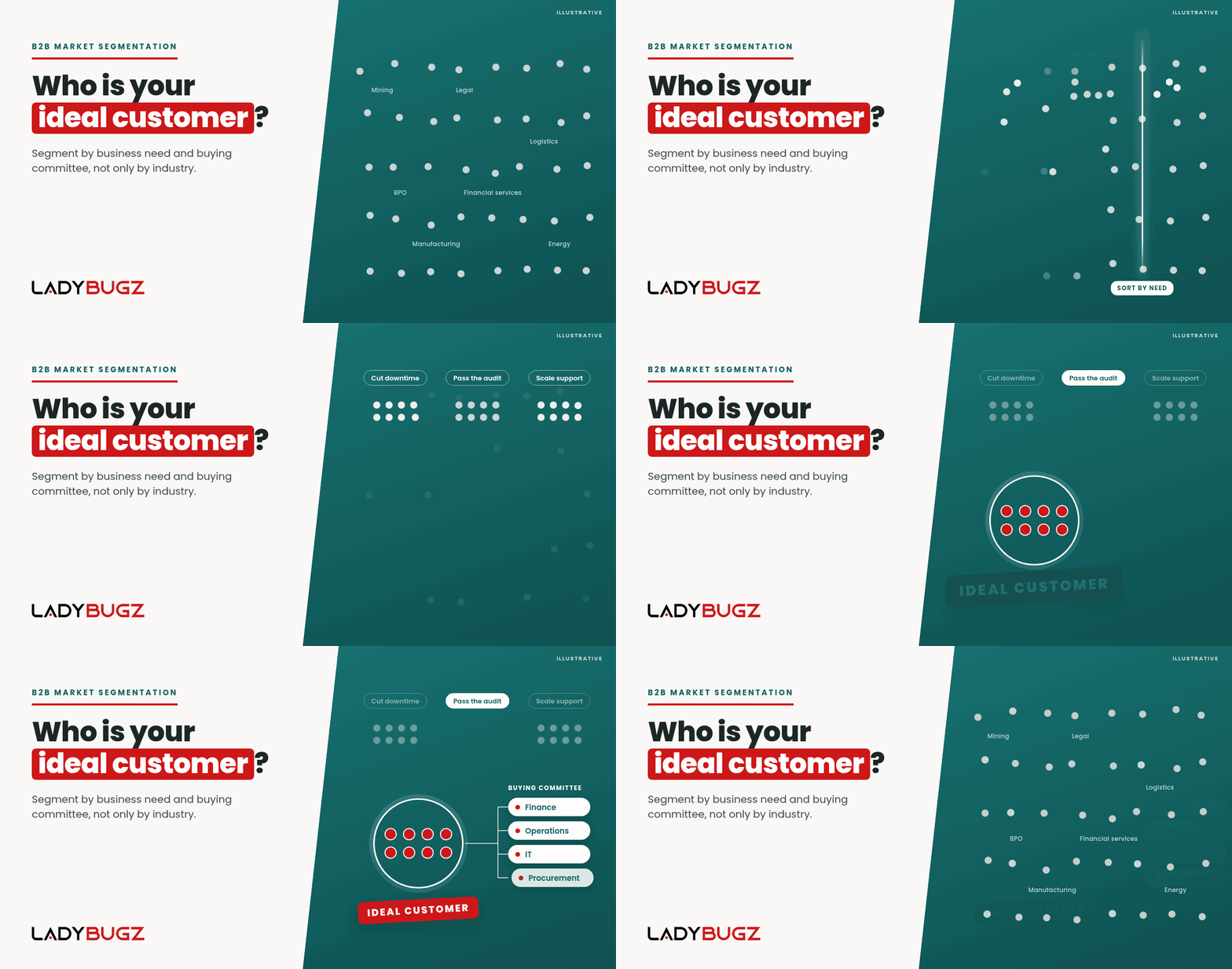
- Downtime. A mining group and a manufacturer both lose money for every hour a plant or production line stands still. A supplier that helps prevent breakdowns has one segment here that spans both industries.
- Compliance. A law firm and a financial services provider both answer to regulators, and both must protect client information under POPIA, the Protection of Personal Information Act. A message about passing the next audit speaks to both.
- Scaling support. A BPO (business process outsourcing) company that runs customer service for overseas clients has to find and train staff quickly when it wins a contract. So does a fast-growing financial services call centre.
- Long approvals. An energy producer or a mining group planning a new project may face approvals that run for years, with technical, financial and legal teams all involved. A supplier that understands that pace sells differently from one used to quick decisions.
Grouped by industry, these companies would land in six different segments. Grouped by need, you get four, and each one has a message that fits.
How do you segment by business need?
You segment by business need by starting with the clients you already serve best and working out what problem each of them hired you to solve. That way your segments start from clients you’ve already won.
- Start with your best clients. Pick the ones who got the most value from your work, stayed the longest or sent others your way. Look at profit as well as size, because a large client that’s costly to serve may not be your best one.
- Write down the problem in their words. Ask what was going wrong before they came to you, or what they were trying to achieve. Keep their plain language. Buyers search and speak in those words, not in your product names.
- Look for that problem in the wider market. Which other companies are likely to face it now? Growth, new regulations, a merger, a new chief executive or a large project can all be signs.
- Check the size. A segment needs enough companies with the budget to buy. It also needs to be small enough that you can get to know them properly.
A smaller segment you know well often earns more than a large one you can only reach with general messages, because buyers notice quickly whether a supplier knows their business.
Who is in a B2B buying committee?
A B2B buying committee is the group of people inside a company who decide on a purchase together, and it’s usually bigger than the person who first contacts you. Gartner, the research and advisory firm, surveyed 632 B2B buyers in August and September 2024. In May 2025 it reported that these buying groups, as Gartner calls them, range from five to 16 people across as many as four functions. Each member may have different priorities and opinions. The same survey found that 74% of buying teams showed what Gartner calls “unhealthy conflict” during the decision, which is one reason your message has to answer every member’s question.
Forrester, another research firm, found that procurement is in the room early. Its State of Business Buying 2026 report says procurement professionals are decision-makers in 53% of business buying cycles, engaging from the start of the process. Neither survey is a South African benchmark, so expect local numbers to differ.
So B2B buying behaviour is about a group reaching agreement. Each person on the committee tends to ask a different question:
- Finance: What will this cost, and when will it pay for itself?
- Operations: Will it disrupt the way we work, and who will run it day to day?
- IT (information technology): Does it fit our systems, and is our data safe?
- Procurement: Does the supplier meet our requirements, including contracts, payment terms and B-BBEE (Broad-Based Black Economic Empowerment) status?
- The executive sponsor (the senior leader who backs the purchase): Will this help me reach the goal I’m measured on?
Segmenting by buying committee means knowing, for each segment, who usually sits on it and what each of them needs to hear. A message written only for the person who will use your product seldom convinces the person who signs the contract.
How do you choose your ideal customer profile?
You choose your ideal customer profile by picking the segment where you solve a problem that matters to the buyer and where you tend to win. Then you describe that type of company clearly enough that sales and marketing both recognise it.
An ideal customer profile (ICP) describes the type of company that gets the most from your work and is worth the most to you. We’ll call it your ideal customer from here. A buyer persona, by contrast, describes one person inside that company.
To test whether a segment deserves to be your ideal customer, ask these questions about the companies in it:
- Need. Do they have the problem you solve, and is it urgent for them?
- Ability to buy. Is there budget, and is the deal big enough to make sense for both sides?
- Access. Can you reach the people on their buying committee?
- Proof. Have you solved this problem for a similar company before?
- Working fit. Do your values and ways of working match theirs?
Some companies turn questions like these into an ICP scoring framework, which gives each potential client a score so sales and marketing agree on which ones to approach first. The useful part of a scoring framework is the conversation it forces. The directors and the sales team have to say out loud which clients they want, and which ones they’d happily lose.
Once you’ve chosen, write your ideal customer down in one paragraph that anyone in the business could repeat. If it runs to three pages, nobody will use it.
Positioning comes from the segment you choose
B2B market positioning is the place you want to hold in your buyers’ minds compared with the other options they’re considering. You can only make it sharp once you know which buyers you mean. Positioning aimed at “everyone in financial services” tends to come out vague. Positioning aimed at mid-sized insurers preparing for a regulatory audit can say exactly what you help them avoid, and how you’ve done it before.
Your positioning then shapes your B2B brand strategy, the decisions about what your company stands for and who it’s for. Clear positioning also gives each person on the buying committee a reason to say yes.
How does segmentation feed account-based marketing?
Segmentation feeds account-based marketing because it tells you which companies belong on your target list, and which people to reach inside each one. Account-based marketing (ABM) treats a short list of named companies as markets of their own, with sales and marketing working each one together. Our account-based marketing service starts from that list, and our article on why ABM outperforms traditional B2B marketing explains why focusing on around 20 well-chosen accounts can work better than spreading effort across 100.
A South African business-technology consultancy we worked with is one example of aiming past the IT team at the wider committee. The consultancy sets up and connects SAP systems (SAP is business software that many large companies run on), and it was seen mainly as a technical implementer. It needed senior executives, such as the chief executive and financial director, and other business leaders to see it as a strategic adviser, alongside the IT teams it already knew. We built a webinar on a business risk those leaders cared about, then spent eight weeks promoting it on LinkedIn to business leaders and decision-makers, with no paid advertising. The webinar drew 621 registrations and 256 attendees, a 41% attendance rate. It also produced 47 qualified sales opportunities, meaning prospects who showed real interest through questions, downloads or follow-up conversations. The full SAP ecosystem webinar case study explains how.
Clear segments also make an organic B2B marketing strategy (marketing that grows without paid ads) far more productive. When you aren’t paying for reach, every post and event has to be aimed at the right people.
Frequently asked questions
What is the difference between a target market and an ideal customer profile?
A target market is the whole group of companies a business has decided to sell to. An ideal customer profile is the best-fit part of that group, the companies most likely to buy and stay, and to get the most from working with you. Many B2B companies have a broad target market with a sharper ideal customer inside it.
How many segments should a B2B company focus on?
Start with one or two segments. Each segment needs its own message and proof, and it takes up sales time. Few marketing teams can do that well for five segments at once. Add another segment once the first is bringing in work.
How often should you review your ideal customer profile?
Review your ideal customer profile at least once a year, and sooner after a big change such as a new service, a merger, a move into a new market or a run of lost deals. Base the review on the clients you won and kept, as well as the ones you hoped to win.
What is the difference between an ideal customer profile and a buyer persona?
An ideal customer profile describes a type of company, by its need, size and situation. A buyer persona describes one person on that company’s buying committee, such as the financial director, and what they care about. Define the ideal customer first, then the personas within it.
Here’s a question to take into your next executive committee meeting. If your three best clients from the last two years sat down together, what problem would they say they hired you to solve? Their answer is the start of your ideal customer. Whatever you agree belongs at the front of next year’s plan, which is why “who we target” is the first part of a board-ready B2B marketing plan. Our audit looks at this too. It starts with strategy and positioning, including whether your message is aimed at the right B2B buyer.
Book your B2B marketing strategy audit
Want to talk through your ideal customer? Contact us at noleen@ladybugz.co.za
Noleen Thompson, Managing Director and Founder, LadyBugz Marketing
Keep reading