Published Wednesday, 11 November 2026 | By Noleen Thompson, LadyBugz Marketing
The B2B (business to business) marketing trends for 2027, drawn from Forrester, VML, Warc, Gartner and South Africa’s own economic numbers, and what a marketing leader should do about them before January.
Key Insights
- Optimism is down: only 46% of marketers expect business to improve in 2027, according to Warc’s Marketer’s Toolkit 2027 survey of 1,000 marketing executives.
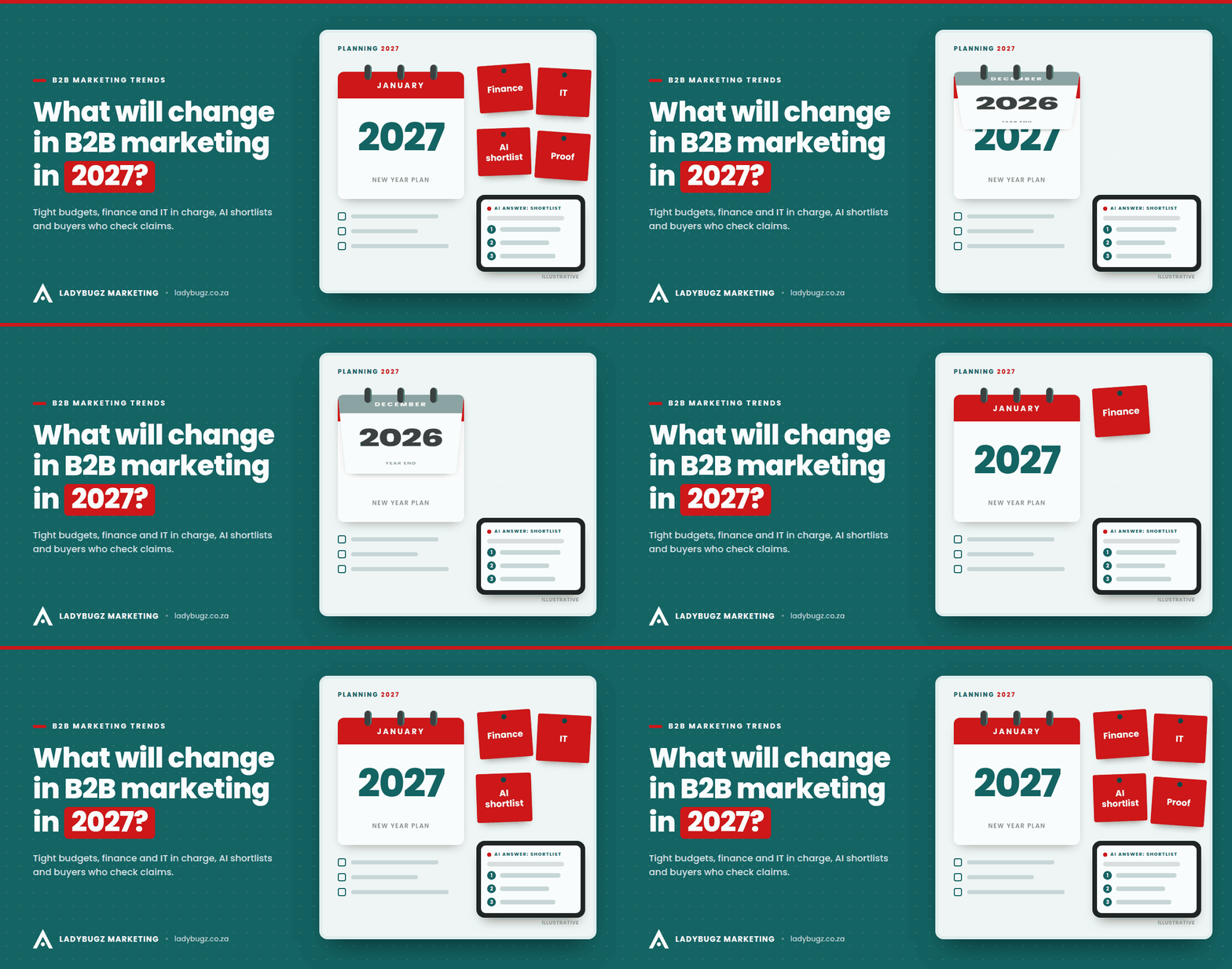
- Finance holds the pen: finance (63%), top executives (57%) and IT (56%) carry the most influence over B2B purchase decisions, while marketing sits at 18% (VML, The Future Buyer 2026).
- AI is the new starting point: 55% of the B2B buyers VML surveyed now start supplier research with generative AI, ahead of Google at 45%.
- Agents join the buying process: Forrester (Predictions 2027) expects 75% of business buyers to use AI agents, software that carries out tasks on their behalf, for work such as supplier discovery and drafting requests for proposals.
- Unproven claims get caught: Forrester expects two out of three B2B providers to fail some part of the checks buyers now run with AI.
- South Africa starts slower: National Treasury forecasts 1.6% economic growth in 2027, and the National Opt-Out Registry, where people can block direct marketing, moves to enforcement in the first half of the year.
In 2027, B2B marketing will be judged harder and found differently. Budgets stay tight, finance and IT hold more sway over decisions, AI tools build the first shortlist, and buyers check claims with real people before they sign. The winners will be easy to find, and their claims will hold up when a finance director checks them.
After we rebuilt our website in July 2026, our Google clicks more than doubled in three months, and from late September enquiries started arriving from people who’d found LadyBugz through AI tools. The latest research and 2027 forecasts from Forrester, VML, Warc and Gartner answer one question for me: what will my clients’ buyers do differently next year? This year the reports agree more than usual.
Will B2B marketing budgets grow in 2027?
B2B marketing budgets are unlikely to grow much in 2027. Marketer optimism has fallen for a third year, with just 46% expecting business to improve (Warc’s Marketer’s Toolkit 2027), and in South Africa National Treasury expects only 1.6% economic growth. Most marketing teams should plan to defend a flat budget, line by line.
Gartner’s 2026 CMO Spend Survey of 401 chief marketing officers (CMOs) in North America, the UK and Europe found 56% said their budget wasn’t enough to deliver their strategy. At home, Treasury’s Medium-Term Budget Policy Statement on 21 October 2026 cut this year’s growth forecast to 1.2%. The Reserve Bank raised the repo rate to 7.25% in September, and the RMB/BER Business Confidence Index sat at 38 in the third quarter, its lowest reading since 2024. Finance directors are reading those numbers too.
AI won’t rescue the budget either. Forrester’s 2027 predictions for consumer marketing expect marketers to scale back a third of their AI initiatives as usage-based pricing pushes costs up, and B2B teams pay the same software bills. Plans will be defended line by line, and “we posted 22 times” won’t survive that review.
Who will make B2B buying decisions in 2027?
Finance, top executives and IT already carry more influence over B2B buying decisions than the business unit that needs the solution, and that is unlikely to reverse in 2027. VML’s Future Buyer 2026 survey found business unit leaders sit fifth in influence, at 40%, so suppliers must win over people who may never feel the problem day to day.
Across the 750 B2B buyers VML surveyed, an average of 6.8 people take part in a significant purchase, from 4.2 in energy to 9.3 in telecommunications. Marketers call them the buying group. They’re careful people. Nearly three in four buyers (73%) told VML a poor purchase would meaningfully damage their career, and VML calls the result a “defensibility bias”. It also found that 38% of major buying initiatives end in no decision at all, with risk and compliance concerns and uncertainty about budget or return on investment (ROI) the main causes buyers cited.
Price matters less than many suppliers think. Lowest price was a top selection factor for only 19% of VML’s buyers, against 49% for provable ROI.
How will AI change the way B2B buyers find suppliers?
AI will increasingly decide which suppliers make the first shortlist in 2027. VML found 55% of B2B buyers now start supplier research with generative AI (tools that write an answer for you), and 36% settle on a preferred supplier before formal evaluation or any sales outreach begins. A company AI can’t find or describe clearly may never be considered.
VML also found 74% of buyers often use AI to research suppliers. The next step is agents. Forrester’s Predictions 2027 expects 75% of business buyers to use AI agents for specific, limited tasks such as spend analysis, contract-renewal analysis, drafting requests for proposals (RFPs) and supplier discovery. Warc’s survey points the same way, with 69% of marketers expecting customers to use AI agents for product research within three years, yet only 8% expecting them to hand over the whole purchase.
South African buyers already have the tools. Google launched AI Mode here in August 2025 and added Afrikaans, Sesotho, Setswana and isiZulu in March 2026. Look at how people are really using AI in 2026 and you’ll find more of them asking it who to call. We’ve seen it at LadyBugz too, with a large increase in enquiries since we updated our own website and content for AI search.
Our guide to B2B go-to-market strategy in the AI era covers how the wider buying journey has changed. For anyone planning B2B lead generation in South Africa, remember that buyers now draw up their shortlist before they fill in a single contact form.
Proof beats promises in 2027
Proof will matter more than promises in B2B marketing in 2027, because buyers now fact-check suppliers with AI and then confirm with people. Forrester’s Predictions 2027 expects two out of three B2B providers to fail some part of those AI checks. Any claim a buyer can’t check now works against you.
Many companies aren’t ready yet. Forrester’s 2025 data found only 40% of B2B decision-makers who work on content were reshaping it so AI could summarise it accurately. Forrester also predicts buyers will double their human interactions to validate what AI recommends, because AI “can’t fully judge fit, feasibility, trust, or accountability”. VML’s buyers already check suppliers through analyst reports (46%), peer reviews (39%) and technical documentation (38%). Relationships with salespeople matter far less, at 15%.
So every number you publish has to match everywhere, because a buyer’s AI will flag figures that don’t. And your experts and clients need to be visible, because they’re who buyers turn to after the AI has spoken. In one of our client webinar campaigns, 41% of registrants attended live, even though it ran in November, at the height of a busy in-person conference season when many of the same people had conferences to attend. That’s a lot of potential buyers meeting the experts in a single session.
Is SEO still worth it when buyers ask AI?
SEO (search engine optimisation, the work of ranking well in Google) is still worth it in 2027, because Google rankings feed both search clicks and AI answers. In an October 2026 study, SEO consultant Marie Haynes found that across the 55 websites that tracked conversions, Google organic search delivered 27 times more conversions than all AI tools combined.
Her study covered 100 websites and 145 million sessions, and ChatGPT sent traffic equal to just 0.62% of Google’s organic (unpaid) visits. That doesn’t make AI search a sideshow, because AI answers can shape which company names buyers type into Google in the first place. It’s also hard to measure, because Google Search Console, Google’s free report on how a site performs in search, counts clicks from its AI answers in the normal report without separating them out.
Our own site shows how the two work together. Between July and September 2026, after our rebuild, our Search Console clicks rose 146% and our average position in Google results moved from 16.2 to 10.0, from page two to page one, with no paid advertising. So keep the search foundations strong and write for buyer intent, meaning what a buyer is trying to get done, rather than for the most-searched phrases. And add a “How did you hear about us?” question with an AI option to every form. Until the reporting tools catch up, it’s the clearest signal you’ll get.
What happens to LinkedIn and social media reach in 2027?
LinkedIn and social media reach in 2027 will depend on relevance more than on follower counts. Richard van der Blom’s Algorithm Report 2026 found posts from people’s own connections fell from 72% of the LinkedIn feed in 2024 to 31% in 2026. The algorithm now decides who sees a post, based on what each reader is interested in.
Organic company page content, meaning unpaid posts from a company’s own page, now makes up only about 1% to 2% of the feed. Warc’s insight director, Aditya Kishore, sees the same shift across social media, saying “algorithms are superseding social connections”. In Warc’s survey, 43% of advertisers believe social advertising is becoming less effective.
For B2B, that points to people over pages. Build your LinkedIn content strategy for B2B around your experts’ profiles and a few clear topics, with the company page in support. Plan webinars and reports so they produce short clips from day one. LinkedIn organic lead generation, meaning enquiries won without paid ads, still works when people want to follow the expert behind the posts.
Where will AI earn its keep inside the marketing team?
AI will earn its keep in 2027 where it saves hours or improves a result you can measure, and it will cost money everywhere else. Gartner found CMOs put 15.3% of their 2026 budgets into AI, yet only 30% said their AI capabilities were ready to scale. Finance will want to know what that spend returned.
Forrester’s Predictions 2027 adds two warnings for B2B teams. Some marketing leaders will cut as many as 25% of roles, expecting AI productivity gains that don’t arrive. They’ll then have to cut programme budgets to rebuild capacity, or get less done with a smaller team. And one in five teams will lean too hard on synthetic personas, AI-generated stand-ins for buyers, instead of building them from real customer research. Nearly a third (32%) of B2B marketing leaders in a Forrester community survey already use them.
Half of all brands, according to Forrester’s consumer marketing predictions for 2027, will make human-generated content a top priority again, as buyers look for proof of real expertise. That matches what we see with clients. AI can speed up the research, but the client stories and the judgement calls still have to come from someone who was in the room.
What changes for B2B marketing strategy in South Africa?
B2B marketing strategy in South Africa faces three local pressures in 2027 on top of the global shifts: slower growth, new direct marketing rules and global research that leaves South Africa out. With growth forecast at 1.6%, local budgets will be tighter than the global surveys suggest, so every rand has to show its return.
The rules are changing. The National Opt-Out Registry, run by the National Consumer Commission, launched on 7 October 2026 and marketers are registering now. News reports put full enforcement from 15 April 2027, and from May 2027 marketers must respect the blocks consumers have registered. Whether it covers business contacts hasn’t been confirmed, so take legal advice. The Protection of Personal Information Act (POPIA) already requires consent for most electronic direct marketing to people who aren’t your customers, and the Information Regulator’s guidance includes LinkedIn direct messages. Our article on POPIA and the opt-out registry explains what getting it wrong can cost.
Most global buyer research also leaves South Africa out. VML surveyed eight markets, none of them ours, so use the global trends as direction and test them against your own buyers. For the local picture, see our earlier look at B2B marketing strategy in South Africa.
What should B2B marketing leaders do before January?
B2B marketing leaders should use the last weeks of 2026 to build a 2027 plan that finance will approve and that holds up when buyers and their AI tools check it. Most of the six steps below cost time rather than money, so they work even if next year’s budget stays flat.
Tie every line to an outcome. Link each budget line to pipeline (the deals in progress), revenue or cost per opportunity (what it costs to bring in each serious sales prospect), the numbers your chief financial officer already tracks.
Check what AI says about you. Ask the AI tools your buyers use the questions they ask, and see whether you’re named and described correctly.
Make your proof consistent. Use the same figures on your website, LinkedIn and proposals, and back them with case studies a buyer can check.
Arm the whole buying group. Give finance, IT and procurement the ROI evidence, implementation plan and risk answers they need to defend choosing you.
Put your experts in front. Build reach through the people buyers want to talk to, and keep a person easy to reach when the deal gets complex.
Clean your contact lists. Confirm how each contact was collected and whether consent is recorded, before the opt-out registry’s enforcement dates arrive.
Frequently asked questions
What are the biggest B2B marketing trends for 2027?
The biggest B2B marketing trends for 2027 are tighter budgets, more influence for finance and IT in buying decisions, AI tools and agents shaping supplier shortlists, buyers fact-checking claims, and reach shifting from company pages to individual experts. In South Africa, slow growth and the National Opt-Out Registry add local pressure.
Will AI replace B2B marketers in 2027?
AI won’t replace B2B marketers in 2027. Forrester’s Predictions 2027 warns that marketing leaders who cut roles expecting AI gains that don’t arrive will have to cut programme budgets to rebuild capacity, or get less done with a smaller team. AI helps skilled people work faster, but strategy, client insight and relationships still need humans.
Does the National Opt-Out Registry apply to B2B marketing?
Whether the National Opt-Out Registry applies to business contacts hasn’t been confirmed. The registry runs under the Consumer Protection Act, with consumer blocks from May 2027. The Protection of Personal Information Act (POPIA) already applies to electronic direct marketing to people at businesses, so take legal advice for your lists.
Is SEO dead now that buyers use AI?
SEO (search engine optimisation) isn’t dead. Google still sends far more website visits and conversions than AI tools do, and pages that rank well in Google are more likely to be cited in Google’s AI answers. AI search adds a new place to be found, so it works alongside SEO.
A word over lunch
If you asked me over lunch what to do first, I’d say this. Before your 2027 plan goes to the board, ask three AI tools the question your best buyer would ask when looking for a company like yours. If you’re not in the answer, or the answer gets you wrong, fix that before you spend a rand on anything louder. Get found, then make sure what buyers find holds up. That’s most of 2027.
Book a B2B marketing audit for 2027
Our audit reviews your whole B2B marketing strategy across six areas, including whether AI search can find you. A LadyBugz strategist reads every report before it reaches you.
Questions? Contact me at noleen@ladybugz.co.za
Noleen Thompson, Managing Director and Founder, LadyBugz Marketing
Keep reading