Published 23 November 2026 | By Noleen Thompson, Managing Director and Founder, LadyBugz Marketing
Most businesses go silent on LinkedIn from mid December to mid January. Their buyers don’t. Here’s what the data says about posting over the holidays, what I’ve seen on my own profile, and how to stay consistent without spending your break on your phone.
Key Insights
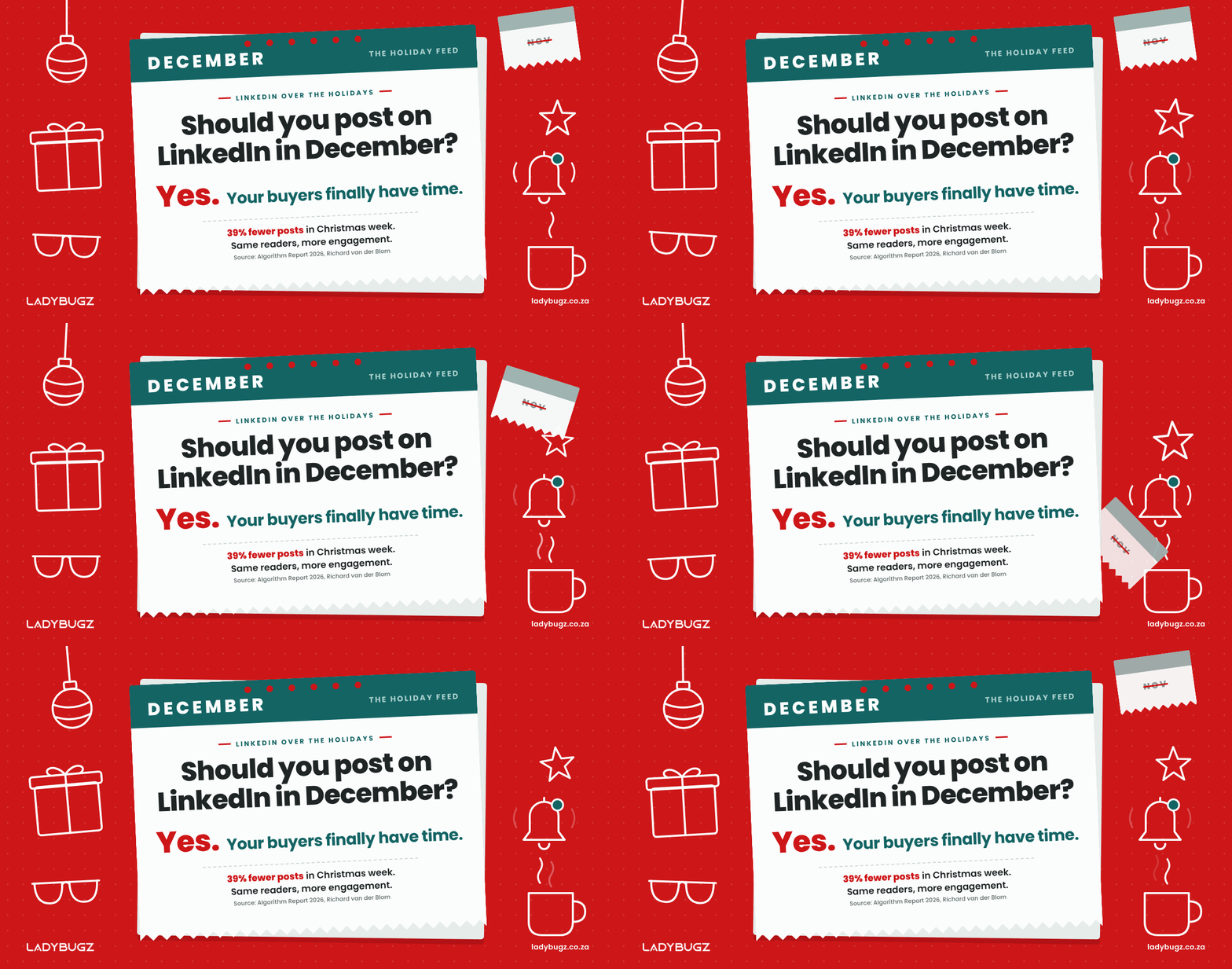
- Fewer posts, same readers: in Christmas week and New Year week 2025, creators published 39% and 35% fewer posts than in the weeks around them, and half posted nothing. The posts that did go out reached as many people as usual and got more engagement (Algorithm Report 2026, Richard van der Blom, November 2026 update).
- LinkedIn’s own figures point the same way: in December 2018, ad engagement for B2B (business-to-business) brands on LinkedIn ran 18% above its February to October average, and by the second week of January engagement was higher than in November (LinkedIn Marketing Blog, December 2019). These were adverts, and the data is old, so read it as direction, not a forecast.
- Busy people have time: in my experience, December and early January are when people I’ve tried to reach all year finally check their LinkedIn and engage.
- Consistency pays over the year: creators who posted every week grew their reach by 9% year on year, while those who posted now and then lost 25% (DemandBird, quoted in the Algorithm Report 2026).
- Personal now, expert later: reflections, lessons and plans perform best over the holidays. Save white papers and heavy expert content for the third week of January. Company pages dip slightly in Christmas week, so the holiday lift belongs to people, not logos.
Yes, post on LinkedIn in December and early January, but make it lighter and more personal. Fewer people post over the holidays, while readers keep scrolling on their phones with more time and less competing for their attention. Schedule a few personal posts before you go on leave, be there to reply when they go out, and hold your heavy expert content until the third week of January.
I’ve seen this on my own profile. All year I’d been trying to get the attention of certain people, and it was in December that I finally reached them. That’s happened across a few industries over the years. Over the holidays they had time to check their LinkedIn and engage. If I’d gone silent with everyone else, I wouldn’t have been there when they looked.
“I know I have reached people in December that I was trying to get the whole year round, but in December and early January, they have time to check their LinkedIn and engage somewhat.”
Noleen Thompson, Managing Director and Founder, LadyBugz
Do people still use LinkedIn over the December holidays?
People still use LinkedIn over the December holidays, mostly on their phones, and many have more time to read than at any other point in the year. Richard van der Blom’s Algorithm Report 2026 puts it simply: “The audience didn’t disappear: people still check LinkedIn on their phones, with more time and fewer posts competing for it.”
LinkedIn saw the same when it studied the 2018 holiday season: sessions dipped over Christmas, most on New Year’s Eve, yet members were “reading and engaging more with content, particularly on mobile”.
In South Africa the break is long. Public schools close on Wednesday 9 December 2026 and learners go back on Wednesday 13 January 2027, according to the Department of Basic Education’s school calendar. Plenty of offices close for two weeks or more. A managing director on leave isn’t in back-to-back meetings or fighting a full inbox. They’re on the couch or at the beach, phone in hand.
And South Africans use LinkedIn more than anyone: 49.2% of internet users aged 16 and over used it in the past month, the highest of any country in DataReportal’s Digital 2027 report. More on that in why South Africa leads the world on LinkedIn.
Why does posting on LinkedIn in December get you noticed?
Posting on LinkedIn in December gets you noticed because the feed is less crowded: fewer people post, so every post competes with fewer others for the same readers.
There’s a longer game too. LinkedIn’s B2B Institute, working with the Ehrenberg-Bass Institute, a marketing science research centre at the University of South Australia, describes the 95-5 rule: 95% of your potential buyers aren’t ready to buy today. They’ll come into the market later, when they need what you sell, and the B2B Institute’s advice is to make sure they remember you when they do. Going silent for six weeks hands that space to whoever kept posting.
Finding it hard to stay consistent on LinkedIn, holidays or not?
Keep your LinkedIn going over the holidays
Will taking a break from LinkedIn hurt your reach?
A short holiday break from LinkedIn won’t hurt your reach, but drifting from a break into months of silence will. Van der Blom’s data shows LinkedIn gives people who come back after time away extra reach on their first posts back, a “welcome-back” effect. It’s strongest for senior people: C-level creators (chief executives and other chief officers) who hadn’t posted for more than a month got up to three times their usual reach on their return.
Consistency is what builds reach over a year. DemandBird’s tracking, quoted in the same report, found weekly posters grew their reach by 9% year on year, while occasional posters lost 25%.
So the choice isn’t between posting every day of your holiday and vanishing. Take your break. Just don’t let two weeks off turn into a silent February. Here’s what going silent on LinkedIn costs you.
Clients have asked me whether they should switch LinkedIn off for December. I’ve always advised against it.
What should you post on LinkedIn in December and January?
The best LinkedIn posts for December and early January are personal and reflective; heavy expert content can wait until the third week of January. Van der Blom found that “personal reflections, lessons learned and plans for next year” are exactly what performs over the holidays. LinkedIn’s own holiday analysis said content that “creates a human connection or that is built around setting new goals in the New Year resonates.”
Your year, in your words. A lesson you learned, a mistake you won’t repeat, a client moment you’re proud of (with their permission, or anonymised).
A thank you that names names. The people, partners and team members who made your year. Tag only the ones who’d be glad to be tagged.
What you’re planning. What you’ll focus on next year, and why. It gives the people reading something to reply to.
One human moment. Where you’re spending the break, what you’re reading, what the year changed for you.
Leave out the launch post and the hard sell; they land better when people are back at their desks. Skip the generic corporate Christmas card, too. A greeting any company could have posted is exactly what LinkedIn’s “Seems like AI slop” button was built for.
If you look after a company page, plan a lighter Christmas week: pages reached 0.92 times their usual audience that week. Over the holidays, your people carry the brand.
How do you stay consistent on LinkedIn without working through the holidays?
You stay consistent on LinkedIn over the holidays by scheduling your posts before you go on leave and choosing times when you can be around for the first two hours after each one goes out.
Schedule before you switch off. LinkedIn’s own scheduler sits behind the clock icon next to the Post button. LinkedIn’s guidance says you can schedule up to three months ahead, but once a post is scheduled you can only change its date and time, not its words, so finish the writing first.
Pick times you’ll actually be there. Van der Blom found the first two hours set a post’s speed: of posts with no real engagement in that window, only 8% went on to above-average reach. Schedule for a moment you can check your phone, not the middle of Christmas lunch.
Reply like it matters, because it does. Answering comments quickly brought 64% more engagement in van der Blom’s data. Over the holidays, a comment from someone you’ve chased all year is the start of a conversation. Answer it the same day.
Share the load. If the whole team is away, agree who checks comments on which days, so nobody gives up their whole holiday.
Want help keeping your LinkedIn active and in your own voice?
Keep your LinkedIn going over the holidays
When should you start posting on LinkedIn again in January?
Start posting on LinkedIn again in the first week of January with a personal welcome-back post, then bring your heavier expert content back from the third week. LinkedIn’s 2018 holiday data found that by the second week of January, “when members are likely refreshed and ready to start a new year with new goals”, engagement was higher than in November.
January is when many of the people you sell to set their plans for the year, and when people rethink their careers: LinkedIn’s job data, published in January 2020, showed jobs got more views and applications per posting in January than in any other month. Some of your contacts will start the year in new roles, a good reason to say congratulations.
As for the hour, van der Blom found no single time stands out for the same person; a fixed slot you can keep matters more, and Sunday posts did slightly better. His data doesn’t include South Africa, so check your own LinkedIn analytics.
Frequently asked questions
Should I post on LinkedIn in December?
Yes. Fewer people post in December, especially in Christmas and New Year weeks, while readers keep checking LinkedIn on their phones. Personal, reflective posts work best. Schedule them ahead and be there to reply when they go out.
Is it worth posting on LinkedIn over the holidays?
Yes, for personal profiles. In Christmas week and New Year week 2025, posts reached as many people as usual and got more engagement, with 39% and 35% fewer posts competing for attention (Algorithm Report 2026, Richard van der Blom). Company pages dipped slightly in Christmas week.
When is the best time to post on LinkedIn in January?
Post a personal welcome-back post in the first week of January and bring heavier expert content back from the third week. For time of day, choose a fixed slot when you can be around for the first two hours after posting.
What is the best time to post on LinkedIn in South Africa?
No large public study covers South Africa specifically. Van der Blom’s data shows no single hour stands out for the same person, and a fixed slot you can keep matters more. Use your own LinkedIn analytics to see when your audience responds.
Should my company page post over Christmas?
Yes, but lightly. Company pages reached 0.92 times their usual audience in Christmas week, according to the Algorithm Report 2026. Personal profiles benefit more from the emptier holiday feed, so let your people lead.
A word over lunch
Over lunch, I’d tell you to take your break. You’ve earned it. Before you go, schedule a few posts that sound like you: what this year taught you, who you’re grateful for, what you’re planning next. Then check in when each one goes out, reply to every comment, and see who turns up. Some of the people you’ve chased all year will be sitting somewhere with their phone and, for once, the time to answer.
If staying consistent is the hard part, our LinkedIn profile management keeps your profile active with content written in your own voice and engagement run by real people, not bots. Nothing goes out under your name until you’ve approved it. If you’d rather your team learned to do it themselves, our LinkedIn training is tailored to your industry, in person or virtual.
Our team does most of the work before we close on 15 December, and schedules the content to keep going out while we’re on break.
Keep your LinkedIn going over the holidays
Prefer to talk it through first? Email me at noleen@ladybugz.co.za.
Noleen Thompson, Managing Director and Founder, LadyBugz Marketing
Keep reading