What independent research, vendor research and South African data say about ads, people and AI search.
By Noleen Thompson, Managing Director and Founder, LadyBugz
Key insights
- Most people scroll past ads: for more than 15 years, about 95% of the people Noleen Thompson trains have told her they scroll past ads, especially on social media (her own training-room show of hands, not a survey).
- Buyers choose before they call: 6sense’s 2025 Buyer Experience Report, a global study of nearly 4,000 B2B buyers, found buyers start about 80% of first conversations with sellers themselves, and the vendor they contact first wins about 80% of the time.
- Paid social missed its targets most often: in Gartner’s 2026 Tech Marketing Benchmarks Survey of 335 global tech marketers, paid social advertising was the channel most often named as performing below expectations in 2025 (33%), ahead of pay-per-click search ads (27%).
- AI answers almost never quote ads: Muck Rack’s May 2026 “What Is AI Reading?” study of more than 25 million links cited by ChatGPT, Claude and Gemini found 84% came from earned sources and 0.3% from paid or advertorial content.
- People reach further than company pages: the same text posted from a person’s LinkedIn profile reached 2.74 times more than when a company page posted it (Source: Algorithm Report 2026, Richard van der Blom).
- Most buyers are not buying today: the Ehrenberg-Bass Institute’s 95-5 rule (Professor John Dawes, 2021) estimates that about 95% of B2B buyers are out of the market at any given time.
Here’s what I see first-hand. For more than 15 years I have asked the people I train whether they scroll past ads, especially on social media. About 95% say they do. They want to engage with people, not an anonymous person behind a brand. That is a show of hands across my training groups, not a formal survey, but the research below points the same way.
So here’s the short answer. Organic, people-led marketing earns the trust that wins B2B deals. Paid advertising buys reach and speed. If a B2B company can only fund one well, I’d fund the people: leaders and experts sharing what they know, where buyers already spend time. Then I’d use paid to carry the best proven ideas further, never to replace them.
See where your marketing earns trust: book a LadyBugz Marketing Audit
What is the difference between paid and organic marketing in B2B?
Paid marketing is any visibility you buy, such as sponsored LinkedIn posts, Google search ads and display banners. Organic marketing is attention you earn without paying the platform: your people’s LinkedIn posts and articles, your website content, newsletters, webinars and referrals. When someone else chooses to write about you, such as a journalist, that’s earned media, and it sits on the organic side.
The line blurs in B2B. LinkedIn’s Thought Leader Ads let a company pay to promote a post written by one of its own people, with that person’s permission. Even the ad products lean on human voices.
Why do B2B buyers scroll past ads?
B2B buyers scroll past ads because they’ve learned to. Nielsen Norman Group’s eyetracking research, “Banner Blindness Revisited” (2018), found people ignore content that looks like an ad, sits close to one, or appears where ads usually go.
South Africans are feeling it too. On 702 in May 2026, MyBroadband editor Jan Vermeulen discussed listeners’ frustration with social feeds now crowded with ads, as reported by EWN. That was about consumers, but your buying group are consumers after hours. Same thumb, same scroll.
Trust runs deeper. The 2026 Edelman Trust Barometer for South Africa found 68% of South Africans are hesitant or unwilling to trust people whose values, information sources or backgrounds differ from their own. When trust shrinks to a closer circle, a familiar person carries more weight than a logo.
Forrester’s State of Business Buying 2026 shows the B2B version. Buyers often start with AI searches, then lean on colleagues and outside influencers to check the decision: 13 internal stakeholders and nine external influencers in a typical purchase. That’s 22 people. An ad might reach one of them. A respected voice gets forwarded to the rest.
Who funds the research that says ads work best?
Much of the most quoted B2B marketing research is funded by LinkedIn, which sells advertising. The LinkedIn B2B Institute commissioned the Ehrenberg-Bass Institute’s 95-5 rule and Les Binet and Peter Field’s 2019 study of B2B growth. LinkedIn also co-publishes an annual B2B Thought Leadership Impact Report with Edelman, a public relations firm.
To be fair, this is respected marketing science, and its core message holds: reach buyers long before they’re ready to buy. But when the company commissioning a study sells reach, the next step it points to is “buy more reach”. Read the findings. Question the prescription.
Independent research is less flattering to ads. In Gartner’s 2026 Tech Marketing Benchmarks Survey (tech marketers at large companies, surveyed January to March 2026), paid social was the channel most often named as underperforming in 2025, at 33%, with pay-per-click at 27%. Gartner suggests answer engine optimisation “may now be delivering high-intent referral traffic” that pay-per-click once captured.
Even the LinkedIn co-funded study backs people-led content. The 2026 Edelman and LinkedIn report found that weak or absent thought leadership can cost a vendor its place in consideration, according to O’Dwyer’s coverage. Thought leadership means useful expert insight under a real name.
Paid vs organic in B2B: how do they compare?
Here’s how they compare for a B2B buyer and whoever signs off the budget.
| Factor | Paid advertising | Organic, people-led |
|---|---|---|
| Trust with buyers | Lower. A labelled ad meets buyers with their guard up. | Higher, when a named person has something useful to say. |
| Speed | Fast. Visibility from the day the campaign starts. | Slower. It builds over months as your track record grows. |
| Cost over time | Ongoing, for as long as you want to be seen. Check vendors for current rates. | Mainly time and expertise. Each piece keeps working after it is published. |
| Compounding | None. Results stop when spend stops. | Strong. Followers, search rankings and AI citations build on each other. |
| AI search visibility and citations | Rarely cited: 0.3% of AI citations (Muck Rack, May 2026). | Earned sources: 84% of AI citations (Muck Rack, May 2026). |
| Buyer stage | Reaching the out-of-market majority at scale, launches and retargeting. | Shapes the shortlist before first contact and helps the buying group check you out. |
| Measurability | Easy to track clicks, though last-click reports can overstate its role. | Harder. Dark social hides much of it, so ask new leads how they heard about you. |
| Risk of ad blindness | High. Buyers learn to skip anything that looks like an ad. | Low if the content is useful. Generic AI-written posts face their own filter. |
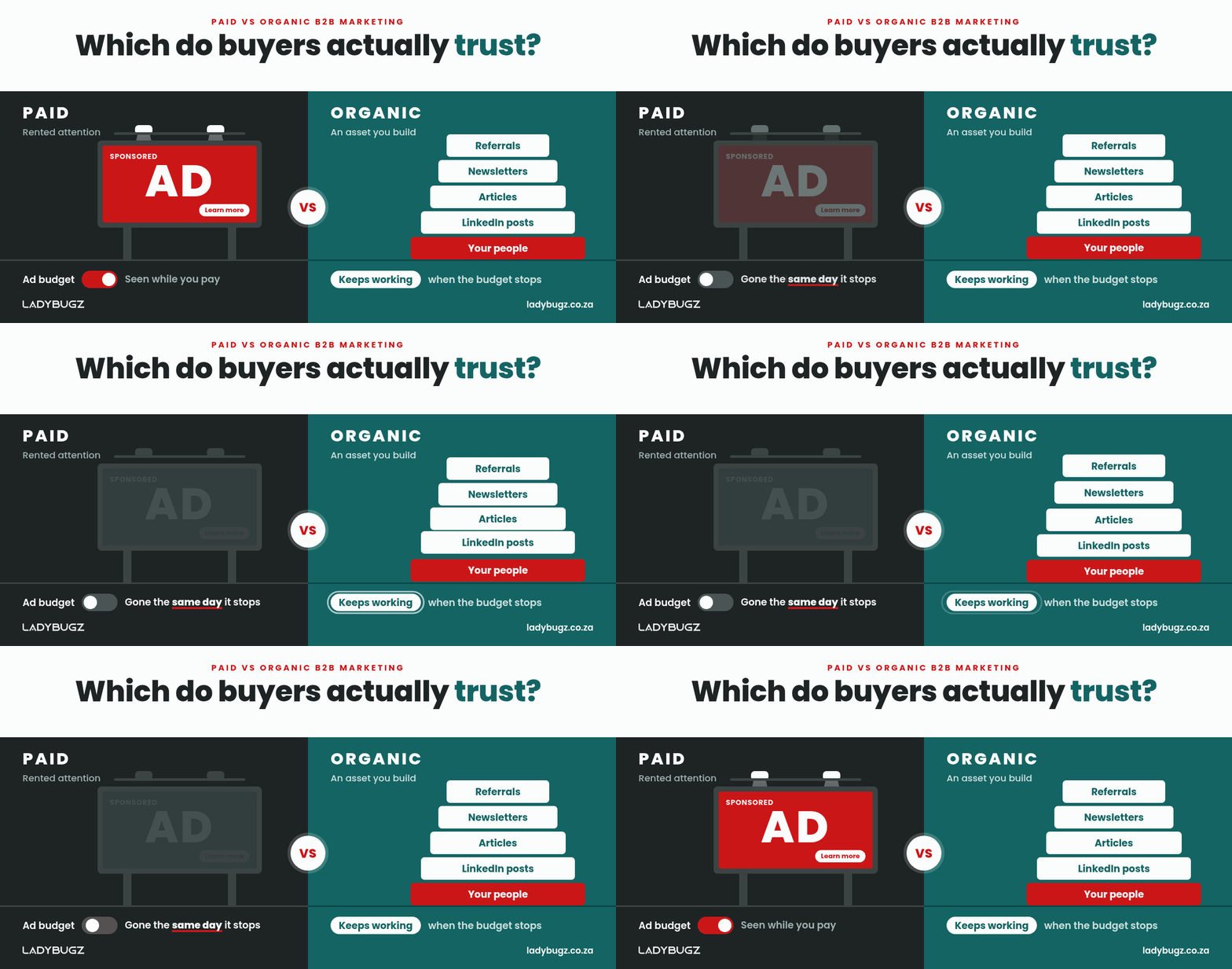
| What stops when the budget stops | Visibility stops the same day. | Content, relationships and citations stay in place. |
| Control | High. You choose the audience, timing and message. | Lower. It depends on quality, consistency and the platform. |
| Where it fits best | Carrying proven ideas further, fast. | Building trust, memory and a place on the shortlist. |
Sources for the figures in this table are named in the article text above.
Want growth that doesn’t switch off with the budget? Explore our Organic B2B Marketing Strategy
Where does paid advertising work in B2B?
Paid works when you need reach, speed or precision you can’t earn quickly, and the 95-5 rule is its strongest case. Professor John Dawes of the Ehrenberg-Bass Institute estimated in 2021 that only about 5% of B2B buyers are in the market at any one time. The other 95% will buy later, from brands they remember.
Yes, another 95. It’s a different measure from my training-room show of hands, and a coincidence, but it lands in the same place: most people aren’t ready for a pitch today.
Paid earns its keep in a few situations:
- Launches and events, when a date matters and you can’t wait for organic reach to build.
- Retargeting, which shows a reminder to people who already visited your website or watched your webinar.
- New audiences, such as a region, sector or job title you can’t reach yet.
- Amplifying what already works, by putting budget behind an expert’s post that people are already saving and sharing.
Why do people beat brand pages on LinkedIn?
People beat brand pages because buyers trust people they can check. The same text posted from a person’s profile reached 2.74 times more than from a company page, and employees writing in their own words drew 7.7 times the engagement of those sharing company posts unedited (Source: Algorithm Report 2026, Richard van der Blom).
Personal branding pioneer William Arruda, writing in Forbes in 2026, warns that leaders underestimate how closely their own LinkedIn profiles are assessed. Buyers check the person, not only the company. He also talks about being “selectively famous”: visible and valuable to the specific people you want to influence. Nobody can buy being remembered by the right 500 people.
Look at how these voices built their names: van der Blom by sharing his research in his posts and newsletter, Arruda through a Forbes column he has written since 2013. Their audiences came from content people chose to read. US solo founder Justin Welsh says he spent nothing on ads while building his business, largely through LinkedIn.
South Africa’s big brands have noticed where attention sits. Almost nine in ten of the country’s largest brands (88%) are now active on LinkedIn, World Wide Worx founder Arthur Goldstuck said of the 2026 Social Media Landscape Report with Ornico, while also describing declining returns from social platforms. Being present isn’t the same as being trusted.
How does AI search change the paid vs organic decision?
AI search tilts the field further toward organic. AEO, or answer engine optimisation, means making your content easy for AI tools such as ChatGPT, Copilot and Google’s AI answers to find, trust and quote. Ads don’t get quoted: in Muck Rack’s May 2026 study, paid or advertorial content made up 0.3% of AI citations. Muck Rack sells PR software and defines “earned” broadly, but that gap is hard to argue with.
Van der Blom’s November 2026 data found 73% of the LinkedIn feed posts cited by AI tools came from personal profiles, and LinkedIn articles were cited 3.6 times as often as posts (Source: Algorithm Report 2026, Richard van der Blom).
Buyers also prefer to research alone. Gartner’s March 2026 survey of 646 B2B buyers found 67% prefer to buy without a sales rep. The shortlist forms before you know they exist.
What happens when the ad budget stops?
When the ad budget stops, paid visibility stops the same day. Organic work keeps going. The article still answers questions, the expert still has followers, and AI tools can still cite the page. That’s why I think of organic as an asset you build and paid as rent.
Organic is also undercounted. Dark social is sharing in private channels such as WhatsApp, Slack, direct messages and email, where analytics can’t see where a visitor came from. In a 2023 SparkToro experiment, 100% of visits from WhatsApp, Slack, TikTok, Discord and Mastodon showed up as “direct” traffic with no referral information.
In South Africa, 93.3% of internet users aged 16 and over used WhatsApp in the past month, according to GWI data (Q2 2026) in DataReportal’s Digital 2027 South Africa report. Much B2B word of mouth never reaches your dashboard. Paid looks more measurable partly because organic hides.
Frequently asked questions
Is organic B2B marketing free?
No. You don’t pay the platform, but you pay in time, expertise and consistency. Someone senior has to hold a point of view and share it. That’s often the harder budget to find.
Should B2B companies stop paid advertising?
Not necessarily. Paid has a real role in launches, retargeting and new audiences. The mistake is using it as a stand-in for a trusted voice. Check each platform’s current plans with the vendor before committing budget.
How long does organic B2B marketing take to work?
Think in quarters and years, not weeks. On LinkedIn, a creator’s own past average explains 51% of the variation in reach (Source: Algorithm Report 2026, Richard van der Blom). Consistency builds that track record. A campaign can’t.
Do LinkedIn ads work in South Africa?
They can reach a large audience. LinkedIn’s advertising tools list 19.0 million South African members (registered members, not monthly active users), according to DataReportal’s Digital 2027 South Africa report. But a sponsored post from a faceless page meets the same scroll as any other ad.
So, paid or organic?
If we were having lunch and you asked where to put your next rand, I’d say start with your people. Get your leaders and experts visible, useful and consistent on LinkedIn and your own website, so buyers and AI tools find a real voice. Once that voice is working, paid can carry it further. Do it the other way round and you’re renting attention for a brand nobody has met yet. If you’d like to talk it through, email me at noleen@ladybugz.co.za.
Book your LadyBugz Marketing Audit
Noleen Thompson, Managing Director and Founder, LadyBugz
Keep reading